

Yes, an electric guitar can sound somewhat like an acoustic guitar when played through a clean amp or digital modeler. However, it will not sound exactly like a true acoustic guitar unless you use special equipment and careful EQ.
For guitarists in the United States, the easiest path is to use a clean amp setting, the neck pickup, light picking, and an acoustic-guitar simulator or impulse response. A standard magnetic electric-guitar pickup still captures a different source than an acoustic guitar’s soundboard, so there are clear limits.

Why an Electric Guitar Does Not Naturally Sound Like an Acoustic
An electric guitar and an acoustic guitar create sound in different ways. That difference matters more than the guitar’s body shape or the amplifier’s settings.
An acoustic guitar uses its strings to vibrate a wooden top. The top moves air through the sound hole and acts as a natural speaker. The guitar’s body adds strong resonance and changes the tone of each note.
A standard electric guitar uses magnetic pickups. These pickups sense the movement of metal strings near magnets. The signal then travels to an amplifier and speaker.
That signal does not contain the full acoustic behavior of the guitar’s top, air chamber, and sound hole. As a result, a clean electric guitar tone may be bright, warm, or clear, but it usually sounds more focused and less open than an acoustic.
Clean does not mean acoustic
“Clean” describes the amount of distortion in the signal. A clean setting has little or no intentional overdrive. It does not automatically add acoustic resonance.
A clean electric guitar can still sound:
- Thin
- Bright
- Compressed
- Nasal
- Smooth
- Sustain-heavy
- Lacking in low-mid body
Acoustic guitar tone is shaped by more than distortion. It also depends on the guitar’s top, bridge, bracing, strings, pick attack, and natural resonance.
Body style helps, but it is not the main factor
A hollow-body or semi-hollow electric guitar may sound more open than a solid-body guitar. Yet it still normally uses magnetic pickups and an electric-guitar signal path.
A semi-hollow guitar can produce a pleasant clean tone. It may also have more feedback at high volume. But it should not be treated as a direct acoustic-guitar replacement.
The pickup type is often more important than the body label.

How to Make an Electric Guitar Sound More Acoustic
You can make an electric guitar sound more acoustic by changing the signal at several points: the guitar, strings, picking method, amplifier, and effects.
No single adjustment does all the work. Think of the process as rebuilding the parts of an acoustic sound that the electric guitar does not naturally provide.
1. Start with the neck pickup
The neck pickup usually gives a fuller and rounder tone than the bridge pickup. Start with the neck pickup or a middle pickup position if your guitar has one.
Then reduce the guitar’s tone control slightly if the sound is harsh. Do not turn the tone control all the way down, because that can make the signal dull.
A useful starting point is:
- Neck pickup
- Guitar volume at full
- Guitar tone between 6 and 8
- moderate pick attack
- Clean amplifier channel
The bridge pickup can work for a sharp acoustic-style rhythm sound, but it may become thin or metallic.
2. Use lighter strings when comfort matters, not as a magic fix
String gauge affects feel and tone, but it will not turn a magnetic electric pickup into an acoustic pickup.
Lighter strings can make strumming feel easy. Heavier strings may produce more volume and a stronger fundamental note. Both can work.
If you change string gauge, check the guitar’s setup. A large change may affect neck relief, action, and intonation. If the guitar has a tremolo bridge, the bridge may also need adjustment.
The string material matters too. Nickel-plated steel strings are common on electric guitars. Phosphor bronze strings are common on many acoustic guitars, but they may not work correctly with every magnetic electric pickup. Some bronze strings produce a weak signal because the pickup does not sense them as efficiently.
3. Use a pick with a controlled attack
Acoustic guitars often have a strong pick attack. Try a medium or thin pick and strum closer to the neck for a softer sound.
For more definition, pick nearer to the bridge. For more body, pick nearer to the neck.
Avoid striking the strings too hard. A hard attack can create a sharp click that sounds more like an electric guitar than an acoustic.
Fingerstyle can also help. Plucking with the fingers creates a softer attack and can make the clean tone feel more natural.
4. Set the amp clean, but do not remove all midrange
A common mistake is to cut the middle control too far. This can make the guitar sound hollow and weak.
Use the amp as a starting point:
| Control | Starting range | What it does |
|---|---|---|
| Gain | Low | Reduces distortion |
| Bass | Low to medium | Adds body without boom |
| Middle | Medium | Keeps notes full |
| Treble | Medium | Adds string detail |
| Presence | Low to medium | Adds attack and air |
| Reverb | Low | Adds space |
These settings are only a starting point. Every guitar, amp, room, and speaker is different.
A small amount of reverb can make the tone feel larger. Too much reverb can hide poor note definition and make the guitar sound artificial.
5. Add acoustic simulation when you need a closer match
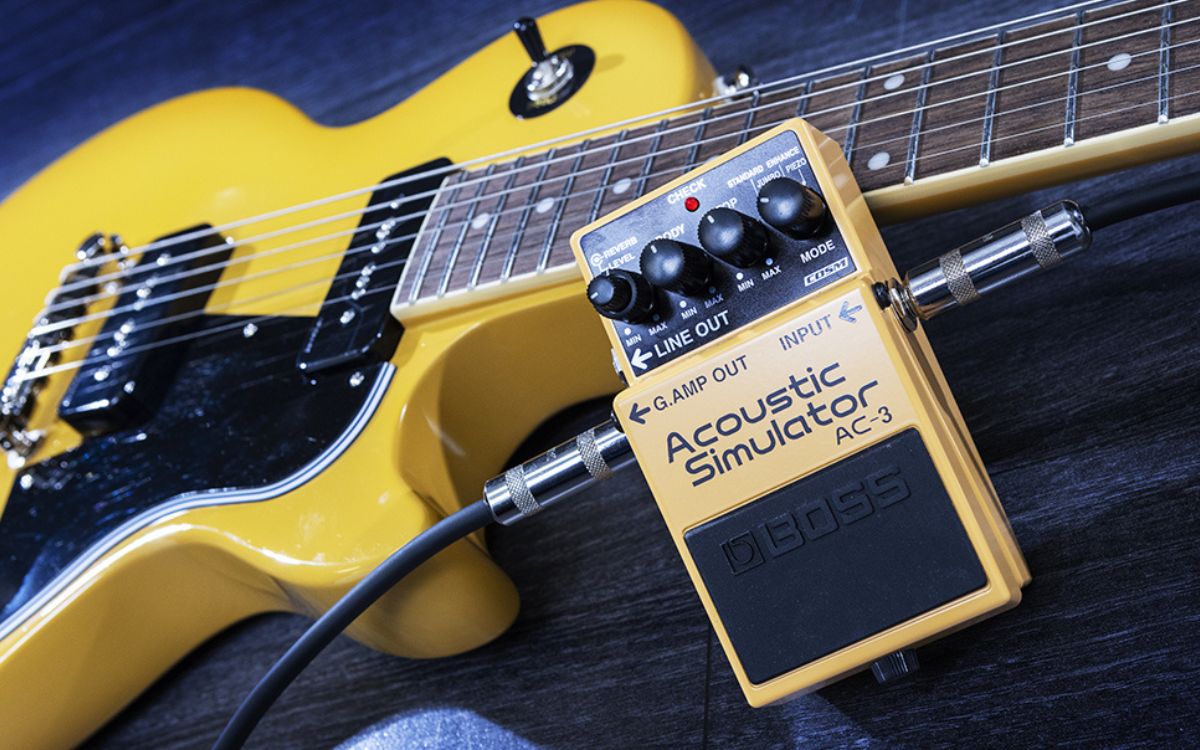
An acoustic simulator changes the electric-guitar signal to imitate some traits of an acoustic guitar. It may add body resonance, adjust the frequency balance, and reshape the attack.
Acoustic simulation can come from:
- A guitar pedal
- A multi-effects unit
- A digital amplifier
- A plug-in
- A guitar processor
- A software modeler
The result varies by device. Some settings work well for strumming but sound unnatural for single-note lines. Others produce a convincing amplified acoustic tone in a full band mix but sound less realistic when played alone.
An acoustic simulator is usually more effective than EQ alone because it changes the character of the signal, not just its bass and treble levels.
6. Use an acoustic impulse response or model
An impulse response, often called an IR, is a recorded response used to shape a signal. An acoustic IR can recreate some of the frequency behavior of an acoustic guitar, microphone, or pickup system.
This method is common with guitar modelers and recording software. It can work well when the electric guitar signal is already clean and has enough natural dynamics.
The best result may require:
- A clean preamp
- An acoustic model or IR
- A high-pass filter
- Light compression
- Small EQ cuts
- Room reverb
An IR cannot create physical vibration that never reached the pickup. It can only reshape the signal that already exists.

The Best Signal Chain for an Acoustic-Style Electric Tone
A practical signal chain is:
Electric guitar → clean preamp or amp → acoustic simulator or model → EQ → light compression → reverb → speaker or recording interface
The order can change, but this setup gives you useful control.
EQ settings to try
Start with small moves. Large EQ boosts often create a harsh or artificial tone.
Try these adjustments:
- Use a high-pass filter around the low bass area to remove rumble.
- Cut muddy low mids if the tone sounds thick.
- Add a small amount of upper-mid detail if the guitar lacks attack.
- Reduce harsh treble if the strings sound metallic.
- Add a little high-end air only after the tone is balanced.
Exact frequency values depend on the guitar and equipment. Avoid copying a preset without listening. A setting that works for a solid-body guitar may sound weak on a hollow-body guitar.
Compression can make strumming more even
Light compression can help an electric guitar behave more like a recorded acoustic guitar. It reduces the difference between loud and soft notes and can add sustain.
Use compression carefully. Too much compression can remove the natural attack that makes acoustic strumming sound lively.
A good starting approach is:
- Set a low or moderate compression ratio.
- Use a slower attack so the pick sound remains.
- Use enough release for the signal to recover between chords.
- Lower the output level to match the bypassed signal.
The exact settings depend on the compressor and playing style.
Reverb should support the guitar
A short room or plate reverb can add space. A long hall reverb may blur fast chord changes.
If the guitar sounds impressive only when the reverb is loud, the dry tone may need more work. Turn the reverb down and improve the pickup, EQ, and attack first.

Which Electric Guitar Works Best for an Acoustic-Style Sound?
A clean tone can work on almost any electric guitar, but some designs make the task easier.
Solid-body electric guitars
A solid-body guitar can produce a useful acoustic-style sound with an acoustic simulator or modeler. It may sound focused and controlled.
This is often a practical choice for live players because solid-body guitars resist feedback better than hollow instruments.
Semi-hollow electric guitars
A semi-hollow guitar can produce a round, open clean tone. It may feel more spacious than a solid-body guitar.
It still does not reproduce a true acoustic response through a normal magnetic pickup. At loud stage volume, it may also feed back sooner.
Piezo-equipped electric guitars
A piezo pickup sits under the bridge and senses vibration from the strings and bridge. This produces a different signal from a magnetic pickup.
Some electric guitars have both magnetic and piezo systems. These guitars can produce a more acoustic-like direct signal, especially when the piezo output has suitable EQ and processing.
Piezo systems can also sound quacky or sharp without preamp shaping. A dedicated acoustic preamp, EQ, or acoustic model can improve the result.
Electric-acoustic hybrid guitars
Some instruments combine electric-guitar features with acoustic-style electronics. They may offer magnetic pickups, piezo pickups, body sensors, or modeling.
These instruments can be useful when one guitar must cover both electric and acoustic parts. The trade-off is cost, setup complexity, and the fact that no single output always sounds ideal for every amplifier.

Electric Guitar Versus Acoustic Guitar: What You Can Expect
The following comparison shows the main practical difference.
| Feature | Clean electric guitar | Acoustic guitar |
|---|---|---|
| Main sound source | Magnetic or piezo pickup | Vibrating soundboard and air chamber |
| Natural unplugged volume | Very low | Loud enough for practice and small settings |
| Sustain | Often long | Often shorter, depending on the guitar |
| Attack | Can be smooth or sharp | Often has a strong wood-and-string response |
| Body resonance | Limited through magnetic pickups | A major part of the sound |
| Feedback risk | Usually lower with solid body | Can be higher at loud volume |
| Acoustic realism | Depends on processing | Native to the instrument |
| Live flexibility | High with effects | Strong for natural acoustic parts |
A clean electric guitar may sit well in a band mix. It can also be easier to control on a loud stage. A real acoustic guitar usually provides a more natural strum, body response, and percussive character.
The right choice depends on the part. If the goal is a convincing acoustic recording, use a real acoustic guitar when possible. If the goal is to cover acoustic and electric parts with one instrument, modeling or a piezo-equipped guitar may be more practical.

Common Problems and How to Fix Them
The tone sounds thin
Possible causes include the bridge pickup, too much treble, weak strings, or an amp with excessive midrange cut.
Try the neck pickup first. Then reduce treble slightly and add a small amount of low-mid body.
The tone sounds muddy
Too much bass, low-mid buildup, or heavy compression may cause mud.
Lower the bass before adding treble. Reduce reverb and check whether the guitar’s tone control is too low.
The tone sounds harsh or metallic
This often comes from too much upper treble, a strong bridge pickup, or an acoustic simulator with an exaggerated attack.
Lower presence and treble. Try the neck pickup and reduce the simulator’s brightness.
The tone sounds like an unplugged electric guitar
A normal clean amp may not provide enough acoustic character. Add an acoustic simulator, acoustic IR, or piezo signal.
Also check the speaker. A traditional guitar speaker is designed for electric-guitar tone. A full-range speaker or suitable recording monitor may reproduce acoustic modeling more accurately.
The tone feeds back
Feedback happens when amplified sound re-enters the guitar or pickup system and creates a loop.
Reduce stage volume, move away from the speaker, change your position, or use a notch filter. Hollow-body and piezo systems may need more feedback control than solid-body magnetic systems.
Never place a loud speaker directly in front of the guitar while testing at high volume. Protect your hearing and lower the volume before changing cables or equipment.
Can You Record an Acoustic Sound With a Clean Electric Guitar?
Yes, but the result depends on the production goal.
For a simple demo, a clean electric guitar with neck pickup, EQ, compression, and reverb may work well. In a dense mix, listeners may notice the part more than the exact instrument.
For exposed fingerstyle, solo guitar, or a close acoustic recording, the difference becomes easier to hear. A real acoustic guitar, piezo system, or acoustic model will usually give a more believable result.
A useful recording chain is:
- Record a clean, undistorted signal.
- Keep the input level below clipping.
- Add acoustic modeling or an acoustic IR.
- Use gentle EQ to remove rumble and harshness.
- Apply light compression.
- Add a small room reverb.
- Compare the processed tone with the dry track at the same volume.
Volume matching matters. A louder tone can seem better even when it is not more accurate.
What Is the Most Effective Method?
For the closest acoustic-like sound from a normal electric guitar, use an acoustic simulator or modeler with a clean neck-pickup signal.
For the most natural acoustic tone, use a real acoustic guitar.
For one instrument that can cover both roles, consider a guitar with a piezo pickup, body sensor, or dedicated acoustic modeling system. These options add cost and setup needs, but they address the main weakness of a standard magnetic pickup: it does not capture the movement of an acoustic guitar’s soundboard.
The simplest low-cost test is:
- Select the neck pickup.
- Set the amp clean.
- Lower the gain.
- Keep the middle control near the center.
- Reduce harsh treble.
- Use light compression.
- Add a small amount of reverb.
- Try an acoustic simulator if the sound still lacks body.
If that sound is close enough for your song, you do not need new gear. If it still sounds like a processed electric guitar, the limitation is likely the pickup and signal source rather than your EQ settings.

FAQs
Can any electric guitar sound like an acoustic guitar?
Any electric guitar can produce an acoustic-style tone, but not every guitar will sound equally convincing. Pickup type, body design, strings, amplifier, speaker, and processing all affect the result.
Does a hollow-body electric guitar sound like an acoustic?
Not automatically. A hollow-body electric guitar may have a more open clean tone, but its magnetic pickups still capture string movement rather than the full acoustic soundboard response.
Can I use acoustic guitar strings on an electric guitar?
Do not assume that acoustic strings are suitable. Many acoustic strings do not work well with magnetic electric pickups, and some may not fit the bridge or tuners correctly. Check the guitar manufacturer’s specifications before changing string type.
Is a piezo pickup better for an acoustic sound?
A piezo pickup can provide a more acoustic-like signal because it senses vibration at the bridge. It may still require EQ, compression, or an acoustic preamp to avoid a sharp or unnatural tone.
Can a clean electric guitar replace an acoustic guitar live?
It can replace one for some songs and band settings. It is less convincing when the acoustic guitar is exposed, fingerpicked, or used for strong body percussion. An acoustic simulator or piezo-equipped guitar improves the result.
Why does my acoustic simulator sound fake?
The simulator may be too bright, too compressed, or too strong in the upper mids. Start with a clean input, lower the effect level, reduce harsh treble, and use a suitable full-range speaker or recording monitor.
Final Answer
A clean electric guitar can sound acoustic-like, but it cannot fully copy a real acoustic guitar through a standard magnetic pickup and guitar amp. Start with the neck pickup and a clean amp, then add careful EQ, light compression, reverb, and acoustic modeling.
For the closest natural result, use a real acoustic guitar or an electric guitar with a piezo or body-sensing system. For live flexibility, a clean electric guitar with acoustic simulation may be the most practical compromise.