
Introduction
The best way to learn piano in the United States is to combine short, regular practice with clear lessons, basic music reading, and songs you enjoy. You do not need to read music before you start, own an expensive piano, or practice for hours each day. A beginner can make steady progress with a keyboard, a simple plan, and 20 to 30 minutes of focused practice most days.
This guide explains how to learn piano from the first week onward. It covers choosing an instrument, learning notes and chords, building a practice routine, avoiding common mistakes, and deciding when a teacher or online course may help.

What You Need Before You Start
You need three things: a playable instrument, a comfortable setup, and a simple learning plan.
Choose a piano or keyboard
An acoustic piano gives you natural key movement and sound. It can be a strong choice if you already have one at home and it is in good working order. However, an acoustic piano needs regular tuning and takes up more space.
A digital piano is often easier for beginners in apartments or shared homes. Look for:
- 88 full-size keys, if possible
- Touch-sensitive keys
- A sustain pedal
- A stable stand or bench
- A headphone jack
- A sound that you enjoy hearing
A 61-key keyboard can work for a beginner. It is smaller and often less costly. Yet, you may outgrow it if you want to play large chords, classical music, or pieces that use a wide range.
Avoid very small keyboards with no touch response for serious study. They can help you learn note names, but they do not feel much like a piano.
Set up your playing position
Sit near the center of the keyboard. Keep your back fairly straight, your shoulders loose, and your elbows slightly in front of your body. Your wrists should stay level rather than bent sharply upward or downward.
Use a bench that lets your forearms sit close to level with the keys. If your seat is too low, your wrists may bend down. If it is too high, your shoulders may rise.
Pick one clear learning path
You can learn piano through:
- A private teacher
- A group class at a music school or community center
- A structured online course
- A book with audio or video support
- A mix of lessons and self-study
A teacher can correct posture, rhythm, fingering, and tension early. Online lessons offer flexibility and lower cost in many cases. The best choice depends on your budget, schedule, learning style, and need for feedback.
Do not use five different courses at once. One clear method is easier to follow than a pile of disconnected lessons.
Learn the Piano Keyboard First
Start by learning the pattern of black and white keys. This gives you a map of the instrument.
The black keys appear in groups of two and three. The white key immediately to the left of a group of two black keys is C. From there, the white keys follow this pattern:
C–D–E–F–G–A–B
Then the pattern repeats.
Middle C is a useful starting point. On a full-size piano, it sits near the center of the keyboard. Many beginner books use Middle C as a reference point, but do not keep both hands there forever. You should gradually learn to recognize notes by their place on the staff and by the keyboard pattern.
Learn finger numbers
Both hands use the same finger numbers:
- Thumb
- Index finger
- Middle finger
- Ring finger
- Pinky
Your right hand usually begins with the thumb on C in simple exercises. Your left hand may begin with the pinky on a lower C. These are starting points, not fixed rules for every song.
Learn the musical alphabet
Music uses the letters A through G. After G, the pattern starts again at A. The distance from one note to the next letter is called a whole step when a black key sits between them. A half step is the smallest distance on the piano, such as E to F or B to C.
You do not need to memorize every music theory term in the first week. You do need to see how notes move up and down the keyboard.
Read rhythm before complex notes
Rhythm tells you when to play. Begin with:
- Whole notes
- Half notes
- Quarter notes
- Eighth notes
- Rests
- Measures
- A steady beat
Count simple rhythms aloud. For example, count “1, 2, 3, 4” for a four-beat measure. Then count “1 and 2 and 3 and 4 and” when eighth notes appear.
A player who knows the notes but cannot keep time will struggle to play songs smoothly. Rhythm deserves attention from the first lesson.
Follow a Step-by-Step Piano Learning Plan
A good beginner plan moves from control to coordination. Each stage prepares you for the next.
Weeks 1 and 2: Build basic control
Focus on:
- Finding C, D, and E
- Learning finger numbers
- Playing with relaxed hands
- Counting a steady beat
- Reading very simple rhythms
- Playing short five-note patterns
Play slowly. Lift each finger with care, but do not strike the keys hard. Your goal is control, not speed.
At this stage, use both hands in short exercises. You can also play simple melodies with the right hand while holding one or two bass notes with the left.
Weeks 3 and 4: Add simple chords
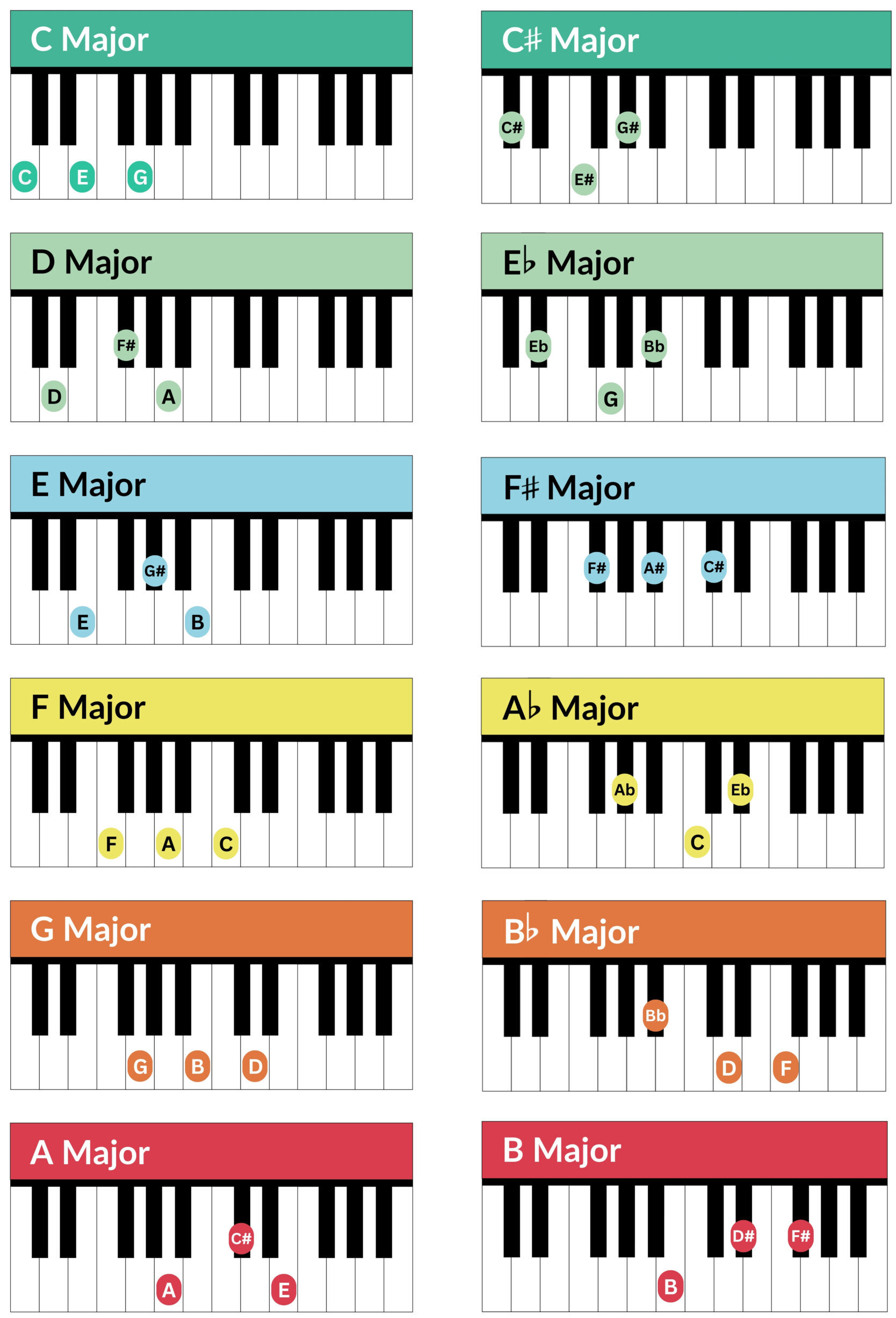
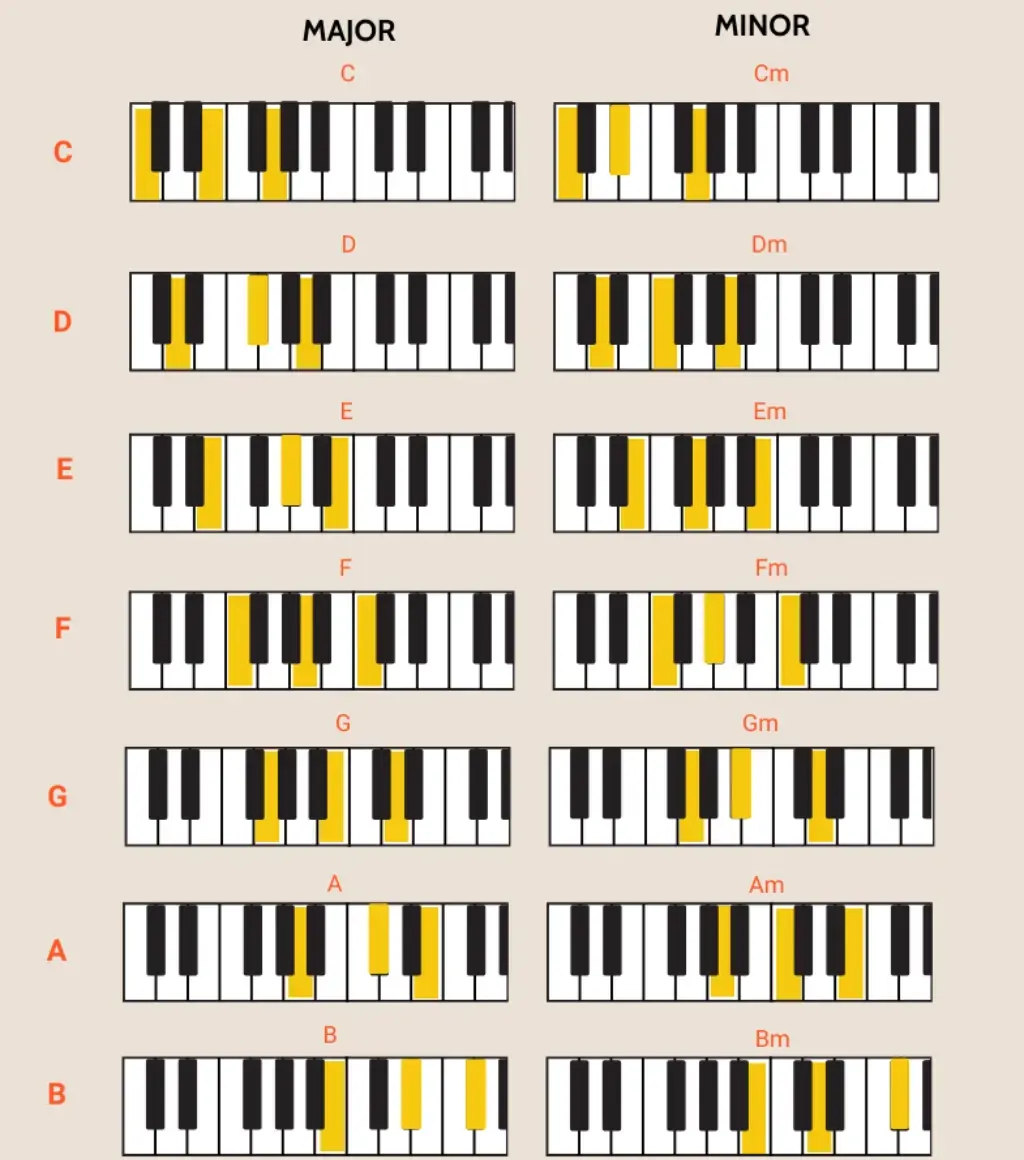
Learn a few common chords, such as:
- C major: C–E–G
- F major: F–A–C
- G major: G–B–D
- A minor: A–C–E
- E minor: E–G–B
A chord is two or more notes played together. Major chords often sound bright or open. Minor chords often sound darker, though music can use them in many ways.
Practice changing between two chords at a time. For example, play C major four times, then G major four times. Keep the beat steady even when the change feels slow.
Weeks 5 and 6: Coordinate both hands
Use easy songs with simple left-hand patterns. The left hand might play a single bass note, an octave, or a broken chord. The right hand may play the melody.
Practice each hand alone first. Then join them at a very slow speed. If the two hands fall apart, reduce the speed again. Slow practice is not a punishment; it is how the brain learns the movement pattern.
After six weeks: Expand your skills
Once you can play short songs with steady timing, add:
- More chords
- Scales in easy keys
- Basic pedal use
- Dynamics, such as soft and loud playing
- Reading notes outside the middle range
- Simple improvisation
- Songs from different styles
You can study classical pieces, pop songs, jazz, gospel, film music, or worship music. Your style choice can shape the skills you learn next.
Use a Practice Routine That Works
A short, focused practice session is better than a long session with no plan.
For a 30-minute session, try this structure:
| Time | Activity | Purpose |
|---|---|---|
| 5 minutes | Warm-up and finger patterns | Wake up the hands |
| 5 minutes | Note reading or rhythm | Build music skills |
| 10 minutes | Difficult song section | Solve a specific problem |
| 7 minutes | Full song or review | Build flow |
| 3 minutes | Free play or notes for next time | End with purpose |
You can adjust the times. A 15-minute session may include three minutes of warm-up, five minutes of a skill, and seven minutes of song practice.
Practice in small sections
Do not always play a song from the first measure to the last. Choose two to four measures that cause trouble. Then:
- Look at the notes and rhythm.
- Play the right hand alone.
- Play the left hand alone.
- Join the hands slowly.
- Repeat the section several times.
- Connect it to the next section.
This method gives you more useful repetitions than repeatedly starting over.
Use a metronome with care
A metronome produces a steady click. It can help you control tempo, but it should not replace your sense of pulse.
Start at a speed where you can play the passage without stopping. Increase the tempo in small steps only when your notes, rhythm, and hand position remain stable. If mistakes increase, lower the speed.
Space your practice
Practice on several days rather than doing one large session each week. Spaced practice gives you repeated chances to recall the notes and movements.
If you miss a day, return to your plan without trying to “make up” all the time at once. Very long sessions can lead to fatigue and tense playing.

Learn Songs Without Skipping the Basics
Songs keep practice meaningful, but songs alone may leave gaps in your skills. Use them with exercises that target reading, rhythm, technique, and chords.
Choose songs at the right level
A good beginner song should let you play most of it slowly after some study. It may include a few hard parts, but the entire piece should not feel like a wall.
Choose music based on:
- The range of notes
- The number of accidentals
- The rhythm
- The hand position
- The amount of hand movement
- The size of the chords
- Your interest in the song
A song that is too easy may feel dull. A song that is far too hard may encourage poor habits.
Use simplified arrangements honestly
A simplified version is not a lesser version. It is a useful step toward the full arrangement. Many songs have beginner editions with easier rhythms, fewer chords, or a smaller range.
If you learn a song from a tutorial, check that the arrangement matches your skill level. Some video lessons move quickly or skip music reading. That can be fine for learning one song, but it may not build broad piano skills by itself.
Learn by ear, by reading, or both
Learning by ear helps you hear pitch, rhythm, and musical shape. Reading helps you learn new music without depending on a recording. Combining both skills gives you more freedom.
Try this process:
- Listen to a short phrase.
- Find the first note.
- Work out the melody by ear.
- Check it against written music when available.
- Play it with a steady beat.
- Add chords or a bass line later.
You do not need perfect pitch to learn by ear. You need patient listening and repeated attempts.
Learn Chords, Scales, and Music Theory
You do not need advanced theory before playing songs. Still, basic theory helps you understand patterns instead of memorizing every note separately.
Start with major and minor scales
A scale is a set of notes arranged in order. The C major scale uses only white keys:
C–D–E–F–G–A–B–C
The G major scale uses one black key, F-sharp. The F major scale uses B-flat. Learning scales slowly can improve note knowledge, finger control, and key awareness.
Do not race through all 12 major scales. Learn one scale, understand its pattern, and use it in music.
Understand chord progressions
A chord progression is a series of chords. Many popular songs use a small group of repeated chords. In the key of C major, a common progression may use C, G, A minor, and F.
Learning progressions helps you:
- Play songs with fewer written notes
- Accompany a singer
- Create simple arrangements
- Improvise
- Recognize patterns in new music
Learn inversions later
A chord inversion uses the same notes in a different order. For example, C major can appear as C–E–G, E–G–C, or G–C–E.
Inversions reduce the distance your hand must move between chords. Learn basic root-position chords first. Add inversions after you can change chords without stopping.

Know When You Need a Piano Teacher
A teacher is especially useful when you feel stuck, tense, or unsure whether your technique is correct.
Consider lessons if:
- You want to study classical repertoire
- You prepare for auditions or exams
- You keep repeating the same mistakes
- You have pain or unusual tension
- You need a clear schedule
- You learn better with live feedback
- You want help choosing music
A good teacher should explain the reason for an exercise, watch your posture and hand use, and choose music that fits your goals. You should also feel able to ask questions.
Online courses can work well when they include a planned sequence, demonstrations, practice tasks, and a way to receive feedback. A video alone cannot see your hands or correct your movement.
Stop if playing causes pain
Normal effort can feel tiring. Sharp pain, numbness, tingling, or lasting soreness is different. Stop playing if these symptoms occur. Check your posture, bench height, hand tension, and practice length. If symptoms continue or return, consult a qualified health professional.
Do not force stretches or continue through pain. Piano playing should not require you to ignore warning signs from your body.

Common Beginner Mistakes
Most early problems have simple causes. Change the process before assuming you lack talent.
Playing too fast
Speed hides errors. Practice at a tempo where you can play the notes and rhythm correctly. Increase the speed only after the movement feels reliable.
Using the wrong fingering every time
Fingering is not always universal, but random fingering makes a passage harder to repeat. Choose a practical fingering and use it consistently. Mark it in the music if needed.
Ignoring rhythm
Many beginners focus only on hitting the right keys. Count aloud, tap the beat, or use a slow metronome. Correct notes without steady time will not sound like a complete performance.
Practicing only from the beginning
Starting at measure one feels safe, but it can leave later sections weak. Begin from different points in the song. Practice transitions, endings, and difficult measures on their own.
Tensing the hands
Raised shoulders, stiff fingers, and locked wrists limit control. Take short breaks. Shake out your hands gently. Keep the fingers curved without forcing them into a rigid shape.
Changing methods too often
A new app or tutorial may feel exciting, but constant switching can interrupt progress. Give one method enough time to show whether it works. Change it when it does not match your goals, not simply because progress feels slow.

How Long Does It Take to Learn Piano?
You can learn basic melodies and chords within the first few weeks. Playing simple songs with both hands may take several months. More advanced reading, technique, improvisation, and performance skills can take years.
Progress depends on:
- Practice frequency
- Practice quality
- Previous music experience
- Lesson quality
- Song difficulty
- Your goals
- Comfort with reading music
- Your ability to solve mistakes
There is no single deadline for “learning piano.” A person who wants to play songs for fun has a different target from a student preparing advanced classical music.
Track useful signs of progress:
- You can keep a steady beat
- You can read more notes without stopping
- You can change between chords smoothly
- You can learn short sections without copying every movement
- You can identify and fix common mistakes
- You can play with less tension
- You can finish a song, even at a slow tempo
These signs matter more than comparing your timeline with another player’s.
Key Takeaways
- Start with a playable piano or keyboard, a stable seat, and a clear learning plan.
- Learn the keyboard pattern, finger numbers, rhythm, and basic note reading first.
- Practice 15 to 30 minutes on most days instead of relying on one long weekly session.
- Work in small sections and join the hands only after each hand is comfortable.
- Learn a few chords and simple scales, but keep songs in your routine.
- Use a teacher when you need feedback, structure, or help with technique.
- Stop and seek professional advice if piano playing causes pain, numbness, or tingling.
- Choose songs that challenge you without overwhelming you.
Frequently Asked Questions
Can I learn piano without reading music?
Yes. You can learn songs by ear, use chord symbols, or follow visual lessons. Reading music becomes more useful as your song choices grow. A balanced plan can include ear training, chords, and basic notation.
Is 30 minutes a day enough to learn piano?
Thirty focused minutes can produce steady progress. Divide the time between technique, reading, song work, and review. If you have only 10 or 15 minutes, practice one small task instead of rushing through a full lesson.
Should I learn piano on a keyboard or an acoustic piano?
Either can work. A digital piano is often practical for apartments, headphones, and adjustable volume. An acoustic piano offers natural key action but needs space and maintenance. Choose the instrument that you can use regularly.
What is the best age to start learning piano?
Children and adults can both learn piano. Younger students may need shorter sessions and more games. Adults often bring strong focus and clear goals. Regular practice matters more than a specific starting age.
Do I need a teacher to learn piano?
No, but feedback can save time and help prevent poor habits. Self-study may work well for basic chords and songs. A teacher becomes more valuable when you want detailed technique, advanced music, performance preparation, or help solving repeated problems.
How can I practice piano if I have no time?
Use small sessions. Five minutes of rhythm, five minutes of chord changes, and five minutes on one song section can still help. Keep the instrument ready to play so setup does not become another barrier.
Your Next Step
Choose one instrument, one learning method, and one easy song. Set a practice time for the next seven days. Begin with five minutes of note and rhythm work, then spend the rest of the session on a small part of the song.
At the end of the week, ask three questions: Can I keep a steady beat? Can I play the section with less stopping? Do I know what to practice next? If the answer is yes, your piano learning plan is working.