

For piano learners in the United States, “reading a piano” usually means reading piano music and finding those notes on the keyboard. You do this by reading two music staffs at once, understanding rhythm, and matching each written note to a piano key.
The fastest way to learn is to break the task into small parts. First, learn the keyboard pattern. Then learn the treble and bass clefs. After that, add rhythm, finger numbers, and musical symbols.

What Does It Mean to Read Piano Music?
Reading piano music means turning written symbols into sound and movement. A piano score tells you three main things:
- Which note to play
- When to play it
- How long to hold it
It may also show how loudly to play, which fingers to use, when to pause, and how to shape a phrase.
Piano music uses a grand staff. The grand staff joins two five-line staffs:
- The treble clef, usually played by the right hand
- The bass clef, usually played by the left hand
These hand assignments are common, but they are not strict rules. A musical passage may cross between the hands.
Sheet music, piano tabs, and chord charts
Traditional piano sheet music shows exact notes and rhythms. It gives you the most complete information.
Other formats include:
- Piano tabs: A simplified system that may show keys or numbers instead of standard notation
- Chord charts: Letter names such as C, F, and G, often used for songs and accompaniment
- Lead sheets: A melody, chord symbols, and lyrics
- Letter notes: Note names written above or below a melody
If your goal is to read classical, jazz, worship, or school piano music, standard notation is the most useful skill to learn.
Learn the Piano Keyboard First
Before reading notes, learn how the keys repeat. This gives every written note a clear place on the instrument.
A piano keyboard uses the letters:
A, B, C, D, E, F, and G
After G, the pattern starts again at A. This repeating group is called an octave.
Find C by using the black keys
The black keys appear in groups of two and three. Every white key directly to the left of a group of two black keys is C.
From C, the white keys go:
C – D – E – F – G – A – B
Then the pattern repeats.
This is one of the most useful keyboard landmarks. If you can find C, you can find every other white key by counting.
Understand sharps and flats
A black key can have more than one name.
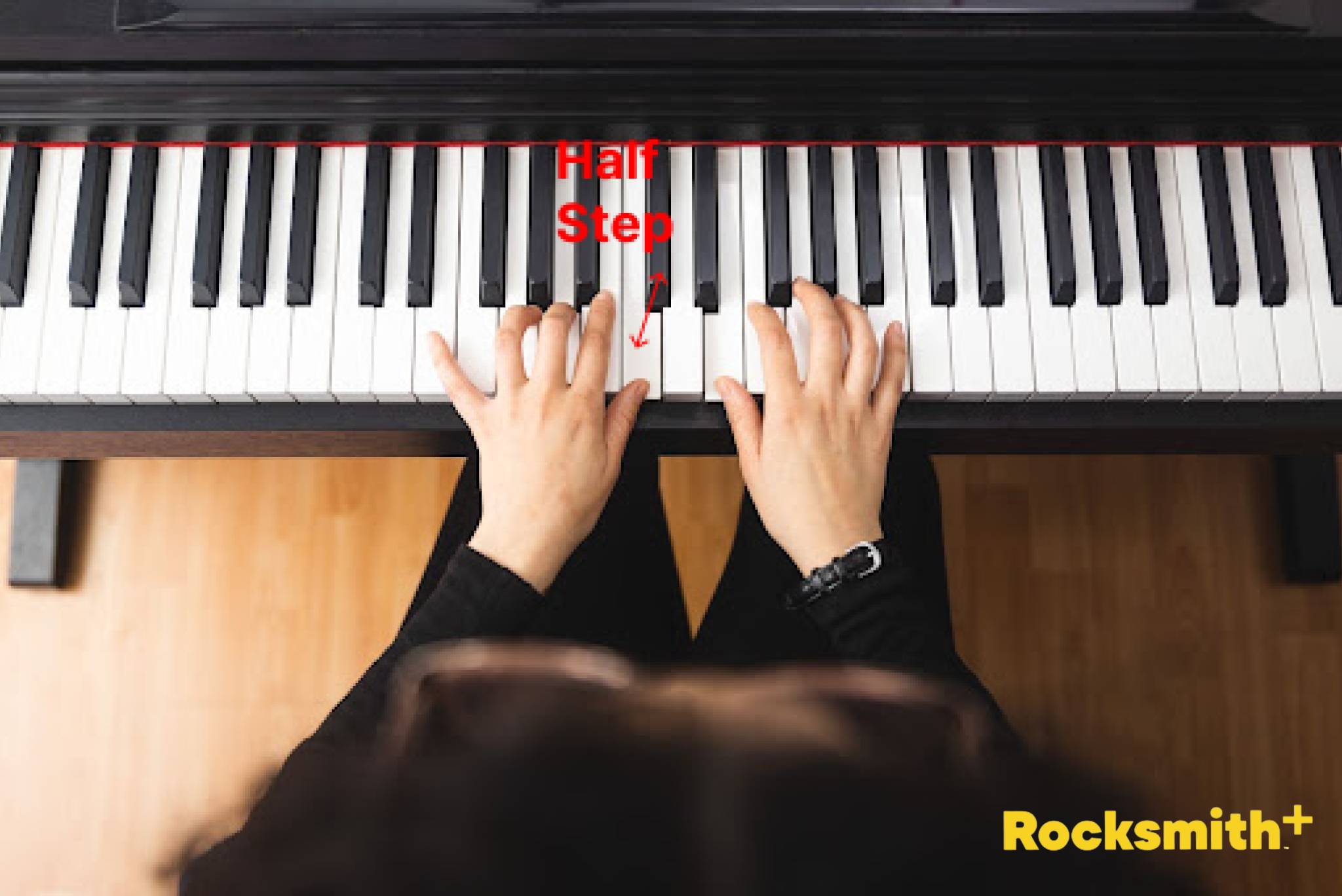
- A sharp raises a note by one half step. For example, C-sharp is written C♯.
- A flat lowers a note by one half step. For example, D-flat is written D♭.
On a standard piano, C-sharp and D-flat usually refer to the same key. These notes are called enharmonic equivalents.
The correct name depends on the key and the musical context. Beginners can first focus on locating the key. Later, learn why the score uses a sharp or a flat.
Find middle C
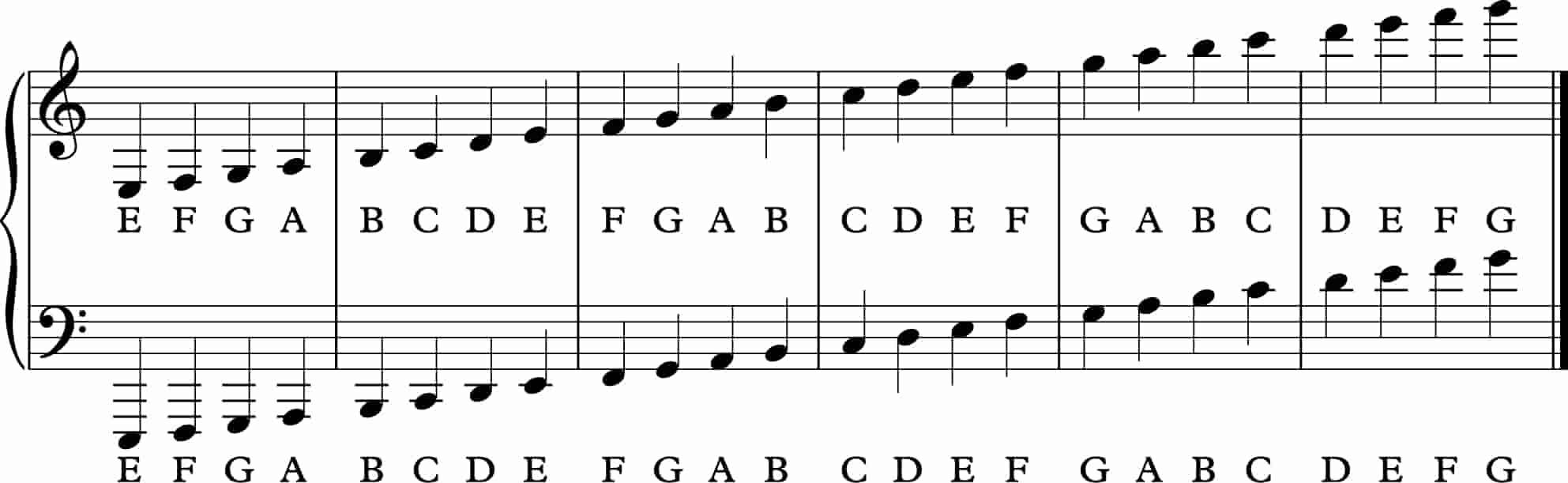
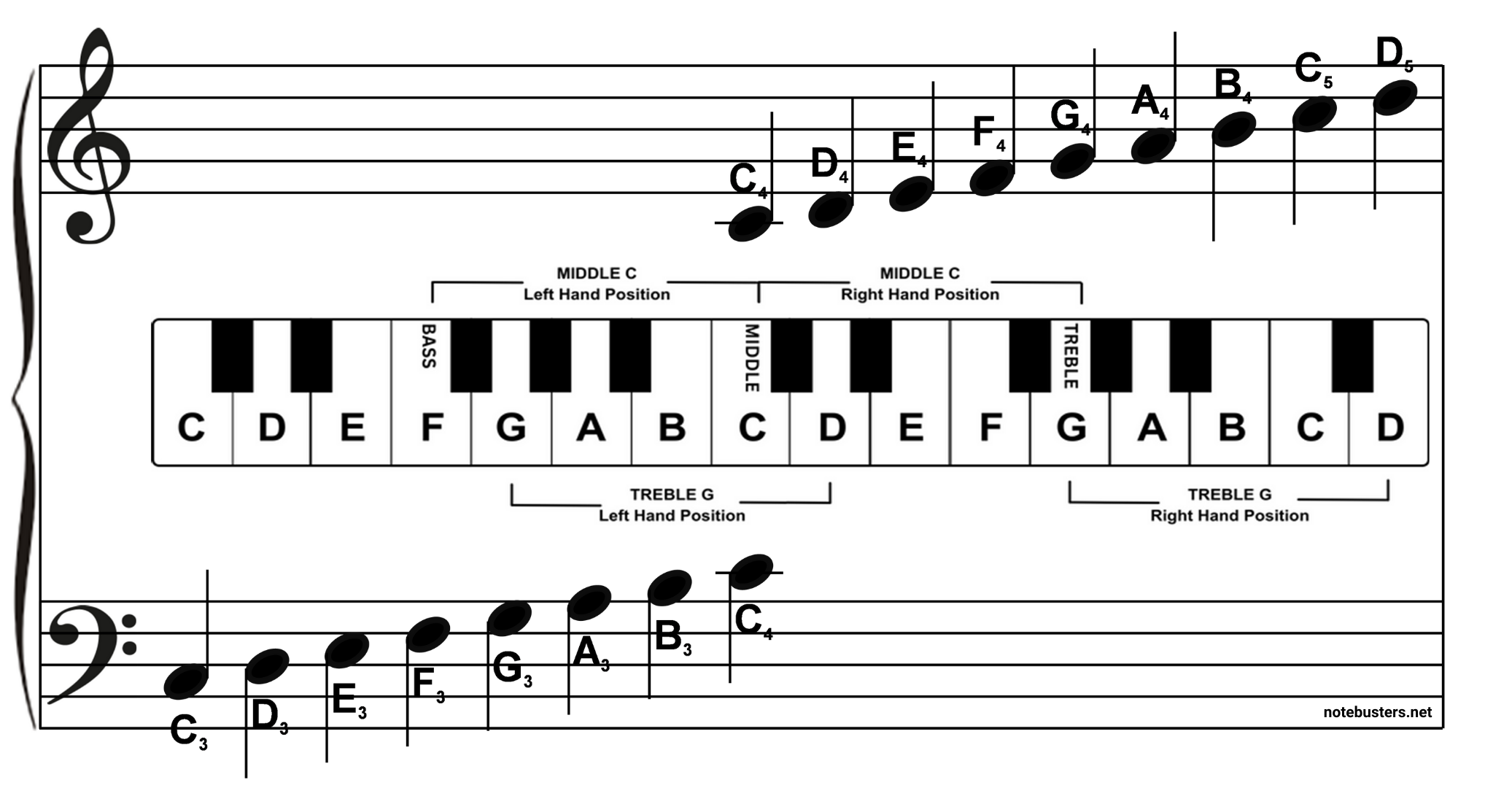
Middle C is a central reference point on the piano. On a full-size 88-key piano, it sits near the middle of the keyboard. It is also the note between the treble and bass staffs in many beginner pieces.
Middle C is not always played by the right hand. It is simply a helpful landmark for reading.
Learn the Treble and Bass Clefs
The two clefs tell you where the notes sit on the staff. A staff has five lines and four spaces.
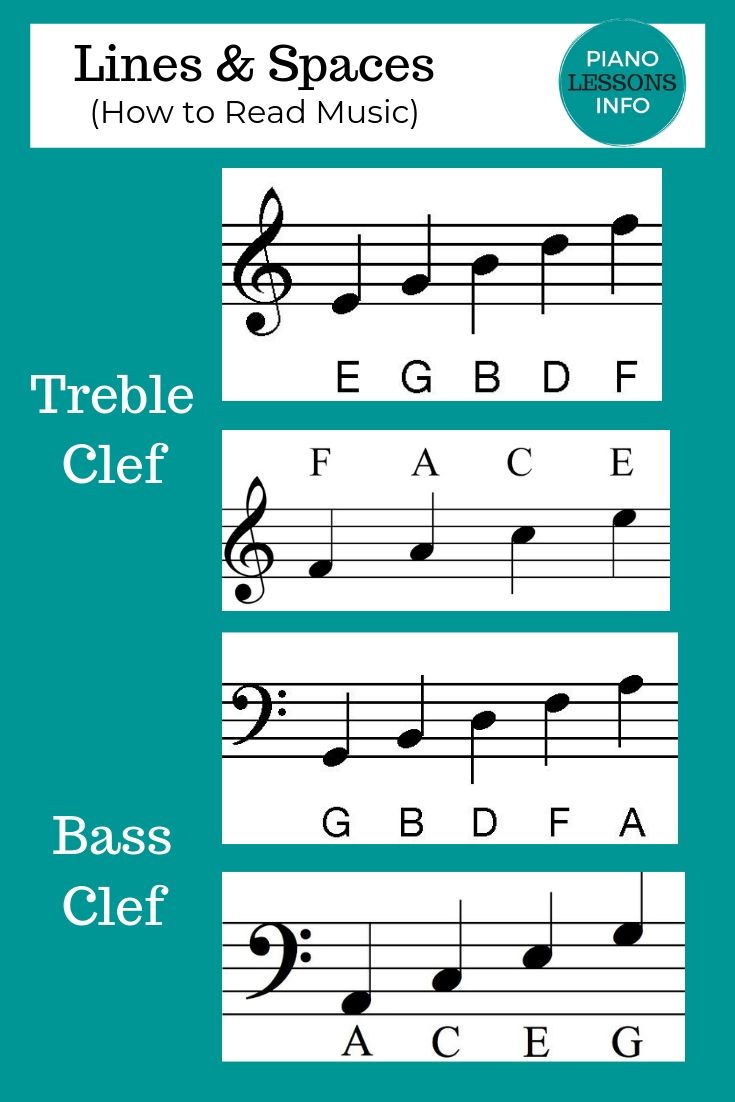
Treble clef notes
The treble clef is also called the G clef because its symbol wraps around the line for G.
From the bottom line upward, the treble clef lines are:
E – G – B – D – F
A common memory phrase is:
Every Good Boy Does Fine
The spaces spell:
F – A – C – E
You can remember this as the word FACE.
The note just below the treble staff is middle C. The note on the bottom line is E above middle C.
Bass clef notes
The bass clef is also called the F clef because its two dots surround the line for F.
From the bottom line upward, the bass clef lines are:
G – B – D – F – A
A common memory phrase is:
Good Boys Do Fine Always
The spaces are:
A – C – E – G
A memory phrase is:
All Cows Eat Grass
The note just above the bass staff is middle C. The note on the top line is A below middle C.
Do not rely only on memory phrases
Memory phrases help at first, but fluent readers do not spell every note from a sentence. They recognize groups and patterns.
Use memory phrases as a bridge. Over time, learn to identify:
- Notes on lines
- Notes in spaces
- Steps between nearby notes
- Skips between notes
- Repeated notes
- Chord shapes
Use landmark notes
Landmark notes give you fast reference points. Useful landmarks include:
- Middle C
- Treble-clef G
- Bass-clef F
- The C above the treble staff
- The C below the bass staff
When you see an unfamiliar note, start at a nearby landmark and count by steps.
For example, if you know a note is middle C and the next note moves up one space, the next note is D. If it moves up another step, it is E.
Learn How Notes Move on the Staff
The distance between notes on the staff gives you useful information.
Steps
A step moves from a line to the next space or from a space to the next line.
For example:
- C to D is a step
- E to F is a step
- G to A is a step
Steps often appear in scales and melodies.
Skips
A skip moves over one staff position.
For example:
- C to E is a skip
- D to F is a skip
- G to B is a skip
Skips often form parts of chords.
Repeated notes
A repeated note stays on the same line or space. The rhythm may change even when the pitch stays the same.
Reading shapes can be faster than naming every note separately. If a melody moves up by steps, your eyes can follow its direction while your hand follows the nearby keys.
Read Rhythm Before Playing the Notes
A correct note played at the wrong time is still a musical error. Learn the rhythm before combining it with pitch.
Most beginner piano music uses a time signature with two numbers, such as 4/4.
- The top number tells you how many beats are in each measure.
- The bottom number tells you which note value receives one beat.
In 4/4 time, each measure has four beats, and a quarter note usually receives one beat.
Common note values
| Note value | Common length in 4/4 time |
|---|---|
| Whole note | 4 beats |
| Half note | 2 beats |
| Quarter note | 1 beat |
| Eighth note | 1/2 beat |
| Sixteenth note | 1/4 beat |
These values can change with the time signature and the presence of dots or ties.
Rests matter too
A rest tells you not to play. Rests have the same basic time values as notes.
For example, a quarter rest means silence for one beat. Count the rest just as carefully as you count a note.
Dots and ties
A dot after a note adds half of that note’s value.
- A dotted half note lasts 3 beats in 4/4 time.
- A dotted quarter note lasts 1½ beats.
A tie joins two notes of the same pitch. Play the first note and hold it for the combined value. Do not play the second note again.
A slur looks similar but has a different purpose. It connects notes that should sound smoothly together.
Count aloud
Count slowly while you play:
1 – 2 – 3 – 4
For eighth notes, use:
1 and 2 and 3 and 4 and
For difficult rhythms, clap or tap the pattern before playing. This separates the timing problem from the note problem.

Follow This Step-by-Step Method
Use this process whenever you start a new piano piece.
1. Check the title and musical markings
Look for:
- The title and composer
- The tempo marking
- The time signature
- The key signature
- Dynamic marks
- Repeated sections
- Fingering suggestions
Do not begin by playing the first note at full speed.
2. Find the time signature
Count the beats in each measure. Notice whether the music is in 2/4, 3/4, 4/4, 6/8, or another meter.
This tells you how to organize the rhythm.
3. Identify the key signature
The key signature appears after the clef. It shows which notes are normally sharp or flat throughout the piece.
For example, one sharp usually indicates the key of G major or E minor. One flat usually indicates F major or D minor. The key signature alone does not always tell you whether a piece is major or minor, so check the musical context.
4. Scan both hands
Look at the right-hand and left-hand parts before playing. Find:
- Repeated patterns
- Scales
- Chords
- Large jumps
- Accidentals
- Changes in hand position
This preview helps you avoid surprises.
5. Mark landmark notes
Find middle C and other notes you already know. Use them to work out less familiar notes.
Avoid writing the name of every note on the page. Too many labels can slow reading later. Mark only notes that truly cause trouble.
6. Clap the rhythm
Clap each hand’s rhythm separately if needed. Then clap both rhythms together.
This step is especially useful when one hand plays steady quarter notes while the other plays eighth notes or rests.
7. Practice each hand alone
Play the right hand slowly. Then play the left hand slowly.
Use a steady pulse. The goal is not to play the whole piece at once. The goal is to make each short section accurate.
8. Combine the hands in small sections
Start with one measure or two measures. Play slowly enough to avoid repeated mistakes.
When a section feels steady, connect it to the next section. Short, correct practice is more useful than fast, uncertain repetition.
9. Add expression
Once the notes and rhythm are secure, follow:
- Dynamics such as piano and forte
- Crescendos and diminuendos
- Articulation marks
- Phrasing
- Pedal markings
- Tempo changes
Expression should come after basic accuracy, not replace it.
10. Increase the tempo gradually
Use a metronome if you tend to speed up or slow down. Increase the tempo only when you can play the passage with relaxed hands and few errors.
A slow, steady performance is a sign of progress. Speed is not the first measure of success.
Learn Finger Numbers and Hand Position
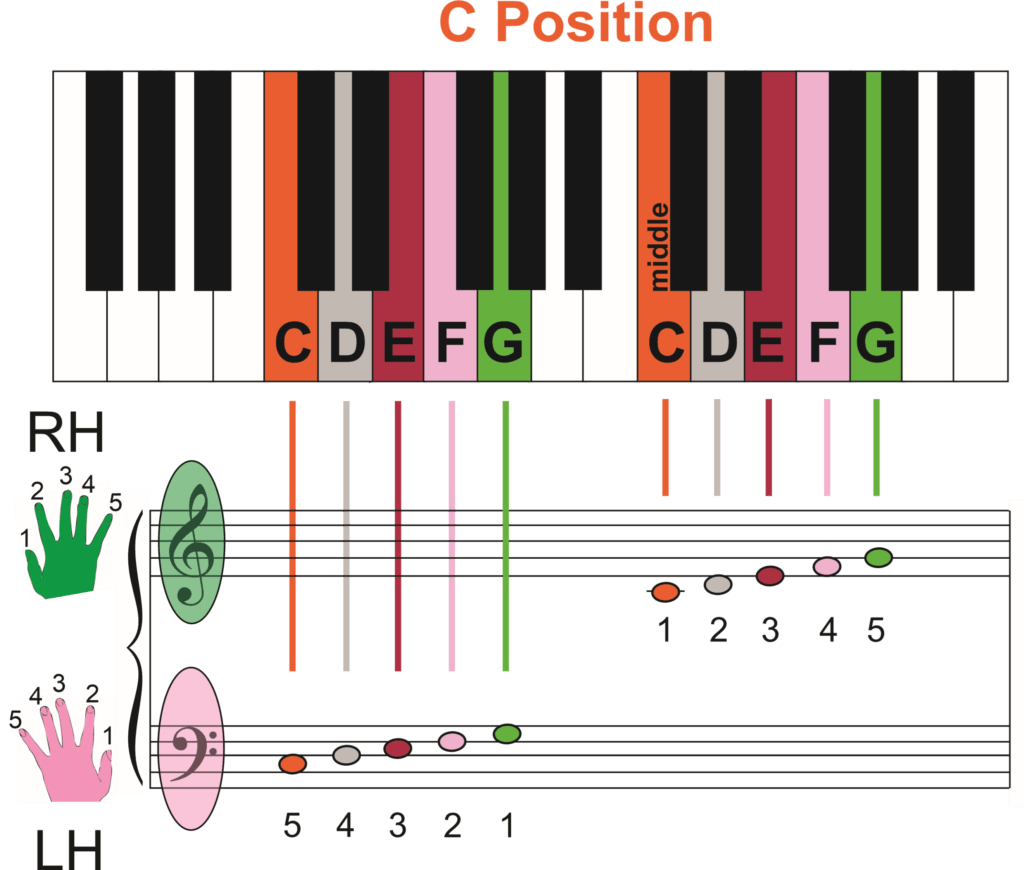
Piano scores often show finger numbers from 1 to 5:
- 1 = thumb
- 2 = index finger
- 3 = middle finger
- 4 = ring finger
- 5 = little finger
The same numbering applies to both hands.
Suggested fingering helps you move smoothly. It does not always mean there is only one correct choice. Hand size, comfort, musical style, and the passage itself can change the best fingering.
Keep your fingers curved and your wrists relaxed. Do not force a stretch or continue through pain. If playing causes sharp pain, numbness, or ongoing discomfort, stop and seek advice from a qualified teacher or health professional.
What does a fingering mark mean?
A number above or below a note suggests which finger to use. The mark may appear only when the fingering changes or when a passage could be confusing.
Follow the printed fingering at first. If it feels awkward, test a small change and use the version that supports smooth, relaxed movement.
Understand Chords and Intervals
Many piano notes appear as groups rather than single lines.
Intervals
An interval is the distance between two notes. Common intervals include:
- Unison
- Second
- Third
- Fourth
- Fifth
- Sixth
- Seventh
- Octave
A third, for example, covers three letter names. C to E is a third. The notes may be played one after another or at the same time.
Chords
A chord is a group of notes played together. A basic major triad contains:
- A root
- A major third
- A perfect fifth
For example, a C major triad uses C, E, and G.
Learn to recognize common chord shapes. This can make left-hand accompaniment much easier to read. Instead of seeing three separate notes, you begin to see one musical unit.
Broken chords and arpeggios
A broken chord plays the notes one at a time. An arpeggio is a broken chord that moves through the notes in order.
The notes may look spread out on the page, but their relationship remains the same. Recognizing that shape helps you read more quickly.
Use a Practice Routine That Builds Reading Skill
A short daily routine can build stronger reading habits than occasional long sessions.
Try this 20-minute plan:
- Three minutes: Find notes on the keyboard.
- Four minutes: Clap or tap a rhythm.
- Five minutes: Read a short passage with the right hand.
- Five minutes: Read the same passage with the left hand.
- Three minutes: Combine both hands slowly.
Use music that is easier than your hardest piece. Sight-reading improves when you can keep going without stopping for every note.
Practice one skill at a time
If the notes are difficult, ignore speed. If the rhythm is difficult, clap first. If the hand movement is difficult, practice the pattern without worrying about dynamics.
This approach reduces mental overload. Your brain can focus on one task before combining several tasks.
Look ahead
Try to read one or two notes ahead of the notes you are playing. Looking ahead helps prevent pauses.
Keep your eyes on the score as much as possible. Looking down at the keys is normal for beginners, but frequent glances can interrupt the flow. Learn the keyboard through landmarks and hand position so you need less visual checking.
Common Problems and How to Fix Them
“I can read the notes, but I cannot play them”
The problem may be coordination rather than note reading. Practice each hand alone, then combine only one or two measures.
Slow the tempo. Make sure your fingers are not tense.
“I know the notes, but I lose the beat”
The rhythm needs separate practice. Clap the rhythm, count aloud, or use a metronome.
Do not stop every time you make a wrong note. Keep a steady pulse during easy reading practice.
“I keep looking at my hands”
Start with five-finger patterns and simple scales. These patterns help you feel nearby keys without watching every movement.
You can also practice finding groups of two and three black keys with your eyes closed, using gentle and controlled movements.
“I confuse the two clefs”
Practice one clef at a time. Read short examples in treble clef, then short examples in bass clef.
After that, practice switching between them. Always connect the written note to its keyboard location.
“I play the right notes but the music sounds stiff”
Check articulation, dynamics, and phrasing. A piece can have correct pitches and rhythm but still need musical shaping.
First make the basic notes secure. Then add one expressive detail at a time.
“I cannot play as fast as the recording”
A recording may use a polished performance at the target tempo. You do not need to match it immediately.
Build speed only after you can play accurately and comfortably. Some markings describe a goal rather than a speed you must reach on your first attempt.

Signs That You Are Reading Better
You are making progress when you can:
- Name landmark notes quickly
- Find notes without searching for every key
- Keep a steady beat
- Read both clefs with less hesitation
- Recognize repeated patterns
- Play simple music without stopping
- Look ahead while your hands continue
- Correct small errors without losing the pulse
Reading ability grows through repeated exposure. You do not need to memorize every note before moving forward.
Frequently Asked Questions
Is piano music hard to read?
Piano music can look difficult because it uses two staffs at once. Start with simple pieces and learn one skill at a time. Most beginners improve faster when they practice short passages slowly and often.
How long does it take to learn to read piano music?
The time varies by practice schedule, prior music training, and the difficulty of the music. Many beginners can learn basic note names and rhythms within a few weeks, but fluent reading takes regular practice over a longer period.
Should I learn chords or individual notes first?
Learn both, but start with individual notes and simple rhythms. Add chords soon after. Chord shapes help you read accompaniment, while note reading helps you understand melodies and detailed scores.
Can I learn to read piano music without a teacher?
Yes. Books, apps, videos, and digital scores can help. A teacher can still provide useful feedback on rhythm, posture, fingering, and tension. If you practice alone, record yourself and check whether you keep a steady beat and use relaxed movements.
Should I memorize note names or use mnemonics?
Use mnemonics at the start, but do not depend on them forever. Aim to recognize notes by their position and relationship to nearby notes. This leads to faster reading than spelling every note from a memory phrase.
What is the best first song to learn?
Choose a short piece with a simple time signature, few accidentals, a narrow hand range, and a slow or moderate tempo. A piece that is too difficult can make note reading feel harder than it is.
Conclusion: Start With Notes, Rhythm, and Small Steps
To read piano music, learn the keyboard pattern, understand the treble and bass clefs, count the rhythm, and connect each symbol to a physical key. Then use a slow, repeatable process: scan the score, clap the rhythm, practice each hand, combine small sections, and add expression.
Start your next practice session with one easy measure. Find the landmark notes, count the beat, and play it slowly. Accurate reading grows one clear measure at a time.