

A standard piano in the United States has 88 keys and 12 different note names. Those notes repeat across the keyboard in higher and lower pitches. The white keys use the letters A through G, while the black keys are named with sharps or flats.
The full pattern is:
A, A♯/B♭, B, C, C♯/D♭, D, D♯/E♭, E, F, F♯/G♭, G, G♯/A♭
After G, the pattern starts again at A.

How many notes are on a piano?
A standard modern piano has 88 keys:
- 52 white keys
- 36 black keys
- A range from A0 to C8
- About 7¼ octaves
The word note can mean two related things:
- A named pitch, such as C, F♯, or B♭
- A physical piano key that produces that pitch
A standard piano contains more than one key for most note names because the same notes repeat in different octaves. For example, the keyboard has several C notes, but each C is higher or lower than the next.
Some keyboards have fewer than 88 keys. Common sizes include:
| Keyboard size | Typical range or use |
|---|---|
| 25 keys | Compact MIDI controllers |
| 49 keys | Portable controllers |
| 61 keys | Beginner keyboards and digital instruments |
| 76 keys | Stage keyboards |
| 88 keys | Full piano range |
A 61-key keyboard can still use the same note pattern as a piano. It simply covers less of the full range.
What are the white-key notes on a piano?
The white keys are named:
A, B, C, D, E, F, and G
These seven letters repeat across the entire keyboard. After G, the next white key is A.
From left to right, a short section of the white-key pattern looks like this:
A – B – C – D – E – F – G – A – B – C
The white keys do not all have the same distance between them. Most neighboring white keys are a whole step apart, but two pairs are only a half step apart:
- B to C
- E to F
This detail helps explain the layout of the black keys.
Why are there no black keys between B and C or E and F?
A black key sits between most neighboring white keys, but not between:
- B and C
- E and F
The reason is that B to C and E to F are already a half step apart. On a piano, a half step is the smallest distance between two adjacent keys.
For example:
- C to C♯ is a half step
- E to F is a half step
- G to G♯ is a half step
A whole step equals two half steps. For example:
- C to D is a whole step
- F to G is a whole step
- A to B is a whole step

What are the black-key notes on a piano?
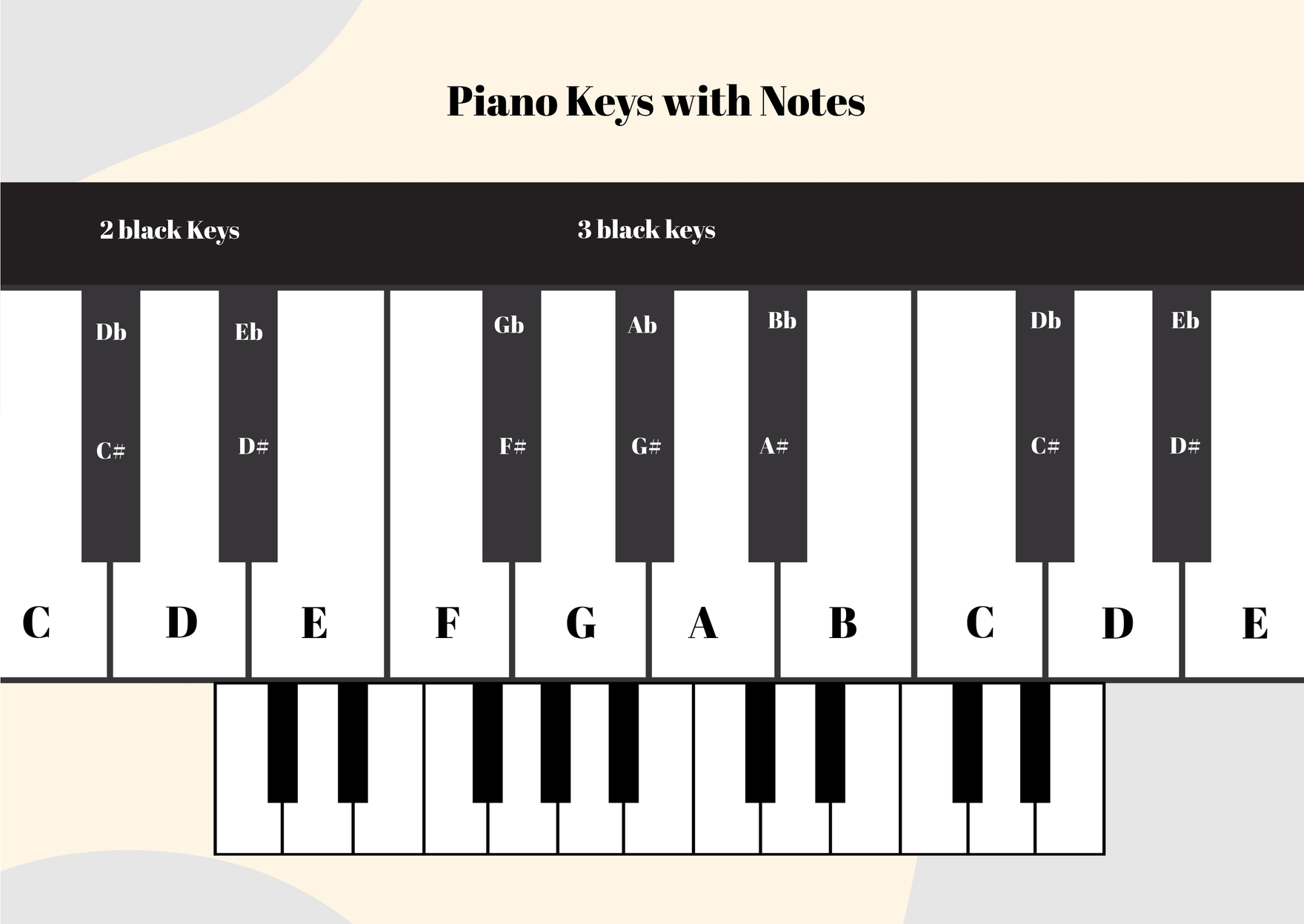
The black keys have two common names. A black key can be named with a sharp or a flat, depending on the key or scale being used.
For example:
- The black key between C and D is C♯ or D♭
- The black key between D and E is D♯ or E♭
- The black key between F and G is F♯ or G♭
This gives the black keys these paired names:
| Black key position | Sharp name | Flat name |
|---|---|---|
| Between C and D | C♯ | D♭ |
| Between D and E | D♯ | E♭ |
| Between F and G | F♯ | G♭ |
| Between G and A | G♯ | A♭ |
| Between A and B | A♯ | B♭ |
These pairs are called enharmonic notes. They use different names but normally produce the same pitch on a modern, equally tempered piano.
For example, C♯ and D♭ are played with the same key. The name changes based on the musical setting.
Why do black keys have two names?
Music uses letter names to show the structure of scales and chords. A composer may write C♯ in one piece and D♭ in another because each name fits a different scale or chord pattern.
For beginners, it is helpful to remember both names. Later, when reading music, the correct name will depend on the key signature and the notes around it.
How do you find the notes on a piano keyboard?
Use the groups of black keys to identify the white notes. The black keys appear in repeating groups of:
- Two
- Three
- Two
- Three
This pattern repeats from one end of the keyboard to the other.
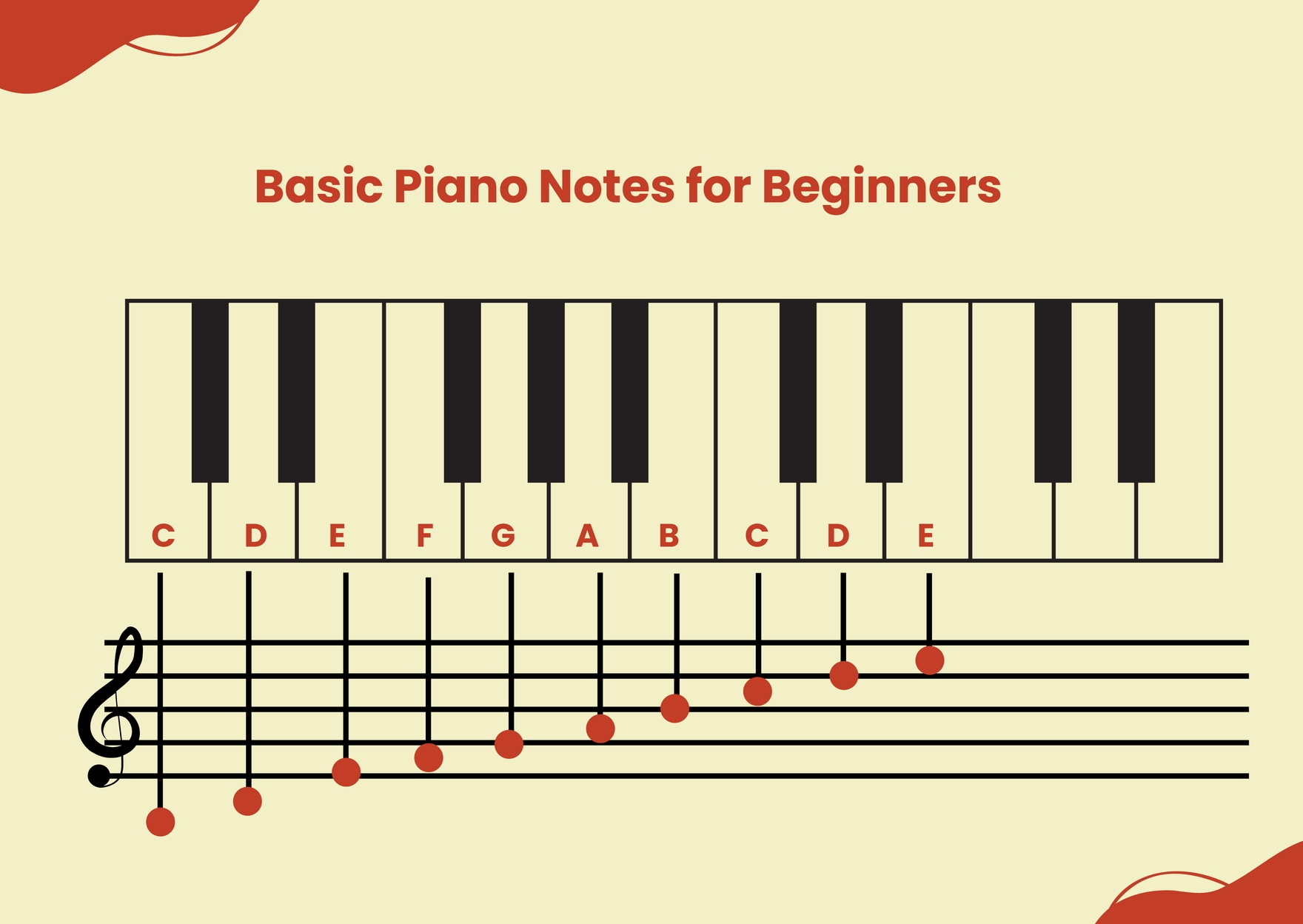
Find C
To find any C:
- Locate a group of two black keys.
- Find the white key immediately to the left.
- That white key is C.
Once you find C, the next white keys are:
C – D – E – F – G – A – B
Then the pattern starts again at the next C.
Find the other white keys
After finding C, count to the right:
| White key position | Note |
|---|---|
| 1 | C |
| 2 | D |
| 3 | E |
| 4 | F |
| 5 | G |
| 6 | A |
| 7 | B |
| 8 | C |
This is one of the fastest ways to learn the keyboard. You do not need to memorize every key at once. Start with C, then use the repeating alphabet pattern.
Find the black keys
The black keys are easier to identify by their position:
- Between C and D: C♯/D♭
- Between D and E: D♯/E♭
- No black key between E and F
- Between F and G: F♯/G♭
- Between G and A: G♯/A♭
- Between A and B: A♯/B♭
- No black key between B and C
What is middle C?
Middle C is C4, the C near the center of a standard 88-key piano.
Middle C is a useful reference point because it helps players locate notes in both the treble and bass areas. On a full-size piano, it is the fourth C when counting upward from the lowest C-like area, although the exact counting method can confuse beginners because the keyboard starts at A0 rather than C0.
On many digital piano displays and music apps, middle C is labeled C4. Some software uses a different octave-labeling system and may call the same pitch C3. The note itself has not changed; only the labeling system has.
How to find middle C
On a standard piano:
- Sit near the center of the keyboard.
- Look for a group of two black keys.
- Find the white key immediately to the left.
- The C closest to the center of the piano is middle C.
On a full 88-key piano, middle C is the 40th key from the left.
What are the piano octaves?
An octave is the distance from one note to the next note with the same letter name. For example:
- C to the next C
- G to the next G
- A to the next A
The higher note vibrates at twice the frequency of the lower note. To a listener, the two notes sound related, but one is higher.
A standard piano has the following labeled range:
| Piano range | Description |
|---|---|
| A0 | Lowest key |
| C8 | Highest key |
| A0–C8 | Full 88-key range |
| C4 | Middle C in the common U.S. labeling system |
Each octave contains 12 semitones:
- Seven natural notes: A, B, C, D, E, F, G
- Five sharp or flat notes
The pattern repeats, but the pitch rises each time the same note name appears in the next octave.
What notes are in each octave?
Each complete octave contains these 12 pitches:
C, C♯/D♭, D, D♯/E♭, E, F, F♯/G♭, G, G♯/A♭, A, A♯/B♭, B
Then the next octave begins with C.
Using common scientific pitch notation, the octave around middle C is:
C4, C♯4/D♭4, D4, D♯4/E♭4, E4, F4, F♯4/G♭4, G4, G♯4/A♭4, A4, A♯4/B♭4, B4
The next note is C5.
The lowest and highest ends of the piano are incomplete octave sections:
- The piano starts at A0
- It includes A♯0/B♭0 and B0
- The next full group begins at C1
- The piano ends at C8
What is the difference between a note, key, and pitch?
These terms are related, but they do not mean exactly the same thing.
Key
A key is the physical part of the piano that you press. It may be white or black.
Note
A note is a named musical sound, such as C, E, or G♯. The term can also describe the written symbol for that sound.
Pitch
Pitch describes how high or low a sound is. A high C and a low C have the same note name but different pitches.
For example, C3, C4, and C5 are all C notes. Their pitch rises as the octave number rises.
The terms may overlap in everyday speech. A piano teacher might say, “Play the C key,” “Play a C note,” or “Play the higher C.” The surrounding context usually makes the meaning clear.
How are piano notes written on sheet music?
Piano notes are commonly written on two five-line staffs:
- The treble staff for higher notes
- The bass staff for lower notes
Together, they form the grand staff used in most piano music.
Middle C sits between the treble and bass staffs on a short ledger line. This makes it a useful bridge between the two parts of the piano score.
The same piano key can appear in different places on written music depending on its octave. For example, several C notes exist on the piano, but each one uses a different position on the staff or a different number of ledger lines.
Treble and bass clefs
The treble clef usually covers notes played by the right hand. The bass clef usually covers notes played by the left hand. This is a general guide, not a strict rule. Piano music can place either hand in a wide range.
A beginner should learn middle C first, then build outward:
- Notes above middle C generally move into the treble area.
- Notes below middle C generally move into the bass area.

Why do piano notes sound different from one piano to another?
The note names stay the same, but the sound can change. Several factors affect the tone:
- Piano size
- String length
- Hammer design
- Soundboard construction
- Room acoustics
- Tuning
- Playing force
- Pedal use
A piano may also be tuned to a different reference pitch. In the United States, professional tuning commonly uses A4 at 440 hertz, often written as A440, but historical instruments and some ensembles may use another reference.
Equal temperament is the standard tuning system used on most modern pianos. It divides the octave into 12 equal semitones. This allows music to be played in all major and minor keys without large tuning problems between keys.
What is the easiest way to memorize piano notes?
Start with the repeating visual pattern rather than trying to memorize all 88 keys.
A simple learning method
- Find every C by looking to the left of each group of two black keys.
- Learn the white-key order: C, D, E, F, G, A, B.
- Practice naming white keys from left to right and right to left.
- Add the five black-key pairs.
- Practice one octave at a time.
- Use middle C as your main reference point.
- Read simple notes on the grand staff while finding them on the keyboard.
Short practice sessions work well. Spend a few minutes naming random keys, then play them. This connects visual memory, touch, and sound.
A common mistake is to memorize key positions without learning the pattern. The pattern is more useful because it works on nearly every piano and keyboard.

Common mistakes when learning piano notes
Confusing key names with octave names
The note C can appear many times. Saying “play C” may not tell the player which octave to use. In written music, the staff position or octave marking provides more detail.
Forgetting the missing black keys
There is no black key between:
- B and C
- E and F
This is normal. Do not assume every pair of white keys has a black key between them.
Treating C♯ and D♭ as unrelated keys
On a standard piano, C♯ and D♭ use the same physical key. Their names differ because of musical spelling.
Starting with all 88 keys
Beginners often feel overwhelmed by the full keyboard. Learn the repeating 12-note pattern first. Then extend it across the range.
Assuming every keyboard has 88 keys
Many electronic keyboards have fewer keys. The note pattern remains the same, but the instrument may not include the entire A0–C8 range.
Key takeaways
- A standard piano has 88 keys.
- The keyboard uses 12 repeating note names.
- The white keys are A, B, C, D, E, F, and G.
- The black keys have sharp and flat names, such as C♯/D♭.
- The black-key pattern repeats in groups of two and three.
- Middle C is commonly labeled C4.
- A standard piano ranges from A0 to C8.
- There is no black key between B and C or E and F.
- The quickest way to find notes is to learn the repeating keyboard pattern.
Frequently asked questions
What are the 12 notes on a piano?
The 12 notes are:
C, C♯/D♭, D, D♯/E♭, E, F, F♯/G♭, G, G♯/A♭, A, A♯/B♭, and B.
This pattern repeats in higher and lower octaves.
What is the first note on an 88-key piano?
The lowest key on a standard 88-key piano is A0. The highest key is C8.
Is middle C the exact center key?
No. On a standard 88-key piano, middle C is the 40th key from the left. It is near the center and serves as a central reference point, but it is not the exact physical midpoint.
Are black keys sharp or flat?
They can be either. For example, the black key between C and D is C♯ when viewed as a sharp, or D♭ when viewed as a flat. The correct name depends on the musical key and context.
Can I learn piano notes without reading music?
Yes. You can learn the keyboard layout by using the black-key groups and the A–G letter pattern. Reading music is still useful because it tells you which notes to play, when to play them, and in which octave.
Conclusion
The notes on a piano follow a simple repeating system. Seven white-note letters combine with five black-note pitches to create 12 notes per octave. Once you learn to spot the groups of two and three black keys, you can locate every note on the keyboard.
Start with C, find middle C, and practice the pattern one octave at a time. After that, connect the keys to basic sheet music and simple scales. The full keyboard may look large, but its note pattern repeats like a clear map.