

You play slide guitar by lightly gliding a tube over the strings while muting unwanted noise with both hands.
Learning how do you play slide guitar is less about force and more about control, touch, and listening. With the right slide, a clean setup, simple muting habits, and steady practice, you can create the smooth blues, country, rock, and gospel tones heard on countless classic recordings.
What Is Slide Guitar?
Slide guitar is a playing technique in which you move a hard tube, called a slide, along the strings. The slide changes the vibrating length of the strings and creates a smooth, vocal sound. Instead of pressing a string down against a fret, you place the slide directly above the fret wire.
The slide does not need to touch the fretboard. It should float just above the strings while your fretting hand controls unwanted noise. This small detail is the foundation of how do you play slide guitar with a clear tone.
You can play slide guitar on an acoustic or electric guitar. Acoustic guitars often produce a bright, woody sound, while electric guitars offer more sustain and make it easier to control volume, distortion, and effects.
 <figcaption style="font-size: 14px; color: #555; margin-top: 8px;">
Source: playguitaracademy.com
<figcaption style="font-size: 14px; color: #555; margin-top: 8px;">
Source: playguitaracademy.com
Choose the Right Slide
The best slide depends on your comfort, guitar setup, and preferred tone. Slides are commonly made from glass, metal, ceramic, or brass.
Glass slides
Glass slides usually sound warm, smooth, and soft. They are popular for blues and roots music. A glass slide can help you produce a round tone with less harshness.
Metal slides
Metal slides create a brighter and sharper sound. Steel, brass, and chrome slides often work well for rock, country, and electric blues. They also tend to feel more durable than glass.
Ceramic slides
Ceramic slides sit between glass and metal in tone. They can sound warm but still have enough attack for clear single-note lines.
Pick the correct finger
Most players wear a slide on one of three fingers:
• Ring finger: This gives a good balance between control and normal fretting ability.
• Pinky finger: This leaves your index, middle, and ring fingers free for regular chords and notes.
• Middle finger: This can feel strong and stable, though it may limit your normal fretting hand shape.
For many beginners, the ring finger is a comfortable starting point. The slide should fit securely without cutting off circulation. If it moves too much, your notes will sound unstable.
When learning how do you play slide guitar, comfort matters more than brand or price. A simple slide that fits well is more useful than an expensive slide that feels loose.
Set Up Your Guitar for Slide
A standard guitar can play slide guitar, but a few setup changes can make the process easier. Low action may cause the slide to hit the frets and create a rough, buzzing sound.
Action is the height of the strings above the fretboard. A slightly higher action gives the slide more room. Many slide players use a guitar with medium or high action, especially for dedicated slide work.
You do not always need a professional setup. Start with your current guitar and learn the basic technique first. If the strings buzz when the slide moves, ask a qualified guitar technician to check the neck relief, nut, bridge, and fret condition.
Use fresh strings when possible. Old strings can sound dull and may have uneven surfaces that make smooth sliding harder. Heavier strings can also produce a fuller tone, but they may feel harder to bend and fret.
Before changing string gauges, check that your guitar can handle the tension. A repair technician can help you choose a safe set.
A common lesson in how do you play slide guitar is that equipment can help, but it cannot replace clean technique. Good muting and accurate movement matter more than a costly setup.

Tune Your Guitar
You can play slide guitar in standard tuning, but alternate tunings often make chords and melodies easier.
Standard tuning
Standard tuning is:
• Low to high: E, A, D, G, B, E
Standard tuning lets you keep using familiar chord shapes. It is a useful choice if you want to switch between slide and normal guitar during the same song.
Open G tuning
Open G tuning is:
• Low to high: D, G, D, G, B, D
Strumming all open strings creates a G major chord. Open G is common in blues, roots, country, and rock. It also makes major chord shapes simple because you can use one finger across the strings.
Open D tuning
Open D tuning is:
• Low to high: D, A, D, F-sharp, A, D
The open strings create a D major chord. Open D gives a deep, wide sound and works well for powerful acoustic slide parts.
Open E tuning
Open E tuning is:
• Low to high: E, B, E, G-sharp, B, E
Open E has a bright and direct tone. However, raising the A, D, and G strings can increase tension. Some players tune to open D and use a capo at the second fret to reach open E with less stress.
Always tune carefully. Use a reliable tuner and check each string again after placing the slide on your finger. Knowing how do you play slide guitar includes knowing how tuning changes the notes under your hand.

Hold the Slide Correctly
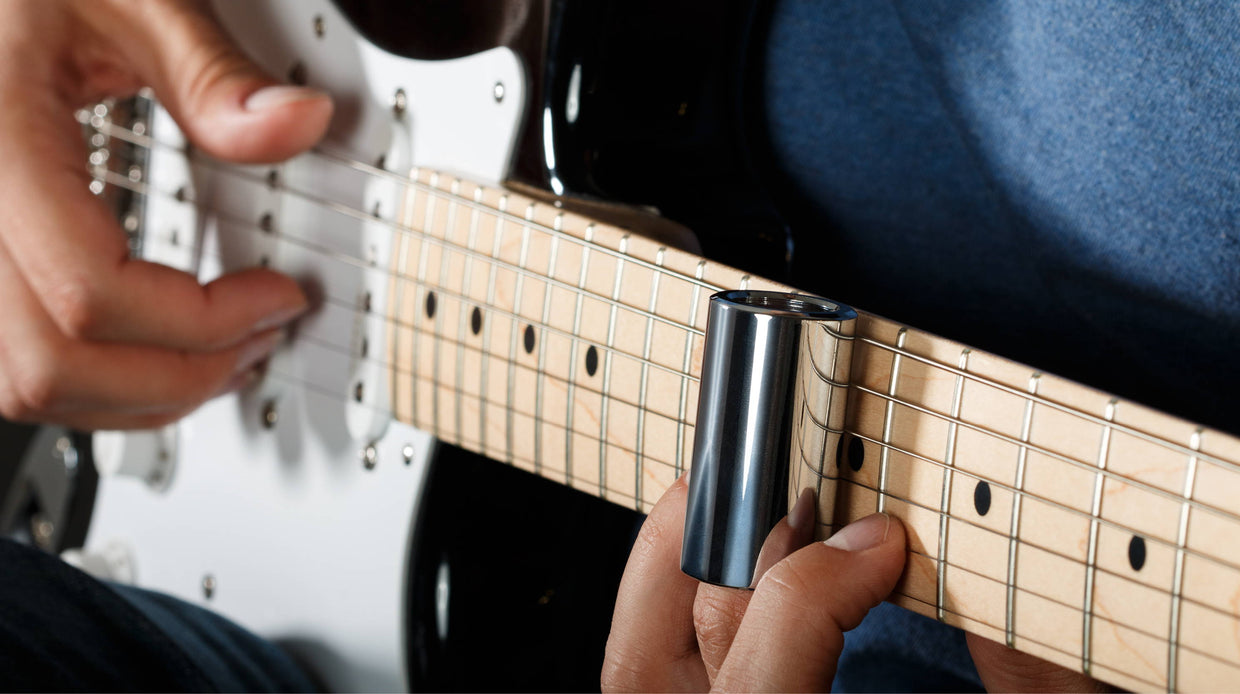
Place the slide over the finger, not between the fingers. Keep your hand relaxed and let the slide sit straight across the strings.
The slide should remain parallel to the frets. If it angles toward the headstock or bridge, some strings may sound out of tune while others sound correct.
Use only enough pressure to touch the strings lightly. Pressing hard can push the strings into the frets and create sharp notes or buzzing. Think of the slide as a glass window moving over the strings, not a finger pushing them down.
Your other fingers should help mute the strings. If the slide is on your ring finger, your index and middle fingers can rest lightly on the strings behind it. This stops the string from ringing behind the slide.
Your picking hand also has a job. Use the side of your palm or unused fingers to quiet strings you are not playing. Clean slide tone comes from this two-hand system.
When practicing how do you play slide guitar, spend time making one note sound clean before playing a full phrase. A clear single note teaches more than a fast line filled with noise.

Learn the Basic Slide Technique
Follow these steps to build a reliable foundation.
Tune the guitar carefully.
Place the slide above the seventh fret on the high E string.
Pick the string once.
Move the slide slowly toward the ninth fret.
Stop directly above the ninth fret.
Listen for the pitch.
Return to the seventh fret and repeat.
The slide should sit directly above the fret, not halfway between two frets. The fret marks the correct pitch even though the slide does not press the string against it.
Move slowly at first. Your ears will tell you when the note is sharp, flat, or centered. A tuner can also help. Play the note, check it with the tuner, then adjust the slide by a very small amount.
Practice short movements before long glides. Try sliding from fret five to fret seven, then from fret seven to fret nine. Keep the motion smooth and even.
This is the core of how do you play slide guitar: pick a note, move the slide, find the pitch, and control the noise.

Master Muting and String Control
Muting is one of the most important parts of slide guitar. Without it, open strings ring together and hide the melody.
Use your fretting hand to mute the strings behind the slide. Rest one or more fingers gently on the strings without pressing them down. This prevents unwanted notes from sounding behind the slide.
Use your picking hand to mute strings below the string you are playing. For example, if you play the G string, your palm or fingers can quiet the lower strings.
Try this exercise:
• Pick the high E string alone.
• Mute the B, G, D, A, and low E strings.
• Move the slide between the fifth and seventh frets.
• Repeat the phrase with a slow metronome.
Then reverse the process. Play the B string and mute every other string. This teaches your hands to separate the melody from the noise.
A useful way to think about muting is to compare it with speaking in a quiet room. The note is your voice, and muting is the silence around it. Without silence, the message becomes unclear.
Many beginners ask how do you play slide guitar without squeaks. The answer is careful muting, lighter pressure, clean string changes, and slower movement.

Pick Notes and Create Vibrato
You can pick slide guitar with a flat pick, your fingers, or both. Each method offers a different sound.
A flat pick gives a clear attack and works well for single-note melodies. Fingerstyle playing gives you more control over bass notes, chord tones, and several strings at once. Hybrid picking combines a pick with the middle and ring fingers.
Start with a single pick. Focus on a steady rhythm and clean notes. Add fingerstyle techniques after your muting feels reliable.
Vibrato adds emotion to a slide note. Instead of moving the slide up and down the neck, rock it slightly from side to side along the fret line. Keep the movement small and controlled.
A wide vibrato can sound dramatic, but it may also become out of tune. Begin with a slow, narrow motion. Listen to the pitch center before making the vibrato wider.
Try holding a note at the seventh fret, then add four slow vibrato movements. Keep the slide parallel to the fret. This simple drill helps you sound more vocal and expressive.
Good vibrato is a major part of how do you play slide guitar in a musical way. It turns a plain note into a phrase with feeling.

Practice Slide Guitar Exercises
A short daily routine can improve your control quickly. Practice for 10 to 15 minutes instead of rushing through a long session once a week.
Exercise one: Clean single notes
Play one string at a time. Move between frets five, seven, and nine. Stop the slide directly over each fret and check the pitch.
Exercise two: Two-string movement
Play the B and high E strings together. Keep the slide level so both strings stay in tune. This builds control for double-stop melodies.
Exercise three: Call and response
Play a short phrase on the high strings. Then answer it on the lower strings. This teaches phrasing and keeps your practice musical.
Exercise four: Vibrato control
Hold one note for four beats. Add slow vibrato during the final two beats. Repeat at different frets.
Exercise five: Open tuning chords
Tune to open G or open D. Place the slide across the third, fifth, and seventh frets. Strum slowly and listen to the chord changes.
Record your practice with a phone. You may hear string noise that you did not notice while playing. Recording is one of the easiest ways to improve how do you play slide guitar because it gives you an honest view of your timing and pitch.

Play Slide Guitar in Different Styles
Slide guitar appears in many musical traditions, and each style uses different techniques.
Blues slide guitar
Blues often uses minor pentatonic notes, call-and-response phrases, bends, and vocal vibrato. Open G and open D are common, but standard tuning also works well.
Try playing a phrase around the twelfth fret. Leave space between lines. Slide guitar sounds more expressive when you allow notes to breathe.
Country slide guitar
Country slide playing often uses bright major sounds, double stops, and quick movements. Standard tuning is useful because it supports normal chord shapes and familiar scale patterns.
Use a clean amplifier tone with moderate compression if you play electric guitar. Keep the notes sharp and rhythmic.
Rock slide guitar
Rock slide guitar often uses higher volume, sustain, and distortion. Distortion can make a note sound large, but it also magnifies mistakes and unwanted noise.
Start with a clean tone. Add gain only after your muting and pitch control are strong.
Gospel and soul slide guitar
These styles often use smooth melodies and emotional vibrato. Let the slide imitate a singing voice. Aim for warmth and space rather than speed.
Understanding style helps answer how do you play slide guitar in a way that fits the music. The technique stays similar, but the phrasing, tone, and rhythm change.
Common Slide Guitar Mistakes
Beginners often make the same errors. Each one has a simple fix.
• Pressing too hard: Use lighter pressure and let the slide float above the frets.
• Stopping between frets: Aim directly over the fret wire.
• Ignoring muting: Rest unused fingers on the strings to stop extra noise.
• Moving too fast: Slow down until each note is in tune.
• Using too much distortion: Start with a clean or mildly driven tone.
• Holding the slide at an angle: Keep it parallel to the frets.
• Forgetting to tune: Check tuning before every practice session.
• Practicing only open strings: Learn slide control in standard tuning and at different fret positions.
One of the most useful lessons in how do you play slide guitar is that clean sound comes before speed. Fast sliding cannot hide poor pitch for long.
Also remember that slide guitar can be physically demanding. If your wrist, hand, or finger hurts, stop and rest. Pain is not a sign of progress. Check your posture and grip before practicing again.
Choose an Amp and Effects
A good slide tone starts with the guitar and your hands. Effects can add color, but they should support your playing.
For electric slide guitar, begin with:
• A clean or slightly overdriven amplifier
• Moderate treble
• Enough midrange to keep notes clear
• Controlled bass to prevent muddiness
• A small amount of reverb
Compression can make notes sustain longer and sound more even. Overdrive can add warmth and bite. Delay can create space, but too much delay may blur your timing.
For acoustic slide guitar, a microphone or acoustic pickup with a balanced tone works well. Avoid excessive bass, since low frequencies can make open tunings sound muddy.
Experiment with volume before adding effects. Slide guitar often sounds best when your picking hand and guitar volume create the dynamics.
The best approach to how do you play slide guitar is to build a clean foundation first. Add effects one at a time so you know what each control does.
How Long Does It Take to Learn Slide Guitar?
Many players can produce a basic slide note in one practice session. Clean pitch, quiet strings, and musical phrasing take longer.
With regular practice, you may notice progress in a few weeks. Your results will depend on your setup, practice time, hearing, and previous guitar experience.
A simple plan looks like this:
• Week one: Learn slide position, light pressure, and muting.
• Week two: Practice single-note movement and pitch control.
• Week three: Add vibrato, double stops, and basic phrases.
• Week four: Play along with slow blues or country backing tracks.
Do not compare your progress with a professional recording. Experienced players may use years of ear training and control that are not obvious when you listen.
If you practice slowly and record yourself, you will develop a better sense of pitch. That skill is central to how do you play slide guitar and cannot be replaced by equipment.
Frequently Asked Questions About How Do You Play Slide Guitar
Do you press the slide onto the strings?
No. Rest the slide lightly on the strings and keep it just above the fretboard. Pressing too hard can cause buzzing, sharp notes, and poor control.
Which finger is best for a guitar slide?
The ring finger is a popular choice because it offers stability while leaving some fingers free. The pinky also works well if you want to switch between slide and normal fretting quickly.
Can you play slide guitar in standard tuning?
Yes. Standard tuning is useful for beginners because you can keep familiar chord shapes and scale patterns. Open tunings may make chord playing easier, but they are not required.
Why does my slide guitar sound out of tune?
Your slide may not be directly above the fret, or it may be angled across the strings. Move slowly, keep the slide parallel to the fret, and use a tuner to check your pitch.
Do you need a special guitar for slide guitar?
No. You can begin on almost any acoustic or electric guitar. A slightly higher action and fresh strings may make slide playing easier, but strong muting and accurate movement matter most.
Is slide guitar harder than regular guitar?
Slide guitar uses different skills rather than simply being harder. Pitch control, muting, and hand coordination may feel challenging at first, but steady practice makes them natural.
Conclusion
Slide guitar begins with a well-fitting slide, light pressure, accurate fret placement, and careful muting. Standard tuning is a strong place to start, while open G, open D, and open E can help you create rich chord sounds.
Practice slowly, listen closely, and focus on clean notes before speed. Learn a few short phrases, add controlled vibrato, and record yourself so you can hear your progress.
Now pick up your guitar, choose one string, and practice moving between two frets with a clean tone. Explore blues backing tracks, try an open tuning, and share your favorite slide guitar lesson or song in the comments.