

Introduction
For piano students in the United States, reading notes means learning how written symbols on sheet music match the keys on a piano. You will read two music staffs at once, find the notes on the keyboard, and play them in the right order and rhythm.
The fastest path is to learn Middle C, the treble clef, the bass clef, and the pattern of lines and spaces. Then, use intervals and short daily practice to read music with less guessing.
What Do Piano Notes Mean?
A piano note tells you two main things:
- Pitch — how high or low the sound is.
- Rhythm — how long to hold the sound.
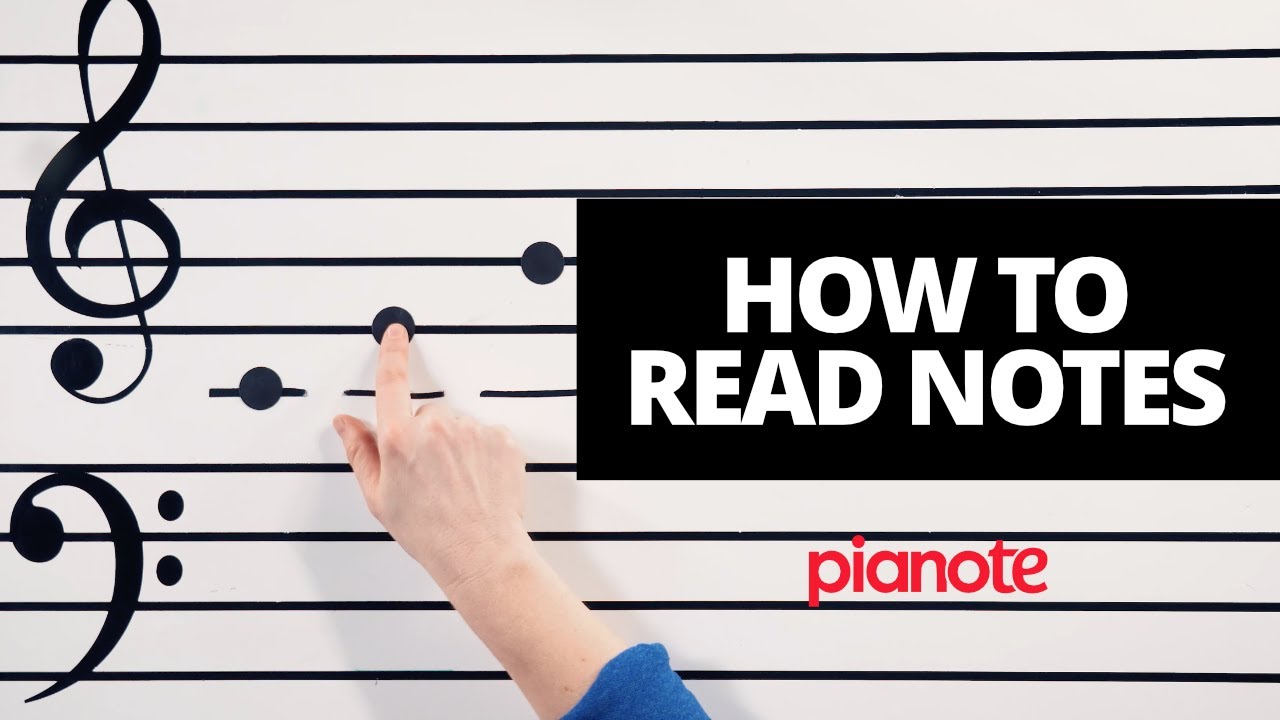
Written piano music uses a system called standard music notation. Notes appear on five horizontal lines called a staff. A note may sit on a line, in a space, or above or below the staff.
The piano has 88 keys on a standard acoustic piano. The written staff helps you know which key to press. The shape of the note helps you know how long to hold it.
The two staffs in piano music
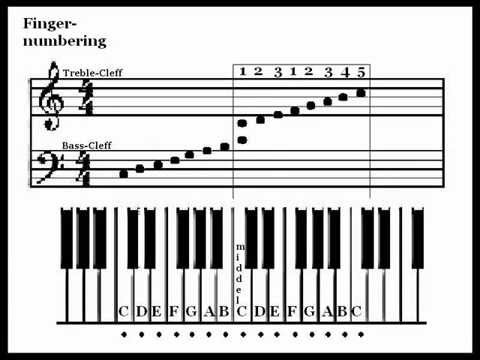
Piano music usually uses a grand staff. It joins two staffs:
- Treble staff — usually played with the right hand
- Bass staff — usually played with the left hand
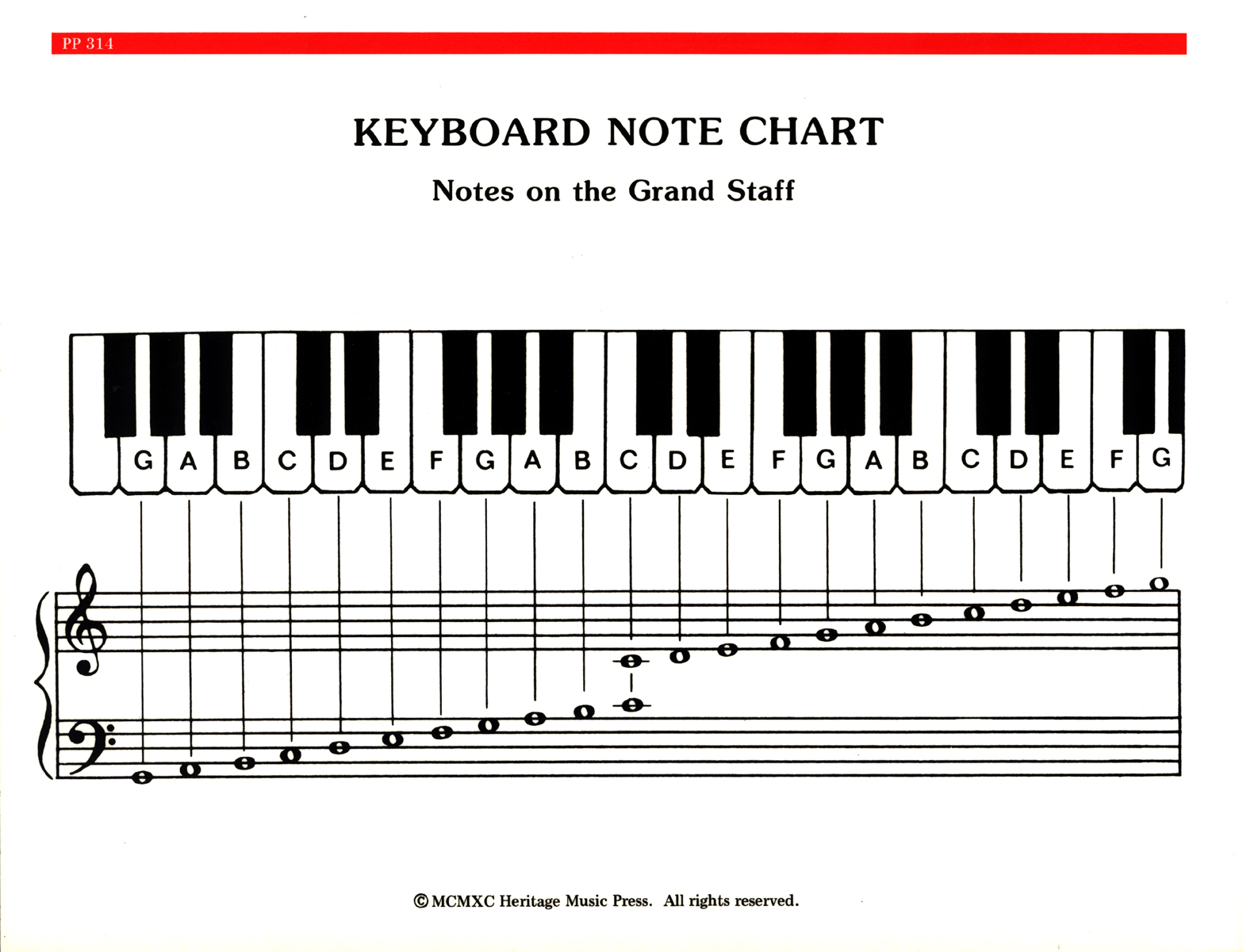
The treble staff shows higher notes. The bass staff shows lower notes. The two staffs meet around Middle C.
The hand assignment is a guide, not a strict rule. A piece may ask your right hand to play bass notes or your left hand to play treble notes.
What is Middle C?
Middle C is the C near the center of the piano. On an 88-key piano, it sits just left of the group of two black keys near the middle.
On sheet music, Middle C sits:
- One small ledger line below the treble staff
- One small ledger line above the bass staff
A ledger line is a short extra line used for notes that fall above or below the main staff.
Middle C is a useful starting point because it links the two staffs. Once you know it, you can move upward or downward by step.

Learn the Treble Clef Notes
The treble clef is also called the G clef. It shows notes that are often played by the right hand.
The treble staff has five lines and four spaces.
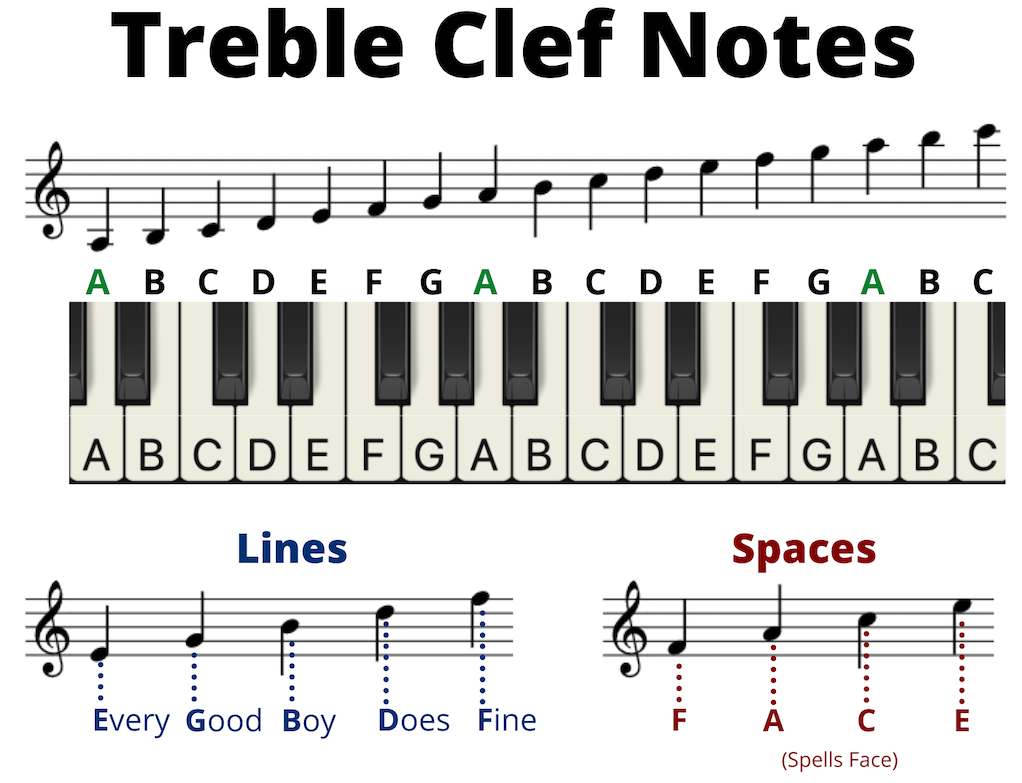
Treble clef lines
From bottom to top, the five lines are:
| Line | Note |
|---|---|
| 1 | E |
| 2 | G |
| 3 | B |
| 4 | D |
| 5 | F |
A common memory phrase is:
Every Good Boy Does Fine
The first letter of each word matches the line notes from bottom to top.
Treble clef spaces
From bottom to top, the four spaces spell:
F A C E
The spaces are easy to remember because they spell the word FACE.
How to use the treble clef
Start at the bottom line, E. Then move upward one note at a time:
- E is the first line.
- F is the first space.
- G is the second line.
- A is the second space.
- B is the third line.
Each move from a line to the next space, or from a space to the next line, is a step.
For example, a note on the third line is B. A note in the space above it is C. A note on the next line is D.
Treble clef notes near Middle c
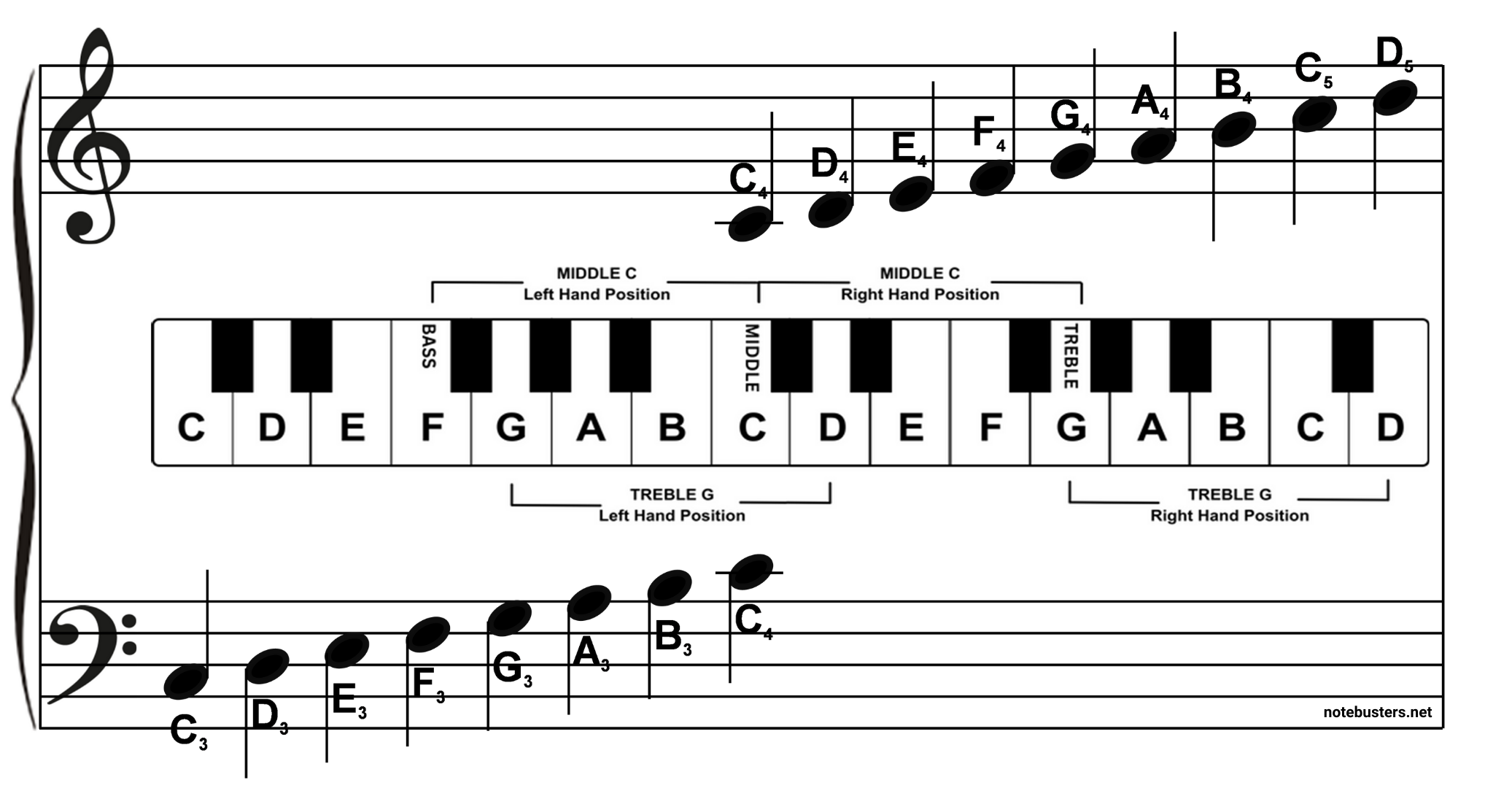
middle C is below the treble staff. The notes rise like this:
- Middle C — ledger line below the staff
- D — space below the staff
- E — first line
- F — first space
- G — second line
- A — second space
- B — third line
This short range appears in many beginner piano pieces.

Learn the Bass Clef Notes
The bass clef is also called the F clef. It shows lower notes and is often played by the left hand.
The bass staff also has five lines and four spaces.
Bass clef lines
From bottom to top, the five lines are:
| Line | Note |
|---|---|
| 1 | G |
| 2 | B |
| 3 | D |
| 4 | F |
| 5 | A |
A common memory phrase is:
Good Boys Do Fine Always
Bass clef spaces
From bottom to top, the four spaces are:
A C E G
One memory phrase is:
All Cows Eat Grass
You can use a memory phrase at first. Over time, try to recognize each note without saying the phrase.
Bass clef notes near Middle C
The notes rise toward Middle C in this order:
- G — first line
- A — first space
- B — second line
- C — second space
- D — third line
- E — third space
- F — fourth line
Middle C is above the bass staff. This is the opposite of its position on the treble staff.
The bass clef symbol
The two dots in the bass clef surround the F line. This helps you identify the note F on the staff.
The bass clef can look unfamiliar at first. Practice it on its own before trying to read both staffs together.
Match Written Notes to Piano Keys
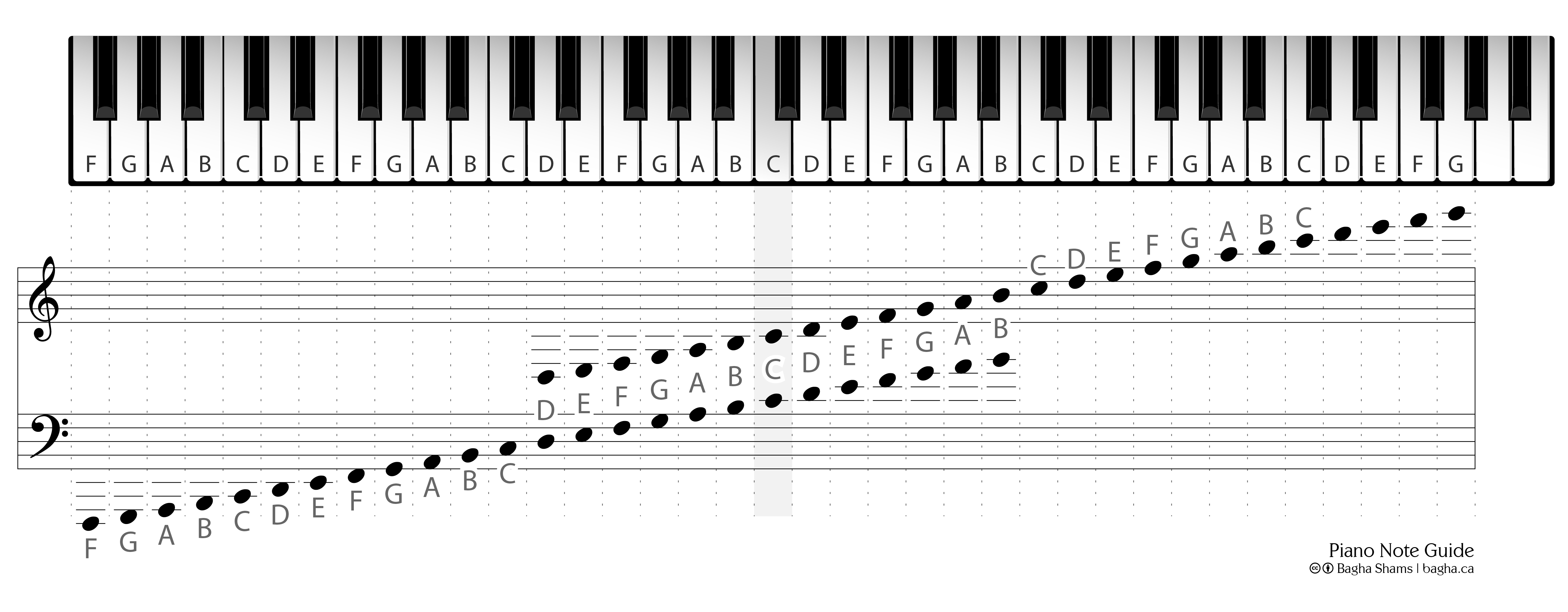
Once you know a note’s name, you must find the matching key.
Find the groups of black keys
Piano keys follow a repeating pattern:
- Two black keys
- Three black keys
- Two black keys
- Three black keys
This pattern repeats across the keyboard.
The white key just to the left of any group of two black keys is C. From C, the white keys move upward in this order:
C – D – E – F – G – A – B
Then the pattern starts again at C.
Find Middle C on your piano
Look near the center of the keyboard. Find a group of two black keys. The white key immediately to the left is a C.
The C closest to the center is Middle C.
On a digital piano, the exact center may vary if the keyboard has fewer than 88 keys. In that case, use the instrument’s central C or the C marked by the manufacturer.
Use the keyboard pattern
You do not need to count every key. Use the black-key groups as landmarks.
For example:
- C is left of two black keys.
- D is between two black keys.
- E is right of two black keys.
- F is left of three black keys.
- G is between the first and second black keys in a group of three.
- A is between the second and third black keys.
- B is right of three black keys.
This pattern works on acoustic pianos, digital pianos, and most keyboards.
What about black keys?
Black keys can have two names:
- A sharp raises a note by one half step.
- A flat lowers a note by one half step.
For example:
- The black key between C and D can be called C-sharp.
- The same key can be called D-flat.
The name depends on the key signature and the music around it.

Understand Steps, Skips, and Intervals
Reading by note name alone can be slow. Strong readers also notice the distance between notes.
That distance is called an interval.
Steps
A step moves from one note to the next note letter.
Examples:
- C to D
- E to F
- A to B
On the staff, a step moves from a line to the next space or from a space to the next line.
Skips
A skip moves over one note letter.
Examples:
- C to E
- D to F
- G to B
On the staff, a skip moves from a line to the next line or from a space to the next space.
Repeated notes
A repeated note stays in the same staff position. The key does not change, but the rhythm may change.
Why intervals help
Suppose you recognize the first note as C. If the next note moves up by a step, it must be D. If it moves up by a skip, it must be E.
This lets you read groups of notes as patterns. It also helps you avoid spelling out every note from the beginning each time.
Read the shape of a melody
A melody may:
- Move up
- Move down
- Repeat one note
- Make small steps
- Make larger skips
- Change direction
Look at the shape before you play. This gives you a quick idea of how the melody should sound.
Read Rhythm Along With Pitch
Knowing the note names is only half of reading piano music. You must also read rhythm.
Common note values
These are common note values in US music instruction:
| Note value | Typical duration in 4/4 time |
|---|---|
| Whole note | 4 beats |
| Half note | 2 beats |
| Quarter note | 1 beat |
| Eighth note | 1/2 beat |
A note’s appearance may include:
- An open or filled notehead
- A stem
- A flag
- A beam connecting it to another note
The symbol tells you how long to hold the note.
Count the beat
In 4/4 time, count:
1 – 2 – 3 – 4
A quarter note lasts one count. A half note lasts two counts. A whole note lasts four counts.
For eighth notes, count:
1 and 2 and 3 and 4 and
Each eighth note takes half of one beat.
Read the time signature
The time signature appears near the beginning of the staff.
The top number tells you how many beats are in each measure. The bottom number tells you which note value gets one beat.
For example:
- 4/4 has four quarter-note beats per measure.
- 3/4 has three quarter-note beats per measure.
- 2/4 has two quarter-note beats per measure.
A measure is the space between two vertical bar lines.
Do not rush the rhythm
If the pitches are correct but the rhythm is wrong, the piece will still sound unclear. Clap or count the rhythm before you play.
A slow and steady beat is better than a fast, uneven one.
Follow These Steps to Read a New Piano Passage
Use this process when you see unfamiliar sheet music.
Step 1: Check the clefs
Look for the treble clef and bass clef. Decide which hand will usually play each staff.
Step 2: Check the key signature
The key signature shows which notes are sharp or flat throughout the piece. It appears after the clef.
Do not assume that every black key is written as a sharp. The key signature determines the correct note name.
Step 3: Check the time signature
Find the time signature. Count the beats in each measure before you begin.
Step 4: Scan the first measure
Look for:
- The starting notes
- Repeated notes
- Steps
- Skips
- Chords
- Rests
- Changes in rhythm
Step 5: Find a starting note
Use Middle C or another known note as an anchor. Then move by steps and skips.
Step 6: Choose the fingering
Use the printed fingering when it is available. If no fingering appears, choose a comfortable position that keeps your hand relaxed.
Step 7: Count aloud
Count the rhythm slowly. Tap the beat if needed.
Step 8: Play slowly
Start at a speed where you can keep the beat and avoid stopping. Speed comes after accuracy.
Step 9: Look ahead
While playing one note, glance toward the next group. This reduces pauses and helps you read music in phrases.
Step 10: Repeat small sections
Practice one or two measures at a time. Join the sections after each part feels steady.

Use a Simple Practice Plan
Short, regular practice usually works better than one long session each week.
Try this 15-minute plan:
| Time | Task |
|---|---|
| 3 minutes | Name treble clef notes |
| 3 minutes | Name bass clef notes |
| 3 minutes | Find notes on the keyboard |
| 3 minutes | Clap and count a rhythm |
| 3 minutes | Read a short passage slowly |
Practice without looking down at your hands for every note. Look down only when you need to reset your hand position.
Use beginner music with a small note range at first. A piece that is too hard can make note reading feel like a guessing game.
Practice with flashcards carefully
Flashcards can help you learn note names. But they do not replace real music reading.
Use flashcards for quick recognition. Then apply the notes to short melodies, scales, and simple songs.
Say, see, and play
Use more than one sense:
- Say the note name.
- See its place on the staff.
- Find the key.
- Play it.
- Hear the result.
This links the written note to the physical key and the sound.
Track accuracy, not just speed
A useful sign of progress is fewer stops and fewer wrong notes at the same slow tempo. Raise the tempo only when your reading stays steady.
Common Mistakes When Reading Piano Notes
Memorizing only one clef
Some students learn treble clef well but avoid bass clef. Piano music needs both.
Spend a few minutes on bass notes every day. Begin with the notes near Middle C, then expand outward.
Counting lines from the top
Always count staff lines and spaces from the bottom. This is the standard way to identify them.
Confusing a note name with one key
A note name may appear in more than one octave. For example, the piano has several C keys.
The staff position tells you which octave to use.
Ignoring ledger lines
Ledger lines are not separate symbols to fear. Continue the same pattern of notes above or below the staff.
For example, above the treble staff:
- Top line is F.
- The space above it is G.
- The next ledger line is A.
Looking at your hands too much
Frequent looking can break your place in the music. Use the black-key pattern and your hand position as guides.
Using mnemonics forever
Memory phrases are useful at the start. But fluent readers recognize the shape and position of notes directly.
Use mnemonics as a backup, not as your only method.
Playing too fast
Fast playing can hide gaps in note reading. Slow down until you can keep a steady beat.
Ignoring rests
A rest is part of the rhythm. Do not fill a rest with sound.
How to Tell If You Are Improving
You are making progress when you can:
- Name common treble clef notes without long pauses.
- Name common bass clef notes with less effort.
- Find Middle C and nearby notes quickly.
- Read repeated notes and simple steps at a glance.
- Count basic rhythms while playing.
- Keep your place after a small mistake.
- Play slowly without stopping at every note.
- Read a short piece you have not memorized.
You do not need to read every note instantly before playing music. Reading improves through repeated contact with real pieces.
If you keep missing notes, reduce the difficulty. If you lose the beat, clap the rhythm first. If your hands feel tense, stop and reset your posture.

Frequently Asked Questions
Is it hard to learn how to read piano notes?
Most beginners find it challenging at first because they must read pitch, rhythm, and hand movement at the same time. Daily practice with short passages makes the process easier.
Should I learn treble clef or bass clef first?
Many beginners start with treble clef because it often carries the melody. Learn bass clef soon after, since normal piano music uses both clefs together.
How long does it take to read piano music?
The time varies by learner and practice schedule. With regular practice, many beginners can read simple notes within a few weeks. Comfortable sight-reading takes longer and develops through steady use.
Do I need to memorize every piano note?
You should learn the common notes well enough to recognize them quickly. You do not need to memorize every possible ledger-line note before you start playing.
Why do the same notes appear in different places?
The same note name repeats in different octaves. Its position on the staff shows which version to play.
What should I do if I cannot read both staffs at once?
Practice each hand separately first. Then combine the hands in very small sections. Use a slow tempo and mark the notes that cause trouble.
Can I learn piano notes without a teacher?
Yes. Books, apps, and guided lessons can help. A teacher can still help correct rhythm, fingering, posture, and reading habits before they become difficult to change.

Conclusion
To read notes on piano, learn the treble and bass clefs, use Middle C as an anchor, match staff positions to keyboard keys, and count the rhythm. Then build speed through short, slow, regular practice.
Start today with five minutes of treble notes, five minutes of bass notes, and one simple melody. Read the notes aloud, find the keys, count the beat, and play without rushing.