

A typical full-size guitar is 38 to 42 inches long, with a body about 19 inches wide.
How big is a guitar depends on its type, shape, scale length, and intended player. An acoustic guitar, electric guitar, classical guitar, and children’s guitar can all have different measurements. After measuring many guitars and helping players choose comfortable instruments, I have found that total length alone does not tell the full story. Body depth, neck length, and scale length matter just as much.
How Big Is a Guitar?
Most standard guitars are about 36 to 42 inches long from the bottom of the body to the tip of the headstock. A full size acoustic guitar usually measures 38 to 42 inches long, while many electric guitars measure around 38 to 41 inches.
The guitar’s body is often 12 to 17 inches wide. Its depth can range from about 3 to 5 inches, depending on the design. A classical guitar tends to have a wider neck, while a steel string acoustic guitar may have a slimmer neck and deeper body.
Here are common guitar measurements:
| Guitar type | Typical total length | Typical body width | Typical scale length |
|---|---|---|---|
| Full size acoustic | 38 to 42 inches | 14 to 17 inches | 24.75 to 25.5 inches |
| Classical guitar | 36 to 39 inches | 13 to 15 inches | 25.5 to 26 inches |
| Electric guitar | 38 to 41 inches | 12 to 14 inches | 24 to 25.5 inches |
| 3/4 size guitar | 34 to 36 inches | 12 to 15 inches | 22 to 24 inches |
| 1/2 size guitar | 30 to 34 inches | 10 to 13 inches | 19 to 22 inches |
| 1/4 size guitar | 28 to 31 inches | 9 to 11 inches | 17 to 20 inches |
These figures are averages, not strict rules. A jumbo acoustic guitar may be wider and deeper than a small parlor guitar, even when both are sold as full size instruments.
Guitar Size by Type
The type of guitar has a major effect on its size. Two guitars may have a similar total length but feel very different because of their body shape, neck width, and weight.
Acoustic guitars
A standard acoustic guitar is often 38 to 42 inches long. Its body width may range from 13 to 17 inches, and its depth is commonly between 3.5 and 5 inches.
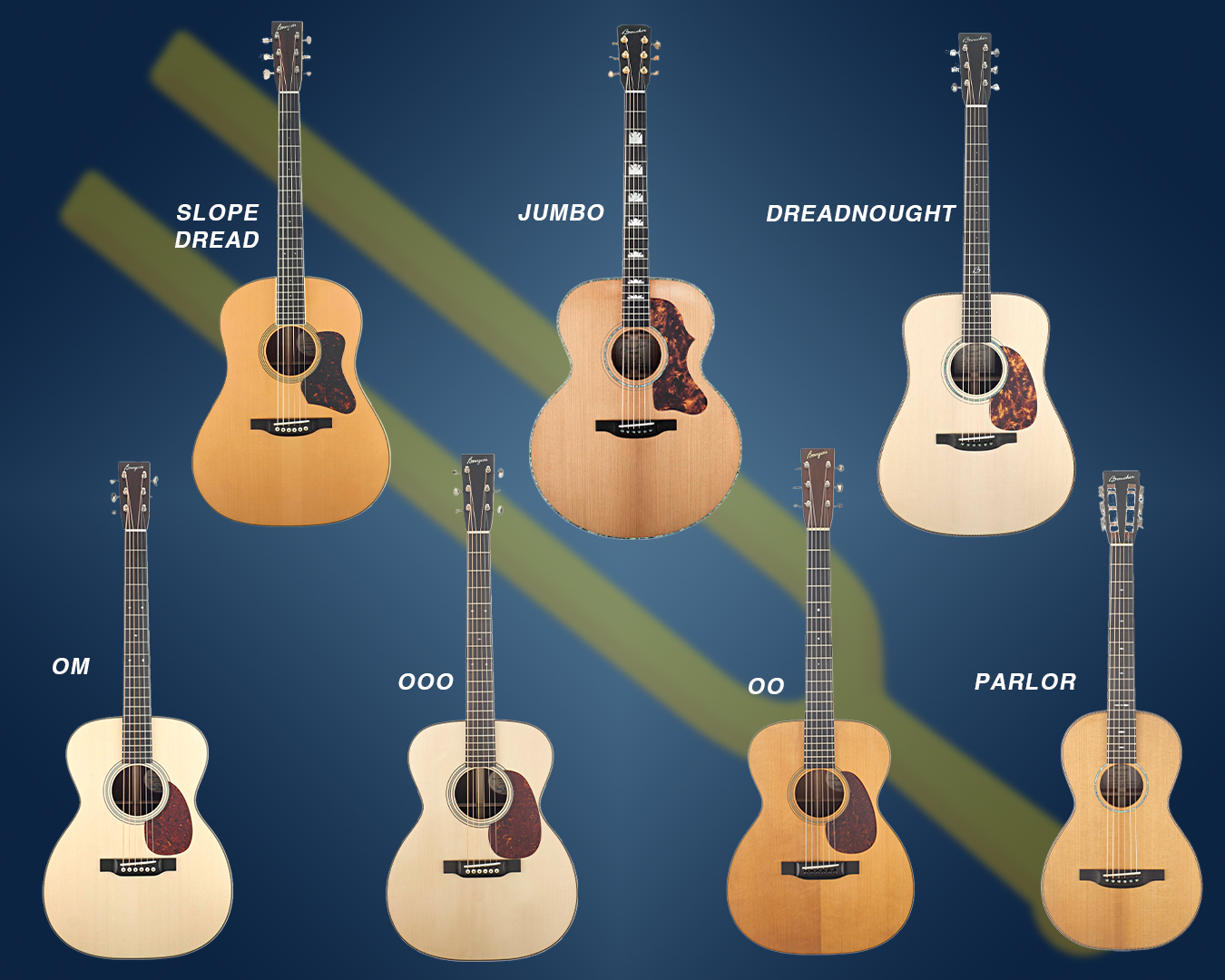
Common acoustic body styles include:
• Dreadnought: A large, square shaped body with strong bass and loud volume.
• Jumbo: A very large body that produces a rich and powerful sound.
• Concert: A medium body that balances comfort, volume, and tone.
• Auditorium: A versatile shape with a curving waist and balanced sound.
• Parlor: A smaller body that is easy to hold and often has a warm, focused tone.
A dreadnought may feel large against the chest and right arm. A parlor guitar may be easier for a smaller player, even though its neck can still have a normal scale length.
Electric guitars
Most electric guitars are about 38 to 41 inches long. Their bodies are often thinner than acoustic guitars, usually around 1.25 to 2 inches deep.
Electric guitars may feel smaller because they are lighter and slimmer. However, some models have long necks, large headstocks, or extended scale lengths. A guitar with a thin body can still feel long when you hold it while standing.
Classical guitars
A full size classical guitar is usually around 36 to 39 inches long. Its body is often slightly smaller than a dreadnought acoustic, but its neck is wider.
Classical guitar necks commonly measure about 2 inches wide at the nut. This gives the fingers more space for fingerstyle playing, but it can feel difficult for young players or people with small hands.
Bass guitars
A bass guitar is usually 44 to 48 inches long. It also has a longer neck and larger scale length than a standard guitar.
Most basses use a scale length of 30 to 35 inches. This longer scale helps the strings produce low notes, but it also increases reach and overall weight.

Guitar Dimensions Explained
Knowing the main guitar dimensions makes it easier to compare instruments. When someone asks, “How big is a guitar?” they may be asking about total length, body size, neck length, or playing scale.
Total length
Total length is measured from the lowest point of the body to the top of the headstock. It includes the body, neck, and headstock.
This measurement is useful when you need to store or transport a guitar. It does not always show how comfortable the instrument will feel while playing.
Body width
Body width is measured across the widest part of the guitar body. This measurement has a strong effect on comfort.
A wide jumbo guitar may sound large and full, but it can feel bulky for a smaller player. A narrow electric guitar may be easier to hold, yet its long neck can still require a wide reach.
Body depth
Body depth is the distance from the front of the guitar to the back. Deep bodies can produce more air movement and a fuller acoustic sound.
Thin electric guitars usually have less body depth. Some acoustic guitars also use thin body designs for players who want better comfort while standing.
Scale length
Scale length is the distance from the nut to the saddle, doubled in a standard measurement. It describes the vibrating length of the strings.
Scale length affects:
• How far the frets are spaced
• How tight the strings feel
• How easy it is to bend notes
• How much hand stretch is needed
A shorter scale guitar can feel easier for a beginner. A longer scale guitar may offer stronger string tension and a firm playing feel.
Neck width
Neck width matters more than many new players expect. A narrow neck may suit rock, pop, and basic chord playing. A wider neck can help with fingerstyle music but may require more finger control.

Guitar Sizes for Adults and Children
Guitar sizes are often described as full size, 3/4 size, 1/2 size, and 1/4 size. These labels usually refer to the overall design and scale length, not only the guitar’s total length.
Full size guitars
A full size guitar is made for most adults and older teens. It commonly has a scale length between 24.75 and 25.5 inches.
A full size acoustic guitar may feel large at first. Most players adjust after a few practice sessions, especially when they learn to sit upright and support the instrument correctly.
3/4 size guitars
A 3/4 size guitar is smaller and often measures 34 to 36 inches long. Its scale length may be between 22 and 24 inches.
This size works well for:
• Children around 8 to 12 years old
• Smaller teens
• Adults who want a compact travel guitar
• Players who find full size guitars uncomfortable
A 3/4 guitar is not just a toy. Many compact instruments have good sound, reliable tuning, and comfortable necks.
1/2 size guitars
A 1/2 size guitar is usually about 30 to 34 inches long. It often has a scale length between 19 and 22 inches.
This size can suit younger children who cannot comfortably reach the first position on a full size guitar. The exact choice should depend on the child’s arm length and hand size, not age alone.
1/4 size guitars
A 1/4 size guitar may measure 28 to 31 inches long. It is designed for very young players and usually has a short scale length.
These guitars can help a child learn basic posture and finger placement. However, a poor quality small guitar may be hard to tune, so build quality still matters.
Travel guitars
Travel guitars vary in size. Some use a short scale, while others keep a nearly normal scale length but reduce the body size.
They are useful for road trips, airplanes, and small apartments. Before buying one, check the neck size and case measurements because travel guitar designs are not standardized.

How to Choose the Right Guitar Size
The right guitar size should feel stable, comfortable, and easy to play. A guitar that is too large can make simple chords feel tiring. A guitar that is too small may feel cramped or produce less volume.
Use these steps when choosing:
Sit in your normal playing position.
Rest the guitar on your leg without squeezing it tightly.
Check whether your strumming arm reaches the sound hole easily.
Make sure your fretting hand can reach the first few frets.
Keep your shoulders relaxed.
Test a few basic chords, such as G, C, D, and E minor.
Play for at least five minutes before deciding.
A good guitar should not force your wrist into a sharp bend. Your thumb should rest naturally behind the neck, and your upper arm should not feel strained.
For children, measure the distance from the player’s shoulder to the palm. This can offer a better guide than age. Children grow quickly, so buying the largest comfortable guitar may provide more playing time than choosing a very small model.
How to Measure a Guitar Correctly
You can measure a guitar at home with a tape measure. Place the instrument on a soft surface to avoid scratches.
Measure total length
Measure in a straight line from the bottom edge of the body to the highest point of the headstock. Do not follow the curves of the guitar.
This tells you how big the guitar is for storage and transport.
Measure body width
Measure across the widest part of the body. On many guitars, this point is near the lower bout.
Write down the width in inches and centimeters. This helps when comparing body shapes or checking whether a guitar will fit comfortably against your body.
Measure body depth
Measure the body at its thickest point. For an acoustic guitar, avoid including the bridge or other parts that stick out from the surface.
Measure scale length
Measure from the front edge of the nut to the center of the 12th fret. Double that number for an approximate scale length.
For example, if the distance to the 12th fret is 12.75 inches, the scale length is about 25.5 inches.
Measure the case
A guitar case is usually a little larger than the instrument. Measure the guitar before buying a replacement case, and check:
• Total length
• Lower bout width
• Upper bout width
• Body depth
• Neck length
My most common practical mistake has been assuming that a case labeled “standard acoustic” will fit every acoustic guitar. Jumbo, dreadnought, classical, and parlor shapes often need different cases.

Why Guitar Size Affects Sound and Comfort
Guitar size changes both the playing experience and the sound. A larger acoustic body usually moves more air, which can create louder volume and stronger low tones.
A smaller body often gives a focused sound with clear mids and highs. It may also be easier to control for fingerstyle playing, recording, or quiet practice.
The main benefits of a larger guitar include:
• More acoustic volume
• Stronger bass response
• A fuller sound for strumming
• More projection in group settings
The main benefits of a smaller guitar include:
• Better comfort for smaller players
• Easier travel
• Less strain on the shoulder and arm
• A more controlled sound
Size does not determine quality. A well made small guitar can sound better than a poorly made large guitar. Wood choice, bracing, setup, strings, and construction all influence tone.
Electric guitar size affects balance and weight more than acoustic volume. The shape of the body, location of the strap buttons, and thickness of the neck can make one electric guitar feel much more comfortable than another.

Common Guitar Size Mistakes to Avoid
Many buyers focus only on total length. That can lead to an instrument that looks suitable on paper but feels uncomfortable in real use.
Avoid these common mistakes:
• Choosing a guitar only by age recommendations
• Ignoring body depth
• Confusing scale length with total guitar length
• Buying a case without measuring the instrument
• Assuming a smaller guitar always has a narrow neck
• Choosing a large guitar for volume when comfort is poor
• Forgetting that a guitar’s weight affects standing posture
A guitar should support your learning, not make every practice session feel like a workout. If your shoulder aches, your wrist bends sharply, or you struggle to reach the first fret, try a different shape or scale.
A professional setup can also improve comfort. Lowering the action slightly, adjusting the neck, or using lighter strings may make a guitar easier to play. These changes cannot fix every size problem, but they can help fine tune a good fit.

Guitar Size Chart in Inches and Centimeters
Some players prefer centimeters, especially when comparing instruments from different countries. The following chart gives useful approximate ranges.
| Guitar size | Approximate length | Approximate length in centimeters | Common player |
|---|---|---|---|
| 1/4 size | 28 to 31 inches | 71 to 79 cm | Very young children |
| 1/2 size | 30 to 34 inches | 76 to 86 cm | Young children |
| 3/4 size | 34 to 36 inches | 86 to 91 cm | Older children and smaller players |
| Full size classical | 36 to 39 inches | 91 to 99 cm | Teens and adults |
| Full size acoustic | 38 to 42 inches | 97 to 107 cm | Teens and adults |
| Electric guitar | 38 to 41 inches | 97 to 104 cm | Teens and adults |
| Bass guitar | 44 to 48 inches | 112 to 122 cm | Teens and adults |
These ranges can overlap. A 3/4 guitar from one brand may be close in length to a compact full size guitar from another brand.
Always check the manufacturer’s specifications when exact measurements matter. Product names are not universal standards, and body shapes vary widely.
Frequently Asked Questions About How Big Is a Guitar
How big is a full size guitar?
A full size guitar is usually 38 to 42 inches long. Its exact size depends on whether it is an acoustic, electric, classical, or jumbo model.
How big is a guitar for an adult?
Most adults can use a full size guitar comfortably. Smaller adults may prefer a concert, parlor, travel, or 3/4 size guitar with a shorter scale.
How big is a 3/4 size guitar?
A 3/4 size guitar is commonly 34 to 36 inches long. It usually has a scale length between 22 and 24 inches.
How big is a guitar for a child?
Children often use a 1/4, 1/2, or 3/4 size guitar. The best choice depends on arm reach, hand size, posture, and comfort rather than age alone.
Is an electric guitar smaller than an acoustic guitar?
An electric guitar may have a thinner and narrower body, but its total length is often similar to an acoustic guitar. Its lighter weight can make it feel smaller in use.
How long is a guitar case?
A guitar case is usually a few inches longer and wider than the guitar itself. Many acoustic guitar cases measure about 40 to 44 inches long, but the correct case depends on the body shape.
Does guitar size affect sound?
Yes. Larger acoustic guitars often produce more volume and bass, while smaller guitars tend to have a focused and balanced tone. Wood, bracing, strings, and setup also affect sound.
Conclusion
So, how big is a guitar? Most full size guitars measure between 36 and 42 inches long, while smaller guitars may range from 28 to 36 inches. The body width, depth, neck width, and scale length are just as important as total length.
Choose the guitar that lets you sit, stand, reach, and play without strain. Measure the instrument before buying a case, and test several body shapes if possible. Explore local music stores, compare manufacturer specifications, and share your guitar size questions in the comments.