

Introduction
If you are asking, “What piano chord is this?” you need to know the notes that are being played. A chord name comes from its root, interval pattern, and any added or altered notes. If you share a clear photo, note list, or short recording, the chord can usually be identified in a few steps.
For example, the notes C–E–G form a C major chord. The notes A–C–E–G form A minor 7. The same notes can look different on the keyboard when they are rearranged, but the chord name may stay the same.
This guide shows how to identify a piano chord by sight or sound. It also explains inversions, slash chords, seventh chords, suspended chords, and common mistakes.

The Quick Answer: How Do You Identify a Piano Chord?
To identify a piano chord, write down every note, move the notes into root position, and compare the note pattern with a chord formula.
Use this process:
- List the notes from low to high.
- Find possible root notes.
- Measure the intervals above each possible root.
- Match the pattern to a chord type.
- Check whether the chord is inverted.
- Add a slash chord name if the bass note differs from the root.
For example:
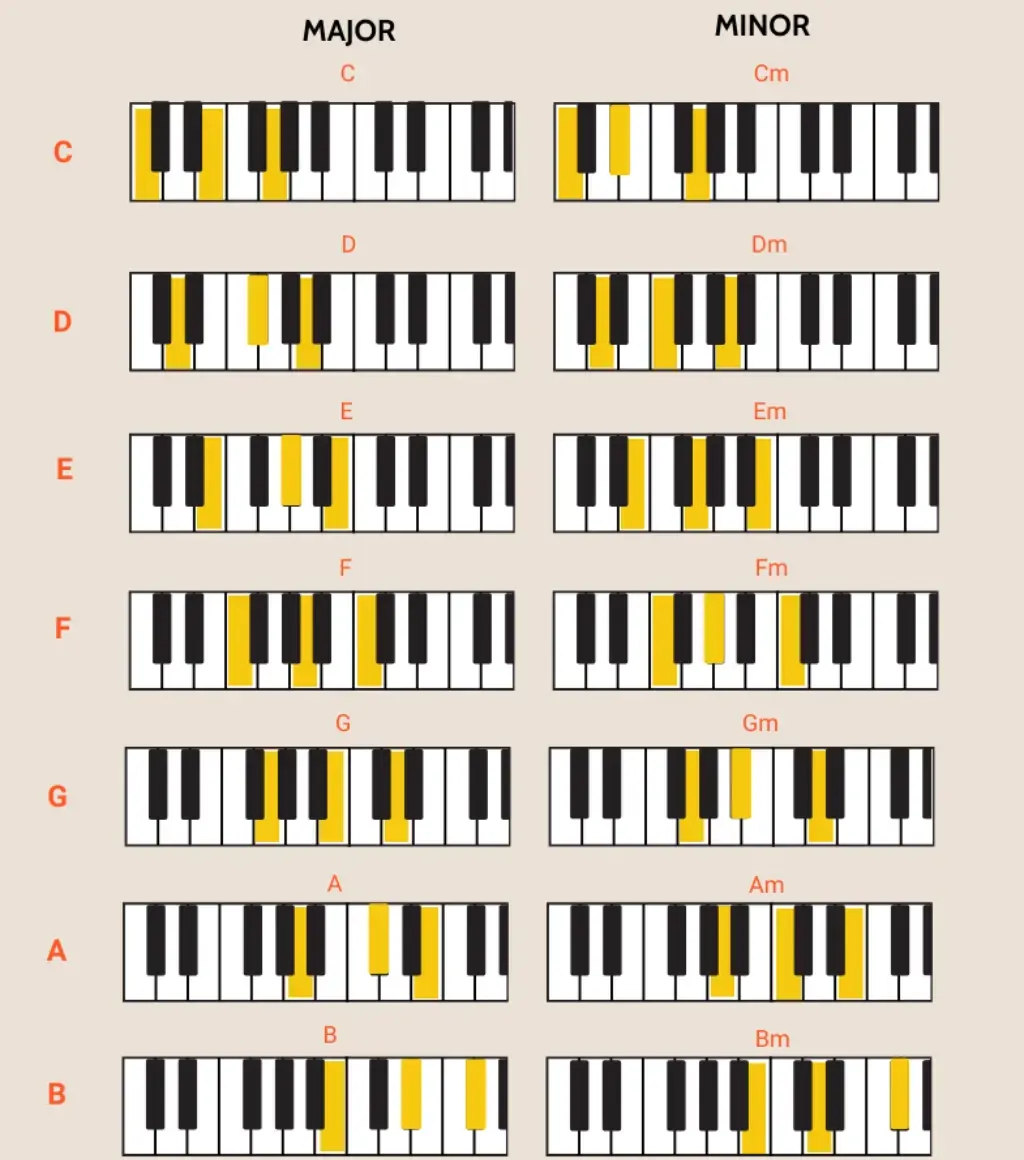
| Notes played | Chord name | Why |
|---|---|---|
| C–E–G | C major | Root, major third, perfect fifth |
| C–E♭–G | C minor | Root, minor third, perfect fifth |
| C–E–G–B♭ | C7 | Major triad plus minor seventh |
| D–F–A–C | D minor 7 | Minor triad plus minor seventh |
| G–C–D | Gsus4 | The third is replaced by the fourth |
| C–G–C–E | C major, second inversion | C major notes with G in the bass |
The lowest note is useful, but it does not always tell you the root. In an inversion, the bass note is a chord tone other than the root.
What Is a Piano Chord?
A piano chord is a group of two or more different notes played at the same time. Most common chords use three or four notes, though some use five or more.
A chord’s name normally tells you three things:
- The root: The note that gives the chord its main name.
- The quality: Major, minor, diminished, augmented, suspended, or another type.
- The added tones: Such as a seventh, ninth, or sixth.
For example, Fmaj7 means:
- F is the root.
- Major describes the main triad.
- 7 adds a major seventh above F.
The notes are F–A–C–E.
A chord symbol may also show a different bass note. C/E means “C chord with E in the bass.” The chord is still based on C, but E is the lowest note.
Chords and intervals
An interval is the distance between two notes. Chord identification depends on these distances more than on the physical shape of the chord on the keyboard.
Starting from C:
- C to E is a major third.
- C to E♭ is a minor third.
- C to G is a perfect fifth.
- C to B♭ is a minor seventh.
- C to B is a major seventh.
The same interval pattern can begin on any note. A major triad always uses:
Root + major third + perfect fifth
that gives:
- C–E–G
- D–F♯–A
- E–G♯–B
- F–A–C

How to Identify a Chord From Piano Notes
Step 1: Write down all the notes
Start with the notes from the piano, written from lowest to highest.
For example:
G–C–E
Do not assume that G is the root just because it is the lowest note. The notes G, C, and E are the same pitch collection as C–E–G.
Also check for notes in other octaves. If the piano plays C2, G2, C3, and E3, the repeated C and G do not create a new chord type. They add thickness and change the voicing.
Step 2: Remove repeated notes
Repeated notes usually do not change the chord name.
These notes:
C–G–C–E–G
are still a form of C major. The repeated C and G affect the sound, but not the basic chord quality.
Keep track of the lowest note, though. It may help you identify an inversion or slash chord.
Step 3: Test each note as the possible root
Try building a chord from each note in the set.
Suppose the notes are:
A–C–E–G
If A is the root, the pattern is:
- A to C: minor third
- A to E: perfect fifth
- A to G: minor seventh
That gives A minor 7, written Am7.
If you instead treat C as the root, the pattern does not form one of the most common simple chord shapes. A is the stronger root choice.
Step 4: Compare the intervals with a chord formula
Use common formulas as a reference:
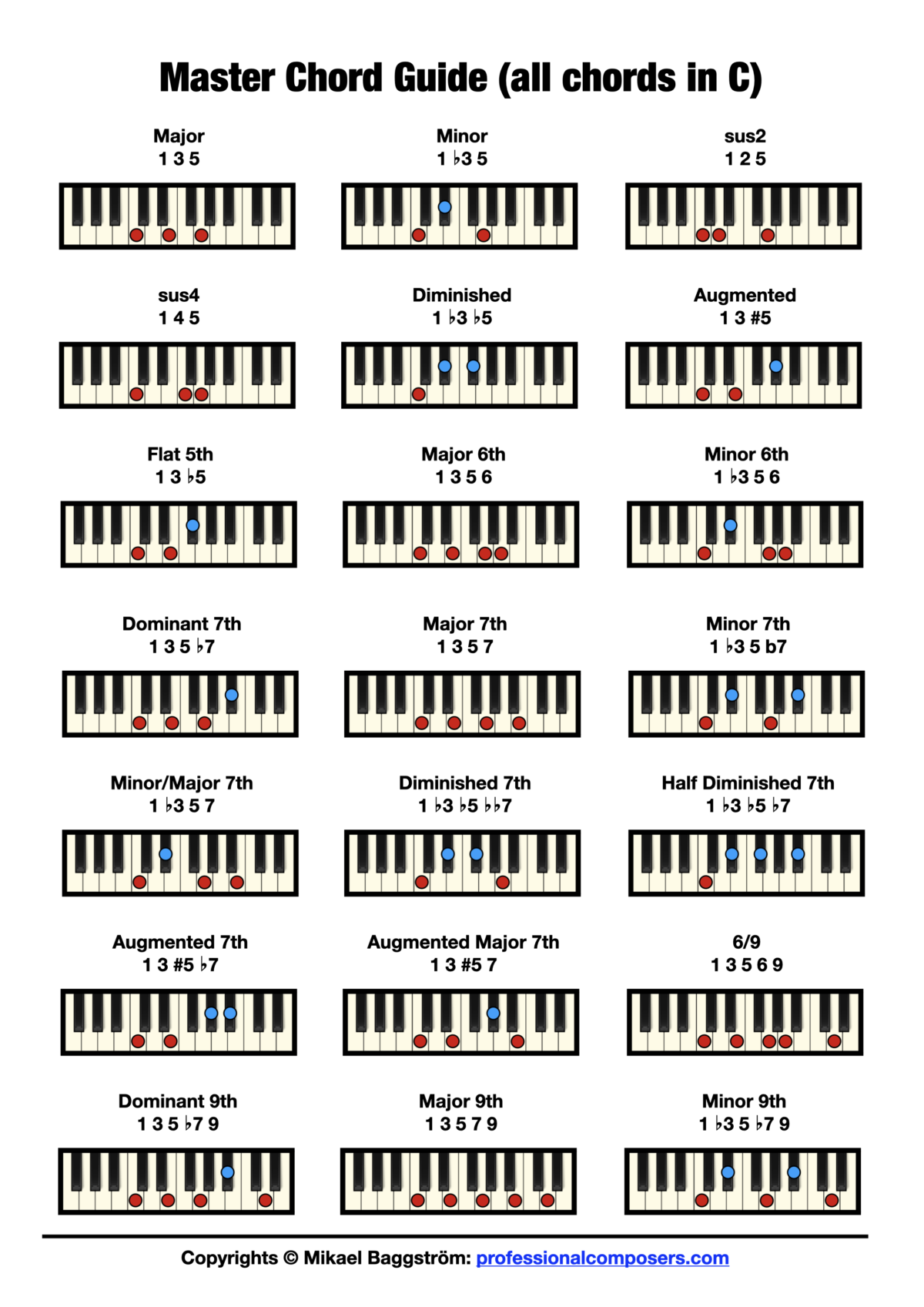
| Chord type | Formula above the root | Example |
|---|---|---|
| Major | 1–3–5 | C–E–G |
| Minor | 1–♭3–5 | C–E♭–G |
| Diminished | 1–♭3–♭5 | C–E♭–G♭ |
| Augmented | 1–3–♯5 | C–E–G♯ |
| Suspended 2 | 1–2–5 | C–D–G |
| Suspended 4 | 1–4–5 | C–F–G |
| Dominant 7 | 1–3–5–♭7 | C–E–G–B♭ |
| Major 7 | 1–3–5–7 | C–E–G–B |
| Minor 7 | 1–♭3–5–♭7 | C–E♭–G–B♭ |
| Half-diminished 7 | 1–♭3–♭5–♭7 | C–E♭–G♭–B♭ |
| Diminished 7 | 1–♭3–♭5–♭♭7 | C–E♭–G♭–A |
The numbers refer to scale degrees above the root. A flat sign lowers a note by one semitone. A sharp sign raises it by one semitone.
Step 5: Name the inversion
If the notes are rearranged, the chord may be inverted.
For a C major triad:
- C–E–G: root position
- E–G–C: first inversion
- G–C–E: second inversion
All three use the same notes. They are different voicings of C major.
If the bass note has special importance, write the chord as a slash chord:
- C/E: C major with E in the bass
- C/G: C major with G in the bass
A slash chord can describe the bass clearly without changing the main chord name.
Common Piano Chord Types and Their Sounds
Major chords
Major chords often sound bright, stable, or open. Their formula is:
1–3–5
Examples include:
- C major: C–E–G
- D major: D–F♯–A
- A major: A–C♯–E
The major third is the note that gives the chord much of its major sound.
Minor chords
Minor chords often sound darker or more reflective. Their formula is:
1–♭3–5
Examples include:
- A minor: A–C–E
- E minor: E–G–B
- D minor: D–F–A
To change a major chord into a minor chord, lower its third by one semitone.
For example:
- C major: C–E–G
- C minor: C–E♭–G
Diminished chords
A diminished triad uses:
1–♭3–♭5
C diminished contains:
C–E♭–G♭
The lowered third and lowered fifth create a tense sound. Diminished chords often move toward another chord, but their exact role depends on the key and musical setting.
Augmented chords
An augmented triad uses:
1–3–♯5
C augmented contains:
C–E–G♯
The raised fifth gives the chord a wide, unsettled sound. Augmented chords can act as passing or dominant-color chords.
Suspended chords
A suspended chord replaces the third with another note.
- Csus2: C–D–G
- Csus4: C–F–G
Because the third is missing, the chord may sound neither clearly major nor clearly minor. The third often appears later to resolve the tension.
Seventh chords
A seventh chord adds a seventh above a triad.
Common examples include:
- C7: C–E–G–B♭
- Cmaj7: C–E–G–B
- Cm7: C–E♭–G–B♭
- Cm7♭5: C–E♭–G♭–B♭
- Cdim7: C–E♭–G♭–A
The symbol 7 without “major” usually means a dominant seventh chord. Thus, C7 and Cmaj7 are not the same chord.

How to Tell Which Chord You Hear
Identifying a chord by ear takes practice, but a fixed process makes it easier.
Listen for the bass note
The lowest note often gives a strong clue. Play or sing that note by itself, then test whether the other notes fit above it.
This method works well when the chord is in root position. It can mislead you when the chord is inverted or when a bass note is not part of the main chord.
Listen for the third
The third often tells you whether a triad is major or minor.
- A major third points toward a major chord.
- A minor third points toward a minor chord.
- No third may indicate a suspended chord, a power chord, or an incomplete voicing.
For C:
- C–E suggests C major.
- C–E♭ suggests C minor.
- C–G without E or E♭ may be C5, often called a power chord.
Listen for tension notes
A seventh, flat fifth, sharp fifth, or suspended note can make the chord easier to classify.
For example:
- C–E–G–B♭ strongly suggests C7.
- C–E–G–B strongly suggests Cmaj7.
- C–E♭–G♭ suggests C diminished.
- C–F–G suggests Csus4.
Compare the chord to a keyboard
If you can play the suspected root, try each chord type above it. Listen for the version that matches all the notes you hear.
Do not rely only on the chord’s mood. A “sad” sound is not proof that a chord is minor. Tempo, register, voicing, dynamics, and the surrounding music can change how the same chord feels.

How to Identify a Chord From a Photo or Chord Chart
A photo of piano keys can help, but the image must show enough detail.
Look for:
- Every depressed key
- The lowest note
- Any pedal use
- Notes hidden by the player’s hand
- The octave of each note
- Whether the photo shows one chord or several moments
If the image shows only the fingers, the chord may be uncertain. One finger can cover a key, and a pedal can allow earlier notes to continue ringing.
For sheet music, read the notes vertically. Notes stacked at the same time form the chord. Then check the key signature before naming accidentals.
For a chord chart, symbols such as these provide direct information:
- G: G major
- Gm: G minor
- G7: G dominant seventh
- Gmaj7: G major seventh
- G/B: G major with B in the bass
- Gadd9: G major with an added ninth
- G9: Usually a dominant seventh chord with an added ninth
The exact meaning of a symbol can vary by style. In jazz, pop, classical, and church music, musicians may use different voicing habits even when the chord symbol is the same.

Why One Set of Notes Can Have More Than One Chord Name
Some note groups have more than one reasonable name. The best choice depends on the bass, key, melody, and musical function.
Enharmonic spellings
On a standard piano, F♯ and G♭ use the same key. They are enharmonic equivalents, but they may have different roles in written music.
For example:
- C–E–G♯ is C augmented.
- C–E–A♭ may be understood differently in a musical passage.
The sound alone may not reveal the correct spelling. The key and surrounding chords often decide it.
Incomplete chords
A chord may omit its fifth, root, or even third.
For example:
- C–E may suggest C major without the fifth.
- E–G–B may be an E minor chord.
- G–B–D–F without the root G can still function as G7.
When notes are missing, several names may fit. Context becomes essential.
Polychords and layered sounds
Two chords played together can create a complex sonority. For example, a pianist may play a simple triad in the left hand and another triad in the right hand.
Do not force every sound into one basic chord name. It may be clearer to describe the layers separately.
Context changes the answer
A group of notes can serve different functions in different keys. For example, the notes C–E–G may be:
- C major in the key of C
- The IV chord in the key of G
- The VI chord in the key of E minor
- Part of a larger passing harmony
The chord name usually stays C major, but its musical function changes.
A Reliable Chord-Identification Worksheet
Use this short worksheet when a chord is hard to name.
Notes heard:
Write every different note.
Lowest note:
Write the bass note separately.
Possible roots:
Test each note as the root.
Third:
Is it major, minor, or missing?
Fifth:
Is it perfect, lowered, raised, or missing?
Seventh or added tone:
Check for sixths, sevenths, ninths, and other notes.
Inversion:
Does the bass differ from the root?
Context:
What key, melody, or chord comes before and after it?
Likely name:
Write the simplest accurate symbol.
Example
Suppose you hear:
E–G–C
The lowest note is E. Test C as the root:
- C to E is a major third.
- C to G is a perfect fifth.
The notes form C major. Since E is in the bass, the best name is:
C/E
If the music clearly uses a C major chord but the bass moves through E, the slash-chord name gives more useful information than simply writing C.
Common Mistakes When Naming Piano Chords
Mistake 1: Calling the lowest note the root
The lowest note may be the root, but it may also be the third or fifth.
Fix: Rearrange the notes mentally and test each possible root.
Mistake 2: Confusing C7 with Cmaj7
These chords differ by one note:
- C7: C–E–G–B♭
- Cmaj7: C–E–G–B
The word “major” applies to the seventh in Cmaj7, not just to the main triad.
Mistake 3: Ignoring missing notes
A piano voicing may leave out the fifth or root. This does not always mean the chord is a different type.
Fix: Use the key and nearby chords to fill in the likely harmony.
Mistake 4: Naming a chord by emotion alone
“Happy,” “sad,” and “mysterious” are useful listening impressions, not chord formulas.
Fix: Count intervals and identify the third.
Mistake 5: Treating every note as part of the chord
A melody note may sound at the same time as a chord without belonging to the chord symbol.
Fix: Separate sustained harmony from passing or melodic notes.
Mistake 6: Adding too much detail to the name
A simple triad does not need a long label. Use the shortest name that describes the sound accurately.
For instance, C–E–G is normally C, not an elaborate description of every interval.
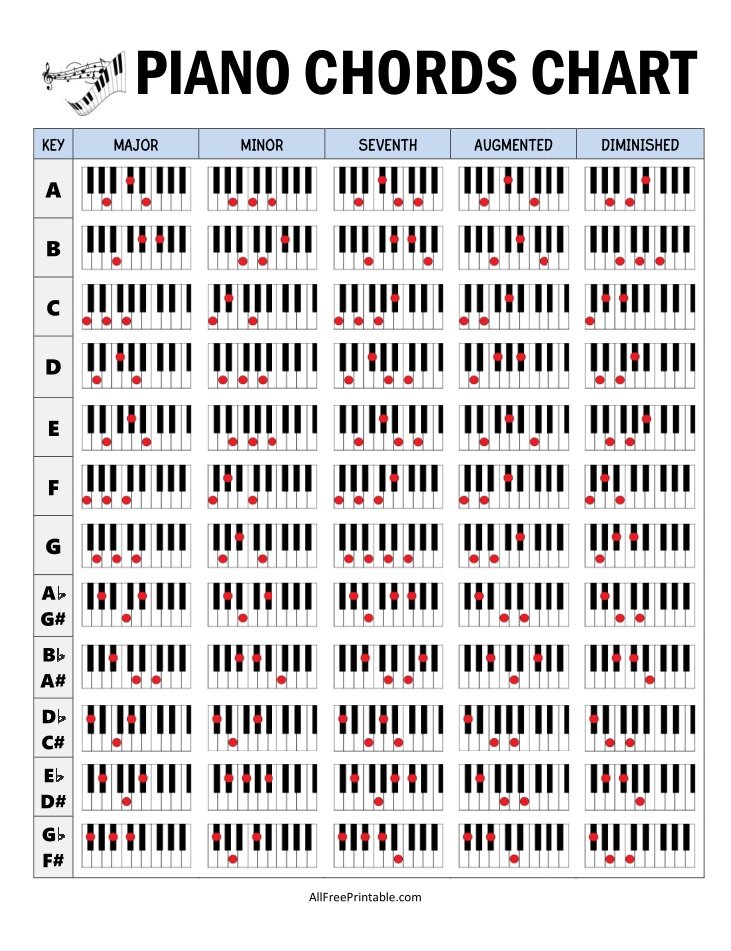
Piano Chord Identifier Tools: What They Can and Cannot Do
Chord-recognition software can help when you provide a clear recording or MIDI file. Some tools also let you click piano keys to see possible chord names.
These tools are most useful when:
- The notes are clear.
- The recording has little background noise.
- One chord is sounding at a time.
- The instrument is tuned close to standard pitch.
- The harmony is not heavily altered.
They may struggle with:
- Pedal resonance
- Fast chord changes
- Arpeggios
- Dense jazz voicings
- Missing roots
- Added melody notes
- Two instruments playing different notes
- Recordings with strong room noise
Treat an automatic result as a starting point, not final proof. Compare it with the bass, key, chord progression, and written notation.
A MIDI piano roll can be more reliable than an audio tool because it shows the exact note events. Even then, the musical meaning may remain uncertain if the chord is incomplete or layered.

Frequently Asked Questions
What is the easiest way to find a piano chord name?
Write down the notes, remove duplicates, and test each note as the root. Then compare the intervals with major, minor, seventh, diminished, augmented, and suspended formulas.
Can I identify a chord from only two piano notes?
Sometimes. Two notes can strongly suggest part of a chord, but they may not provide enough information for a unique name. For example, C and E could belong to C major, A minor, F major 7, or another voicing.
Does the lowest piano note name the chord?
No. The lowest note is the bass. It names the chord only when it is also the root. Otherwise, the chord may be inverted or written as a slash chord.
What is the difference between a chord and an inversion?
A chord describes the notes and their interval pattern. An inversion changes which chord note is in the bass. C–E–G and E–G–C are both C major, but the second is a first inversion.
Why do chord apps give different answers?
Apps may interpret the bass, spelling, missing notes, and musical context in different ways. A chord can also have more than one valid name. Check the surrounding key and progression before choosing a final label.
Final Takeaway
To answer “what piano chord is this,” start with the notes, not the hand shape or lowest key. Find the likely root, measure the intervals, identify the chord quality, and then check for an inversion or slash chord.
The fastest practical method is:
- List the notes.
- Remove repeated notes.
- Test each note as the root.
- Match the interval pattern.
- Check the bass and musical context.
For further study, the open music theory lessons on triads and seventh chords explain the interval formulas behind common chord names.