

Introduction
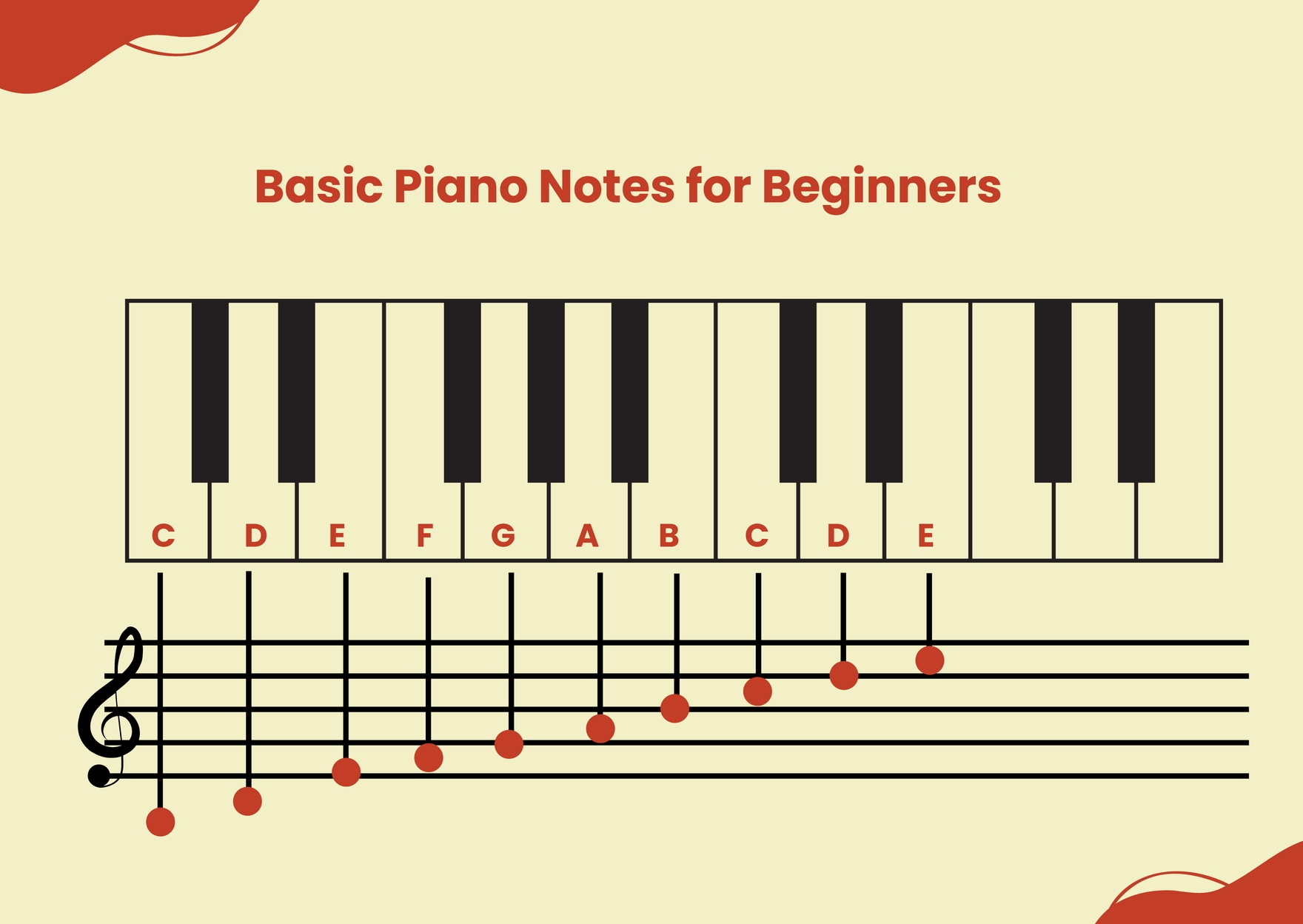
To play piano notes, find the correct key, use the right finger, and press the key with a relaxed hand. On a standard 88-key piano in the United States, the white keys use the letters A, B, C, D, E, F, and G. The pattern then repeats across the keyboard.
The fastest way to learn is to use the black-key groups as landmarks. Two black keys help you find C. Three black keys help you find F. Once you can find C, you can name every nearby white key and begin playing simple songs.
This guide explains how piano notes work, how to read them, where to place your fingers, and how to fix common mistakes.

Learn the Piano Key Pattern
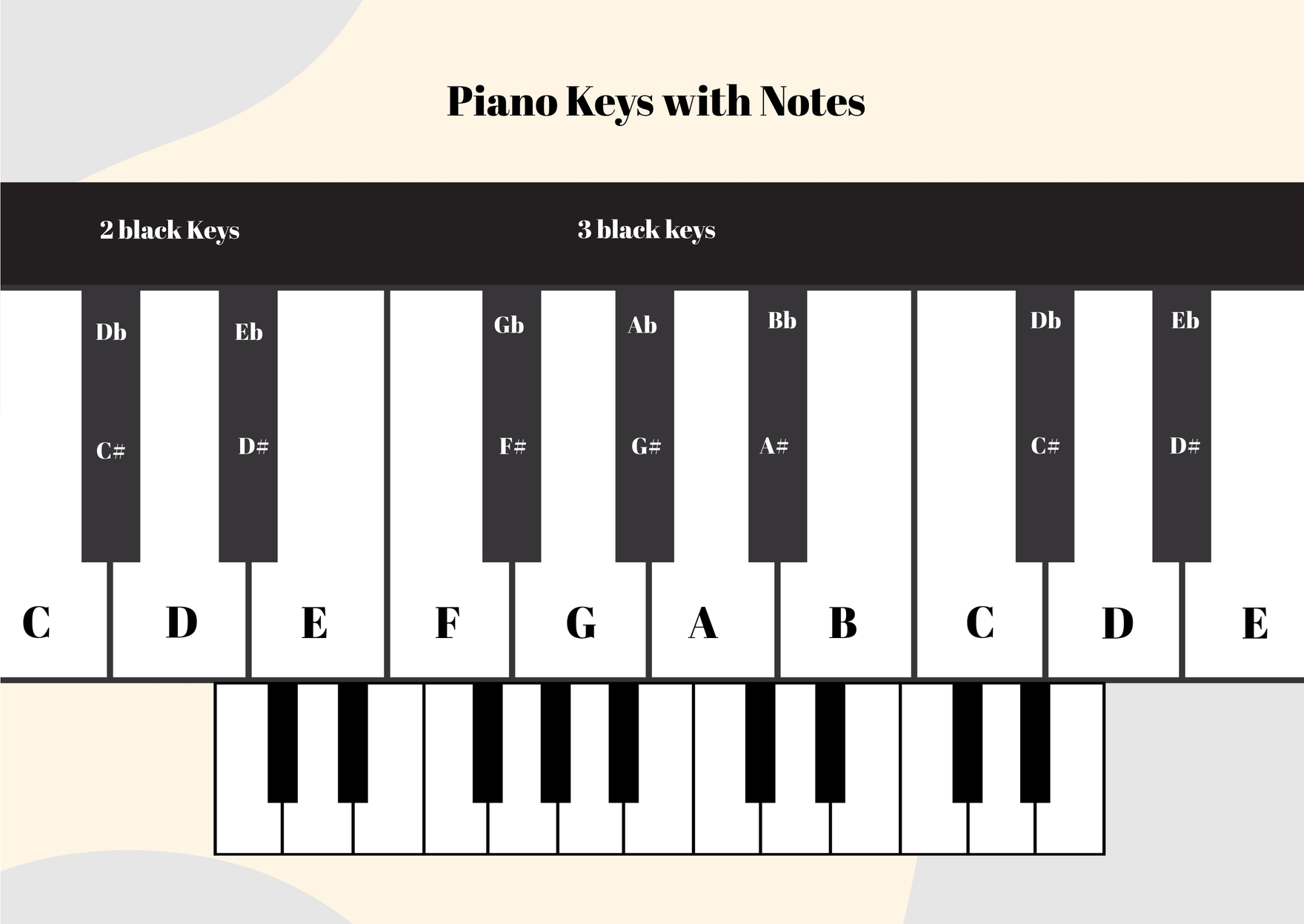
A piano keyboard has a repeating pattern of seven white notes and five black notes. The white notes are:
A – B – C – D – E – F – G
After G, the pattern starts again at A.
The black keys have two names. For example, the black key between C and D is called either:
- C-sharp (C♯)
- D-flat (D♭)
These names describe the same key on a piano. The name depends on the musical key or scale being used.
Use the black keys as landmarks
The black keys appear in groups of two and three:
- The group of two black keys sits above C and D
- The group of three black keys sits above F, G, and A
To find C, look at any group of two black keys. The white key directly to the left is C.
To find F, look at any group of three black keys. The white key directly to the left is F.
This pattern works on almost every standard piano and digital keyboard.
Name the white keys
Once you find C, move from left to right:
| Key position | Note |
|---|---|
| Left of the two black keys | C |
| Between the two black keys | D |
| Right of the two black keys | E |
| Left of the three black keys | F |
| Between the first and second black keys | G |
| Between the second and third black keys | A |
| Right of the three black keys | B |
Then the next white key is C again.
Find middle C
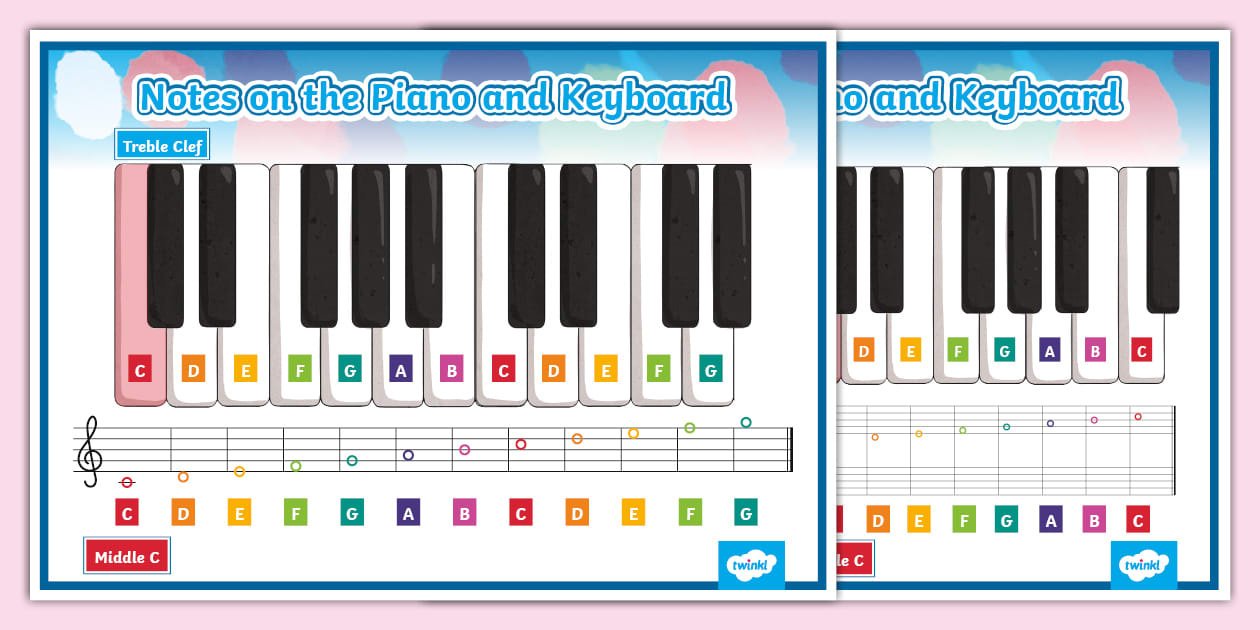
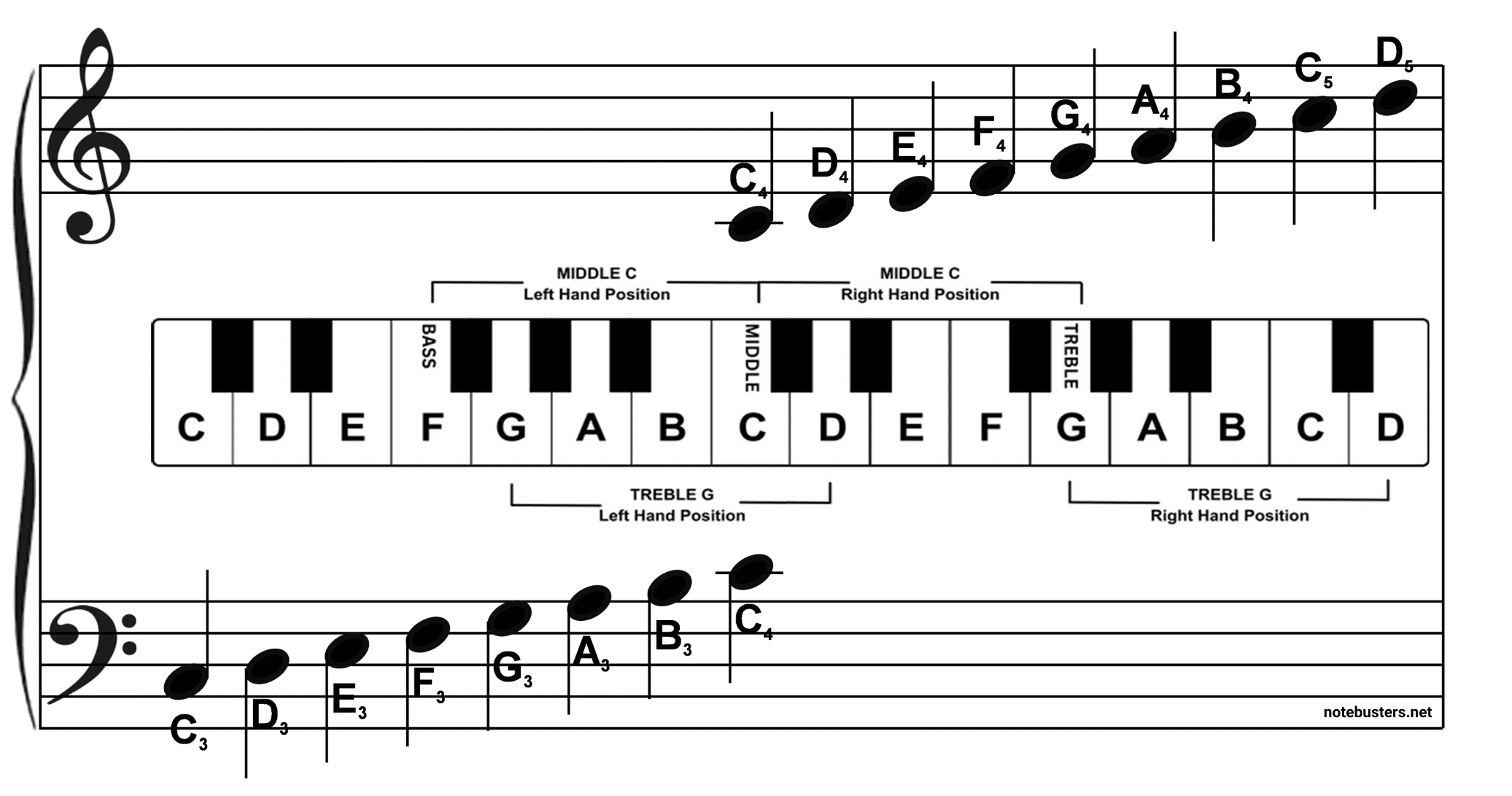
Middle C is the C near the center of the keyboard. On an 88-key piano, it is usually the 40th key from the left. It is also known as C4 in scientific pitch notation.
Middle C is a useful starting point because beginner songs, exercises, and piano methods often use it as a central reference.
Sit in front of the keyboard and find the group of two black keys near the middle. The white key just to the left is middle C.

Play Your First Piano Notes
Start with one hand. The right hand is often easier for first exercises because many beginner lessons begin near middle C.
Number your fingers
Piano finger numbers are the same for both hands:
- Thumb = 1
- Index finger = 2
- Middle finger = 3
- Ring finger = 4
- Little finger = 5
place your right thumb on middle C. Let your other fingers rest on the next four white keys:
| Finger | Note |
|---|---|
| Right thumb, 1 | C |
| Right index finger, 2 | D |
| Right middle finger, 3 | E |
| Right ring finger, 4 | F |
| Right little finger, 5 | G |
Press each key one at a time. Keep your fingers curved and your wrist level.
Use a relaxed hand shape
Your hand should look as if it is holding a small ball. Do not flatten your fingers. Do not lift each finger high before pressing.
Use the soft part of your fingertip, not the flat part of your finger. Press down with control, then let the key return before playing the next note.
Your shoulders should stay loose. If your hand, wrist, or arm begins to hurt, stop and rest. Short, relaxed practice is better than forcing a long session.
Practice a five-note pattern
Play these notes slowly:
C – D – E – F – G – F – E – D – C
Use these right-hand fingers:
1 – 2 – 3 – 4 – 5 – 4 – 3 – 2 – 1
Try to make each note the same volume. Start at a slow speed. Accuracy matters more than speed.
Add the left hand
For the left hand, place the little finger on C and the thumb on G:
| Finger | Note |
|---|---|
| Left little finger, 5 | C |
| Left ring finger, 4 | D |
| Left middle finger, 3 | E |
| Left index finger, 2 | F |
| Left thumb, 1 | G |
Play the same five-note pattern with the left hand:
C – D – E – F – G – F – E – D – C
The finger numbers are reversed because the left hand moves toward the right with its thumb.
Understand Whole Steps and Half Steps
A half step is the smallest distance between two adjacent piano keys. A whole step equals two half steps.
On a piano:
- C to C♯ is a half step
- C♯ to D is a half step
- C to D is a whole step
- E to F is a half step
- B to C is a half step
Notice that E and F have no black key between them. The same is true for B and C.
Sharp notes
A sharp raises a note by one half step.
Examples:
- C becomes C♯
- F becomes F♯
- G becomes G♯
On the keyboard, C♯ is the black key just above and to the right of C.
Flat notes
A flat lowers a note by one half step.
Examples:
- D becomes D♭
- G becomes G♭
- A becomes A♭
The black key between C and D can be called C♯ or D♭. These are called enharmonic notes because they sound the same on a standard piano but have different names in written music.
Natural notes
A natural is a white key without a sharp or flat sign. The notes C, D, E, F, G, A, and B are natural notes.
A natural sign, written as ♮, cancels a sharp or flat earlier in the same measure.
Read Piano Notes on the Staff
Written piano music uses a set of five lines called a staff. Notes can sit on lines or in the spaces between them.
Piano music commonly uses two staffs:
- The treble clef for higher notes
- The bass clef for lower notes
The two staffs together are called the grand staff.
Learn the treble clef
The lines of the treble clef are:
E – G – B – D – F
A common memory aid is:
Every Good Boy Does Fine
The spaces spell:
F – A – C – E
This spells the word FACE.
Learn the bass clef
The lines of the bass clef are:
G – B – D – F – A
A memory aid is:
Good Boys Do Fine Always
The spaces are:
A – C – E – G
A common memory aid is:
All Cows Eat Grass
These memory aids can help at first, but reading becomes faster when you learn to recognize the notes by sight.
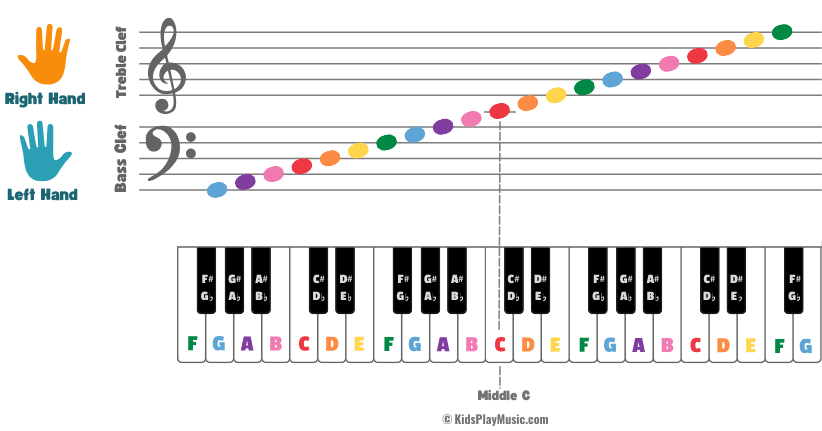
Locate middle C on the grand staff
Middle C sits between the treble and bass staffs on a small ledger line. It is:
- Just below the treble staff
- Just above the bass staff
When you see a note on this short line, play middle C.
Match written notes to keys
Use this process:
- Identify the clef.
- Find the note’s line or space.
- Count upward or downward from a note you know.
- Find the matching key on the keyboard.
- Check for a sharp, flat, or natural sign.
- Play the note with the assigned finger.
Do not guess from the note’s height alone. The clef tells you how the lines and spaces are named.

Learn Simple Scales
A scale is a set of notes played in order. The C major scale is the easiest first scale because it uses only white keys:
C – D – E – F – G – A – B – C
The pattern of whole and half steps in a major scale is:
Whole – Whole – Half – Whole – Whole – Whole – Half
For C major, the half steps occur between:
- E and F
- B and C
C major scale fingering
Use this right-hand fingering:
1 – 2 – 3 – 1 – 2 – 3 – 4 – 5
The thumb passes under the hand after E. This lets the hand continue moving to F, G, A, B, and high C.
For the left hand, use:
5 – 4 – 3 – 2 – 1 – 3 – 2 – 1
The middle finger passes over the thumb after G.
Do not rush the thumb crossing. Practice the first five notes, pause, and then add the next notes.
Practice with a steady beat
Use a slow count:
1 – 2 – 3 – 4
Play one note on each count. A metronome can help you keep a steady beat, but set it slowly enough that you can play without tension.
If the notes are uneven, slow down. Speed usually improves after the movement becomes smooth.

Play Piano Notes in Songs
A song is more than a list of notes. It also has rhythm, rests, dynamics, and phrasing.
Start with a short section. Two to four measures are enough for one practice session.
Follow this practice order
- Look at the notes without playing.
- Name the notes out loud.
- Identify the hand and finger numbers.
- Tap or count the rhythm.
- Play the notes slowly.
- Repeat the same section several times.
- Join it to the next section.
- Play the full passage without stopping.
This method helps you solve one problem at a time. Trying to learn notes, rhythm, fingering, and speed all at once can make practice feel harder than it needs to be.
Separate hands at first
If both hands are difficult, practice each hand alone. Make sure each hand knows its notes and fingering before combining them.
Then combine only a short part. For example, play the first two beats with both hands, stop, and repeat. Add two more beats when the first part feels secure.
Watch the rhythm
A note tells you what to play. Rhythm tells you when to play it and how long to hold it.
Common note values include:
- Whole note: held for four quarter-note beats in common time
- Half note: held for two beats
- Quarter note: held for one beat
- Eighth note: held for half a beat
The exact count depends on the time signature. In 4/4 time, the top number shows four beats in each measure, and the quarter note usually receives one beat.

Use Chords to Play Several Notes Together
A chord is two or more notes played at the same time. Beginners often start with three-note chords called triads.
The C major chord uses:
C – E – G
The F major chord uses:
F – A – C
The G major chord uses:
G – B – D
These three chords appear in many beginner arrangements.
Basic right-hand chord fingering
For a simple right-hand position:
- C major: fingers 1, 3, and 5 on C, E, and G
- F major: fingers 1, 3, and 5 on F, A, and C
- G major: fingers 1, 3, and 5 on G, B, and D
Press the notes together. Keep your wrist loose and avoid squeezing the keys.
Play chords as broken patterns
A broken chord plays the notes one at a time instead of together.
For C major:
C – E – G – E
This pattern is useful because it trains note recognition, finger control, and smooth movement.
Do not force stretched chords
If a chord feels too wide, move your hand closer to the keys or use a different fingering suggested by the music. Never force your fingers into a painful stretch.
Some chords require a hand position change. That is normal. Move the whole hand rather than twisting the wrist.

Fix Common Piano Note Problems
Most early problems come from key location, note reading, rhythm, or tension. Check one cause at a time.
“I cannot find the right key”
Likely cause: You are not using the black-key pattern.
Fix: Find a group of two black keys. The white key just to the left is C. Use that C to name the next white keys.
“I play the right note but the wrong octave”
Likely cause: You found the correct letter but played it too high or too low.
Fix: Compare the note with middle C. Octaves repeat the same letter name at higher and lower pitches. Move seven white-key steps to reach the next same-letter note.
“My notes sound uneven”
Likely cause: You are moving too fast or lifting your fingers too high.
Fix: Slow down. Use a steady count. Keep your fingers close to the keys and aim for equal pressure.
“My hand feels tense”
Likely cause: You may be pressing too hard, raising your wrist, or holding your fingers stiffly.
Fix: Stop and shake out your hand. Let your arm hang loosely by your side. Then return with a curved hand and a level wrist.
If pain continues, stop practicing and consider guidance from a qualified piano teacher or health professional.
“I keep missing black keys”
Likely cause: Your hand may be too far forward or too far back.
Fix: Use the black keys as touch points. Place your fingers near the front edge of the white keys, but allow your thumb to move comfortably. Practice black-key groups slowly before adding songs.
“I forget the note names”
Likely cause: You are relying only on finger memory.
Fix: Say each note name while you play. Mix the order. Ask yourself to find every C, every F, or every G on the keyboard.
Build a Short Daily Practice Plan
A short plan can cover the skills that matter most.
Try this 15-minute routine:
- Two minutes: Find all the Cs and Fs on the keyboard.
- Three minutes: Play C–D–E–F–G with each hand.
- Three minutes: Play the C major scale slowly.
- Five minutes: Practice a short song section.
- Two minutes: Review note names or rhythm.
Practice five days a week if possible. Consistency matters more than long sessions. If you have only five minutes, play the same small pattern with care.
Track signs of progress
You are improving when you can:
- Find C without counting every key
- Name white keys in order
- Tell the difference between a half step and whole step
- Read simple notes on the treble staff
- Keep a steady beat
- Play with less hand tension
- Repeat a short passage with fewer errors
Do not judge progress only by speed. A slow, clean performance builds better habits than a fast, tense one.
Choose the Right Learning Setup
You can learn piano notes on an acoustic piano, digital piano, or electronic keyboard. The basic note pattern stays the same.
Acoustic piano
An acoustic piano uses hammers and strings to make sound. It does not need power, but it takes up more space and may need regular tuning.
Digital piano
A digital piano creates sound electronically. Many models include weighted keys, a headphone output, and volume control. These features can help with quiet practice.
Electronic keyboard
A keyboard is often lighter and less costly than a digital piano. However, some smaller models have fewer keys or lighter key action. That may be fine for note practice but less suitable for music that uses a wide range or piano-style touch.
What matters most for a beginner
Choose an instrument that:
- Has clearly labeled or easy-to-find key patterns
- Gives you enough room to practice
- Lets you sit with good posture
- Does not make you avoid practice because of noise or access
- Supports the type of music you want to play
You do not need an expensive instrument to learn the names of piano notes. You do need regular access to keys.
Common Questions About Playing Piano Notes
How many notes are on a standard piano?
A standard modern piano usually has 88 keys: 52 white keys and 36 black keys. Some keyboards have fewer keys, but the same A-to-G note pattern repeats.
What is the easiest piano note to find?
C is usually the easiest note to find because it is the white key just left of every group of two black keys. Middle C is a useful central starting point.
Should I learn notes or chords first?
Learn basic note names first. Then add simple chords. You need to know the individual notes inside a chord to understand, find, and change that chord.
Do I need to read sheet music to play piano?
No. You can learn notes by letter names, chord symbols, tutorials, or ear training. Sheet music is still useful because it shows pitch, rhythm, fingering, and musical details in one system.
Why do some black keys have two names?
A black key can have a sharp name and a flat name. For example, C♯ and D♭ use the same piano key. The correct name depends on the musical scale or written passage.
How long does it take to learn piano notes?
Many learners can memorize the basic white-key pattern in a few practice sessions. Reading notes fluently takes longer. Progress depends on practice time, focus, prior music experience, and the difficulty of the music.
Conclusion
To play piano notes, begin with the keyboard pattern. Find C beside the group of two black keys, then name the white keys from C through B. Use middle C as your main landmark.
Next, learn relaxed five-finger positions, half steps, whole steps, simple scales, and basic rhythm. Practice slowly, say the note names, and correct one problem at a time.
Your next step is simple: find middle C, place your right thumb on it, and play C–D–E–F–G–F–E–D–C with a steady beat.