

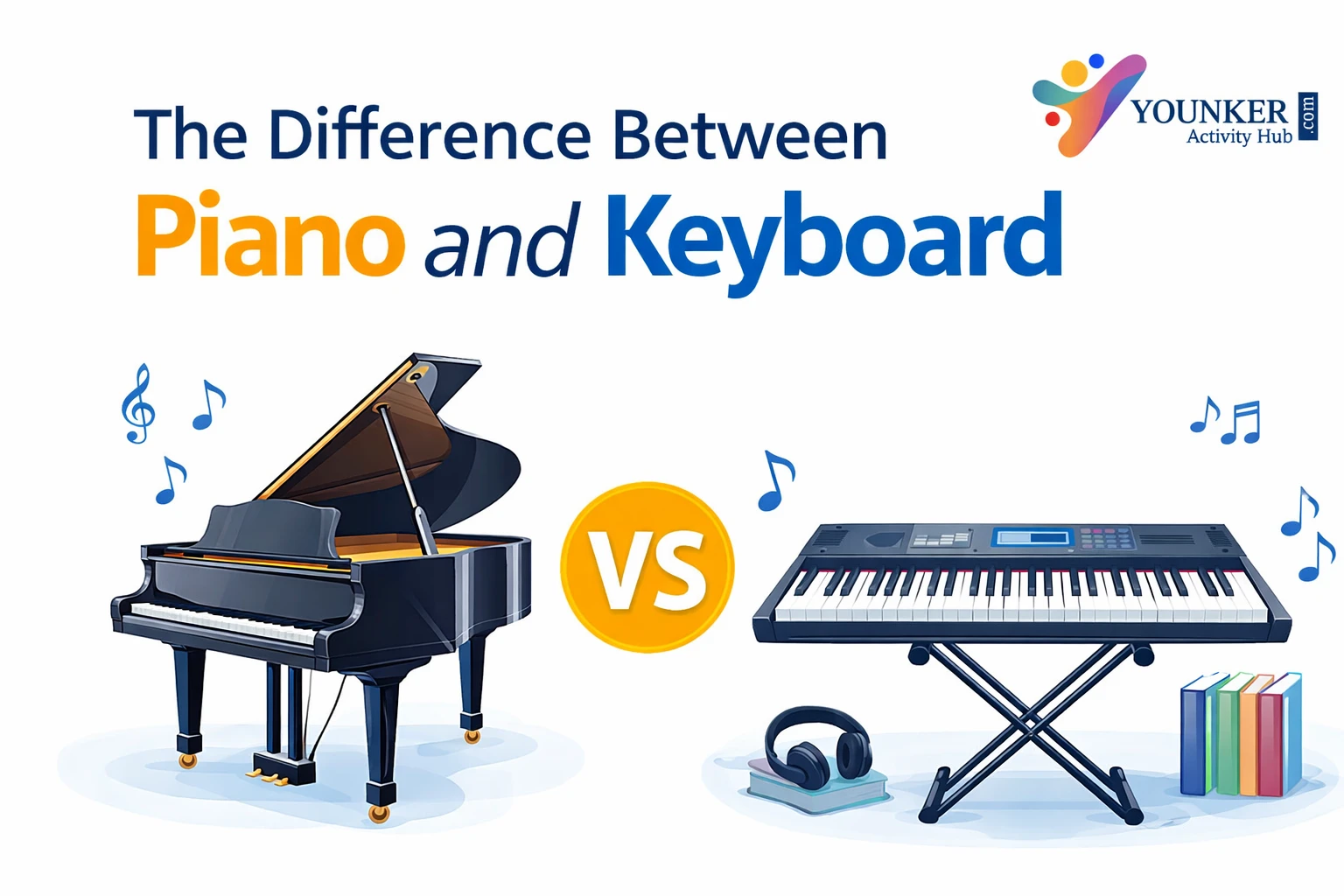
For shoppers, students, and families in the United States, the main difference is simple: a piano uses strings and hammers to make sound, while an electronic keyboard uses digital sounds and speakers. A traditional piano is usually larger, heavier, and more costly to move. A keyboard is often lighter, more portable, and offers many sounds, rhythms, and recording features.
The word piano can also mean a digital piano, which looks and feels like a piano but uses electronics instead of strings. That is why it helps to compare three types of instruments:
- Acoustic piano: Uses strings, hammers, and a soundboard.
- Digital piano: Uses sampled or modeled piano sounds and usually has 88 weighted keys.
- Electronic keyboard: Often has 61 or 76 lighter keys, many sounds, rhythms, and digital features.
The best choice depends on your goals, available space, budget, noise limits, and plans for lessons or performance.

Piano vs. keyboard: the main differences
A piano and a keyboard both use keys, but they are built for different jobs. An acoustic piano focuses on touch, tone, and musical expression. A keyboard focuses on flexibility, portability, and electronic features.
| Feature | Acoustic piano | Digital piano | Electronic keyboard |
|---|---|---|---|
| Sound source | Strings and hammers | Digital piano sounds | Digital sounds |
| Typical keys | 88 | Usually 88 | Commonly 61 or 76 |
| Key feel | Fully mechanical | Weighted or semi-weighted | Light and easy to press |
| Volume control | Usually limited | Headphones and volume control | Headphones and volume control |
| Extra sounds | Few or none | Some piano, organ, and instrument sounds | Many sounds and rhythms |
| Portability | Very low | Medium to high | High |
| Maintenance | Regular tuning and service | Little routine care | Little routine care |
| Best for | Traditional piano study and performance | Piano practice at home | Music making, portability, and variety |
An acoustic piano creates sound through a physical chain. When you press a key, it moves a felt-covered hammer. The hammer strikes a string, and the string’s vibration travels through the soundboard. This process gives an acoustic piano its natural changes in volume and tone.
A digital piano records or models the sound of a piano. Sensors detect how fast and how hard you press each key. The instrument then plays a digital sound through speakers or headphones.
An electronic keyboard works in a similar digital way, but it often gives greater weight to features such as auto-accompaniment, drum patterns, sound effects, and easy transport.

Key feel and learning: why the action matters
Key action is one of the most important differences for piano students. Acoustic pianos and quality digital pianos provide resistance that changes as you play. Many basic keyboards have light keys with little resistance.
This resistance is called weighted action. It helps develop finger control, hand strength, and dynamic playing. Dynamic playing means changing the volume and tone by pressing keys with different force.
Most acoustic pianos have 88 keys. Many digital pianos also have 88 keys and try to copy the heavier feel of the lower keys and the lighter feel of the higher keys. This design is called graded or graduated weighting.
Many keyboards have:
- 61 keys for general playing
- 76 keys for a wider range
- 88 keys on some advanced models
- Unweighted or lightly weighted action
- Smaller key sizes on some compact models
A 61-key keyboard can work well for pop songs, basic melodies, chords, music production, and beginners who need a portable instrument. It may not cover the full range of some classical pieces.
If you plan to study classical piano, ask your teacher whether you need 88 weighted keys. A small keyboard may help you start, but it can limit your technique as your music becomes more complex.
A keyboard is not automatically a poor learning tool. The key question is whether its touch matches your learning goals. The National Association of Music Merchants Foundation and many music educators support access to different types of instruments, but the right action still depends on the student’s program and repertoire.

Sound, volume, and musical expression
An acoustic piano offers a natural acoustic sound, while a keyboard gives you controlled digital sound. Neither option is automatically better for every player.
On an acoustic piano, the strings, soundboard, room, and cabinet all affect the tone. A player can produce subtle changes by varying finger speed, pressure, pedaling, and release. The sound continues to develop after the hammer strikes the string.
A digital piano uses speakers, headphones, or both. Its sound depends on the quality of its recordings or sound modeling, speakers, sensors, and software. Better digital pianos often respond to touch and pedal use in ways that feel closer to an acoustic piano.
Electronic keyboards usually provide more sound choices. Depending on the model, you may find:
- Electric piano sounds
- Organs
- Strings
- Brass
- Synthesizers
- Drum kits
- Bass sounds
- Sound effects
- Built-in rhythm patterns
This variety makes a keyboard useful for songwriting, home recording, church music, bands, and music production. You can play a piano part, add a drum pattern, and change to an organ sound without changing instruments.
The trade-off is focus. A keyboard’s many features can inspire creativity, but they can also distract a new student from learning rhythm, posture, reading, and technique.

Size, portability, and home use
A keyboard is easier to move and store than an acoustic piano. This difference matters in apartments, dorm rooms, shared homes, and small practice spaces across the United States.
An upright piano can weigh hundreds of pounds. A grand piano needs even more floor space and careful handling. Moving one usually requires professional piano movers because stairs, narrow doors, and uneven floors can cause injury or property damage.
A keyboard may fit on a folding stand, desk, or dedicated furniture stand. Many models can be carried by one person, although an 88-key digital piano may still be heavy.
Before buying, measure:
- The space where you will play.
- The path through doors and hallways.
- Storage space for the stand and bench.
- The location of an electrical outlet.
- Space for a pedal unit and music stand.
An acoustic piano also affects the room. It can be loud for nearby family members and neighbors. A digital piano or keyboard lets you lower the volume or use headphones, though headphone use should still be comfortable and moderate.
For apartments and shared homes, a digital piano is often the practical middle ground: it offers a piano-like layout and touch while allowing quiet practice.

Maintenance and tuning
Acoustic pianos need more care than digital pianos and keyboards. Their strings change tension over time, and changes in temperature and humidity can affect tuning.
The Piano Technicians Guild explains that acoustic pianos need regular tuning, with the exact schedule depending on use, climate, and the instrument’s condition. A new or frequently played piano may need more attention than a piano used only occasionally. You can learn more from the Piano Technicians Guild.
Routine acoustic piano care may include:
- Professional tuning
- Cleaning by safe methods
- Regulation of the action
- Repair of worn felt or parts
- Control of moisture and extreme temperature changes
- Safe handling during moves
Digital pianos and keyboards do not need tuning because they do not use strings. They still need protection from spills, dust, heat, and impact. Some models may need software updates, replacement power adapters, or service for keys and screens.
Do not place drinks on any instrument. Liquid can damage electronic circuits, wood, felt, and metal parts. For a serious repair, use a qualified piano technician or an authorized electronic service center.

Features: what a keyboard can do that a piano cannot
Keyboards usually provide more built-in features than acoustic pianos. These features can support practice, composition, performance, and recording.
Common keyboard features include:
- Transpose controls
- Metronomes
- Lesson modes
- Recording
- USB or MIDI connections
- Bluetooth audio or MIDI on some models
- Auto-accompaniment
- Split keyboard functions
- Layered sounds
- Drum patterns
- Built-in effects
MIDI is a digital communication standard. It sends performance information, such as which key you played, how hard you played it, and how long you held it. MIDI does not itself carry a recorded piano sound. It tells another device or software what notes to play.
The MIDI Association provides technical information about MIDI and related standards. Compatibility can vary, so check the exact ports, cables, apps, and operating systems before buying.
An acoustic piano does not normally connect directly to music software. You can record it with microphones, but that requires extra equipment and a suitable room. A keyboard or digital piano with USB or MIDI output may connect more easily to a computer or tablet.
Which one should you buy?
Choose an acoustic piano if you want traditional piano touch, natural sound, and long-term piano study, and you can manage the size and maintenance.
Choose a digital piano if you want realistic piano practice, quiet volume, and less maintenance.
Choose an electronic keyboard if you value portability, many sounds, automatic rhythms, and creative features.
Use this decision guide:
Choose an acoustic piano when:
- You have enough room.
- You want a traditional playing experience.
- You enjoy the sound of real strings.
- You plan to study piano seriously.
- You can budget for tuning and moving.
- You do not need headphones for regular practice.
Choose a digital piano when:
- You want 88 keys and weighted action.
- You need to practice quietly.
- You live in an apartment or shared home.
- You want little routine maintenance.
- You want piano sounds plus a few extra features.
- You may need to move the instrument later.
Choose a keyboard when:
- You need a light instrument.
- You want many sounds and rhythm patterns.
- You are writing songs or making beats.
- You need to take the instrument to rehearsals.
- You want to connect to music software.
- You are learning basic chords or melodies.
Do not choose only by the number of sounds. A keyboard with hundreds of sounds may not be suitable for piano lessons if its keys are too light or its range is too narrow.

Common mistakes when comparing pianos and keyboards
The most common mistake is treating every keyboard as a replacement for every piano. A simple keyboard can play notes, but it may not provide the touch, range, pedals, or speaker response needed for advanced piano study.
Other mistakes include:
- Buying fewer than 88 keys for a student who needs full piano range
- Assuming “weighted” means the same thing on every model
- Forgetting to budget for a stand, bench, pedals, or headphones
- Ignoring the instrument’s dimensions and weight
- Buying an acoustic piano without planning for tuning
- Assuming digital instruments never need service
- Connecting a keyboard to an app without checking compatibility
- Placing an instrument near heat, moisture, or direct sunlight
- Using headphones at an uncomfortable or excessive volume
- Choosing many sounds when the real need is better key action
Try the instrument before buying when possible. Play soft notes, loud notes, repeated notes, scales, chords, and the sustain pedal. If you are buying for a child, ask the teacher what key count and action they recommend.
For used acoustic pianos, hire a qualified piano technician to inspect the instrument before purchase. The outside may look good while the action, soundboard, bridges, or pinblock need costly work.
Frequently asked questions
Is a keyboard the same as a piano?
No. A keyboard is a broad term for an electronic instrument with piano-style keys. A digital piano is one type of keyboard, but many keyboards are designed more for portability, sounds, and rhythm features than for copying an acoustic piano.
Can you learn piano on a keyboard?
Yes, but the keyboard should match your goal. A beginner can learn notes, rhythm, chords, and simple songs on a basic keyboard. For serious piano study, an 88-key digital piano with weighted action is usually a closer match to an acoustic piano.
Is a digital piano better than an electronic keyboard?
Neither is better in every case. A digital piano is usually better for piano technique, realistic touch, and full-range playing. An electronic keyboard is often better for portability, sound variety, rhythms, and music production.
Do keyboards need tuning?
Most electronic keyboards and digital pianos do not need tuning because they do not use strings. They can still need cleaning, repairs, new power equipment, or software support.
Can a keyboard replace an acoustic piano?
A good digital piano can replace an acoustic piano for many home players, especially when quiet practice and low maintenance matter. An electronic keyboard may replace one for basic playing or creative work, but its lighter action and smaller range may not suit advanced piano study.

Key takeaways
- An acoustic piano makes sound with strings and hammers.
- A digital piano uses electronics but usually aims to copy piano touch and tone.
- An electronic keyboard usually offers lighter keys, more sounds, and greater portability.
- Weighted 88-key action is the closest digital option for traditional piano study.
- Acoustic pianos need tuning and more physical care.
- Digital pianos and keyboards allow volume control and headphone practice.
- The best choice depends on touch, space, noise, maintenance, portability, and musical goals.
Conclusion
The difference between a piano and a keyboard is mainly the way they create sound, how the keys feel, and what the instrument can do.
Choose an acoustic piano for traditional sound and physical response. Choose a digital piano for realistic piano practice with headphones and less maintenance. Choose an electronic keyboard for portability, many sounds, rhythms, and easy connection to music tools.
Before you buy, decide what you will play, where you will practice, and whether key feel matters more than extra features. Those three answers will usually point you to the right instrument.