
Introduction
In the United States, you can learn piano on your own with a keyboard, a clear plan, and short, regular practice. You do not need to wait for weekly lessons or own an acoustic piano. A digital piano, free sheet music, and a simple practice routine can take you from the first notes to full songs.
The key is to learn in the right order. Start with posture, rhythm, note names, and simple chords. Then build reading, hand control, and song skills at the same time. Self-study works best when you practice small tasks often instead of trying to play hard songs too soon.
Can You Really Learn Piano Without a Teacher?
Yes. Many beginners can learn basic piano skills on their own. You can learn to play simple songs, read easy sheet music, build chords, and play with both hands through guided practice.
A teacher can still help. A teacher is useful when you:
- Feel pain or tension while playing
- Keep making the same mistake
- Want to prepare for an audition or exam
- Need help with advanced technique
- Want a fixed lesson plan and outside feedback
Self-learning has one main risk: you may repeat poor habits without noticing them. Record yourself from time to time. Watch your hand shape, timing, posture, and sound. A short lesson with a qualified piano teacher can also correct problems before they become hard to change.
Research on learning supports regular, spaced practice rather than long, rare sessions. The National Center for Biotechnology Information summarizes evidence on practice methods, including the value of spacing work over time. This idea applies well to piano: 20 minutes on most days is often more useful than one long session each weekend.
What You Need to Start Learning Piano
You need four basic things: an instrument, a seat, learning material, and a practice plan.
Choose a piano or keyboard
You have three common choices in the United States:
| Instrument | Best for | Main trade-off |
|---|---|---|
| Acoustic piano | Players who want a full, natural sound | It is large, costly to move, and needs tuning |
| Digital piano | Beginners who want piano-like keys at home | It costs more than a basic keyboard |
| Portable keyboard | Low-cost practice and small spaces | Many models have light keys and fewer features |
A beginner can start with a 61-key keyboard. An 88-key digital piano is a better long-term choice if you want to study classical music, use the full range of the piano, or develop a stronger feel for weighted keys.
Look for these features:
- Full-size keys
- A sustain pedal or pedal input
- A headphone jack
- A stable stand or firm table
- Touch-sensitive keys
- A metronome
- Weighted or semi-weighted keys if your budget allows
Touch sensitivity means the sound changes when you play with more or less force. This helps you learn control. Weighted keys feel more like an acoustic piano, but they are not required for your first lessons.
Set up your practice space
Place the keyboard so your elbows sit near the level of the keys. Sit far enough back that your forearms reach the keyboard without stretching. Keep your feet on the floor or on a small footrest.
Use a firm bench or chair. Avoid a soft couch. A couch can place your body too low and make your wrists bend in an awkward way.
You also need:
- A pencil for marking music
- A metronome, app, or built-in metronome
- A notebook or practice log
- A phone or camera for recording
- A lamp if your music stand is dim
Do not practice through sharp pain, numbness, or tingling. Stop and rest if these symptoms appear. If they continue, seek advice from a health professional who understands hand or movement problems.
Learn the Piano Basics in the Right Order
A good order saves time. Do not begin by memorizing many songs without learning how the keyboard works.
1. Learn the layout of the keys
The black keys form groups of two and three. These groups help you find notes.
- The white key just to the left of a group of two black keys is C.
- The white key just to the left of a group of three black keys is F.
- The white keys repeat from A through G.
Middle C is near the center of most keyboards. It is a useful starting point for reading music and placing your hands.
Learn the names of the white keys first. Then learn sharps and flats. A sharp raises a note by one half step. A flat lowers a note by one half step. On a piano, a half step is the distance from one key to the next key, including black keys.
2. Learn finger numbers
Piano finger numbers are the same for both hands:
- Thumb: 1
- Index finger: 2
- Middle finger: 3
- Ring finger: 4
- Little finger: 5
Most beginner music uses finger numbers to show hand position. Use them as a guide, not as a rule that replaces good movement. Keep your fingers relaxed and avoid pressing down with stiff joints.
3. Learn rhythm before speed
Rhythm tells you when to play. Begin with:
- Whole notes
- Half notes
- Quarter notes
- Eighth notes
- Rests
- Measures
- Time signatures
A time signature shows how beats are grouped. In 4/4 time, four quarter-note beats fill each measure.
Count out loud while you play. For example:
1, 2, 3, 4
For eighth notes, count:
1 and 2 and 3 and 4 and
A slow, steady beat is better than a fast, uneven one. Use a metronome at a speed that lets you play without stopping.
4. Learn basic chords
Chords let you play many songs with fewer notes. Start with major and minor triads.
A major triad has:
- A root note
- A major third
- A perfect fifth
For example, C major uses C, E, and G.
A minor triad has:
- A root note
- A minor third
- A perfect fifth
A minor uses A, C, and E.
Learn these common chords first:
- C major
- G major
- F major
- A minor
- E minor
- D minor
Practice changing between two chords. Do not rush through a long list. If you can move between C and G without losing the beat, you are building a useful skill.
5. Read music and use chord charts
Sheet music shows pitch and rhythm. Chord charts show the harmony in a simpler form. Learn both if you want flexibility.
Sheet music helps you:
- Play music you have never heard
- Understand rhythm
- Read separate parts for each hand
- Build long-term musical skill
Chord charts help you:
- Play pop, folk, country, and worship songs
- Accompany singing
- Improvise
- Learn songs with less notation
Do not treat one system as the only correct path. A well-rounded self-taught pianist can read simple music and understand common chords.

Build a Piano Practice Routine That Works
A useful practice routine is short, focused, and repeatable. Begin with 20 to 30 minutes a day, five days a week. If you have more time, add minutes slowly rather than forcing long sessions at once.
Try this beginner routine:
| Practice task | Time | Goal |
|---|---|---|
| Warm-up and finger movement | 3 minutes | Relaxed, even motion |
| Note reading or rhythm | 5 minutes | Improve basic reading |
| Chords and scales | 7 minutes | Build hand knowledge |
| Song practice | 10 minutes | Apply new skills |
| Review and record | 2 minutes | Notice progress |
You do not need to follow this exact plan every day. The main idea is to divide practice into clear tasks.
Use the slow-practice method
When a song feels hard, lower the speed. Practice one small section at a time.
Use this order:
- Listen to the section.
- Read the notes and rhythm.
- Practice each hand alone.
- Put the hands together at a slow speed.
- Repeat the same section several times.
- Increase the speed only when the section feels steady.
- Connect it to the next section.
If you make the same error three times, stop and find the cause. You may be using the wrong fingering, missing a rhythm mark, or trying to play too fast.
Practice in small sections
A full song can feel overwhelming. Divide it into sections of two to eight measures. Mark each section with a letter or number.
Work on the hardest section first while your attention is fresh. Then play an easier section for variety. End by playing something you can already do well. This helps you finish with a clear sense of control.
Keep a practice log
Write down:
- The date
- The song or exercise
- The slowest clean tempo
- The section you practiced
- The next small goal
A practice log turns a vague goal into visible progress. Instead of writing “practice piano,” write “play measures 9–12 with both hands at 60 beats per minute.”

Follow a Simple Six-Month Piano Learning Plan
Your pace will depend on practice time, past music experience, and the music you choose. The following plan is a guide, not a promise.
Month 1: Keyboard awareness and rhythm
Focus on:
- Note names
- Finger numbers
- Good sitting position
- Basic rhythm
- Five-finger patterns
- Very short melodies
Success looks like this: you can find notes without counting every key, keep a slow beat, and play simple melodies with one hand.
Month 2: Both hands and basic chords
Add:
- Left-hand bass notes
- Simple two-hand pieces
- C, F, and G major chords
- Basic chord changes
- Simple rests and eighth notes
Success looks like this: you can play an easy song with both hands, even if the speed is slow.
Month 3: Scales and reading
Learn:
- C major scale
- G major scale
- F major scale
- Treble clef notes
- Bass clef notes
- Simple intervals
An interval is the distance between two notes. Learning intervals can help you read by shape instead of naming every note one at a time.
Months 4 and 5: Song fluency
Choose two or three songs at an appropriate level. Work on:
- Smooth chord changes
- Hand coordination
- Dynamics
- Pedal use
- Playing without stopping
Dynamics are changes in volume. Start with control before adding strong expression.
Month 6: Review and performance
Choose one or two songs to finish. Record them from beginning to end. Listen for:
- Uneven rhythm
- Missed notes
- Sudden stops
- Excess pedal
- Tension in your hands
- Sections that sound too loud or too soft
A recording may feel uncomfortable at first. It gives you useful feedback that you cannot always notice while playing.

How to Choose Songs That Match Your Level
The right song is challenging but manageable. A song is probably too hard if you cannot play a short section slowly after several focused sessions.
Choose music with:
- A clear melody
- Repeated patterns
- A moderate number of chords
- A steady rhythm
- Few large jumps
- A slow or medium tempo
Avoid starting with full versions of advanced movie themes, classical showpieces, or fast pop arrangements. A simplified version can teach the same musical idea without creating poor habits.
Use a three-level song system:
- Comfort song: You can play it with little help.
- Growth song: It contains one or two new skills.
- Challenge song: It is harder and needs slow work.
Spend most of your time on the growth song. Use the comfort song to build confidence and the challenge song to stretch your skills in small doses.
Do not judge a song only by its title. Arrangements differ. A beginner arrangement of a famous song may be suitable, while a concert arrangement of the same song may be far beyond your level.
Learn Piano Online Without Getting Lost
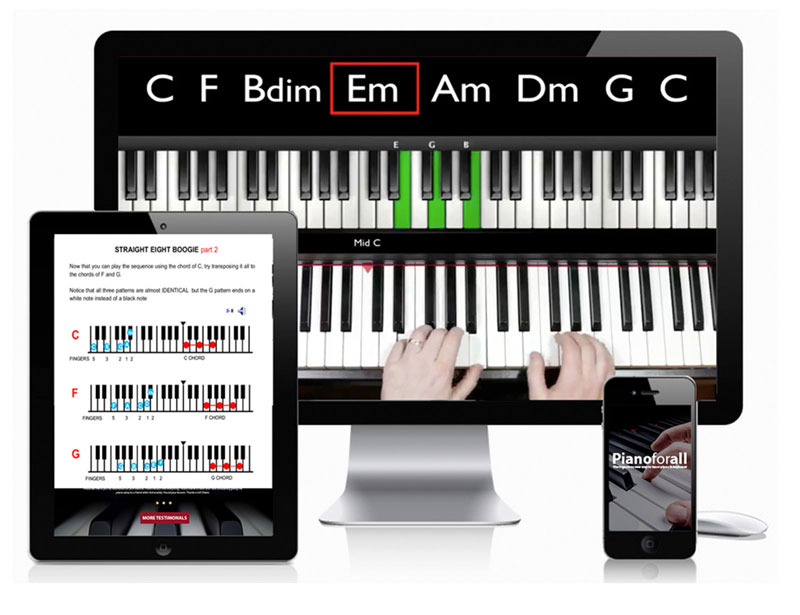
Online piano lessons can help, but only if you use them as part of a plan. Do not jump between dozens of videos. Choose one main course or method for your first stage.
A useful online lesson should include:
- A clear skill goal
- Demonstration from more than one angle
- Slow examples
- Practice steps
- Rhythm guidance
- A way to check your work
- Songs that match the lesson
Apps can help with note reading, rhythm, and motivation. They may not show every detail of posture, wrist motion, or sound quality. A screen can tell you that you played the right note, but it may not tell you that your hand is tense.
You can combine resources like this:
- Use one structured course for the main path.
- Use a metronome for timing.
- Use sheet music or chord charts for songs.
- Use videos to explain a skill you do not understand.
- Record yourself to check your sound and movement.
Check whether an app works with your device before paying. Some tools require a microphone, a specific operating system, a subscription, or a digital connection. These details can change, so review the current terms on the provider’s official site.

Use Pedal, Scales, and Technique Safely
Learn the sustain pedal after the basics
The sustain pedal lets notes continue after you lift your fingers. It can make music sound full, but too much pedal can blur the harmony.
Start with simple pedal changes:
- Play a chord.
- Press the pedal.
- Change to the next chord.
- Lift and press the pedal as the new chord begins.
The pedal should follow the harmony. If two chords sound mixed together, change the pedal sooner.
Add scales in small amounts
Scales can improve note knowledge and finger control. They are useful, but they should not replace real music.
Start with one octave of C major. Play slowly and evenly. Keep your thumb movement smooth. Add G major and F major only when C major feels controlled.
Do not force your thumb under the hand or stretch your fingers to reach notes. Good scale technique uses relaxed movement, not strain.
Avoid common technique errors
Watch for:
- Raised shoulders
- Collapsed finger joints
- Bent wrists
- Locked elbows
- Pressing harder than needed
- Holding your breath
- Playing through pain
Relaxation does not mean a weak hand. It means you use only the effort needed to make the sound.
For persistent pain, numbness, or loss of strength, stop playing and seek qualified medical advice. Piano practice should challenge your attention and coordination, not injure your body.

Common Self-Taught Piano Problems and Fixes
| Problem | Likely cause | Useful fix |
|---|---|---|
| You play the right notes but lose the beat | You focus on pitch only | Count aloud and use a slow metronome |
| You can play each hand alone but not together | The coordination step is too large | Use smaller sections and slower speed |
| You keep stopping at the same spot | You memorized movement without understanding | Read the rhythm and notes again |
| Your playing sounds rushed | The tempo is too fast | Reduce the metronome speed |
| Chords feel slow to change | You lift the whole hand too far | Keep fingers near the keys |
| You forget songs quickly | You only practice from the beginning | Start from several points in the song |
| Your hands feel tense | You use too much force | Pause, shake out your hands, and restart softly |
| You cannot tell if you improved | Your goals are too broad | Track a specific tempo or measure range |
What to do when practice stops working
First, stop repeating the error. Repetition can make the wrong motion stronger.
Next, ask:
- Is the fingering clear?
- Is the rhythm correct?
- Is the section too long?
- Is the tempo too fast?
- Am I using unnecessary force?
- Can I explain what each hand is doing?
If you cannot answer these questions, simplify the task. Play one hand, clap the rhythm, or name the notes. Then return to the piano.

How Long Does It Take to Learn Piano on Your Own?
There is no single timeline. Progress depends on practice quality, practice frequency, musical goals, and the difficulty of your songs.
A person who practices 20 minutes on five days each week may build steady beginner skills. Another person may practice for an hour but spend most of that time repeating mistakes. More minutes do not always mean more progress.
A better way to measure progress is by skill:
- You can find notes without long pauses.
- You can keep a steady beat.
- You can read simple music.
- You can play basic chords.
- You can use both hands.
- You can learn a new easy song with less help.
- You can play through a song without stopping.
These signs matter more than a fixed number of weeks. Piano learning is not a race. Your goal is to make the next small task easier.

Key Takeaways
- Start with a suitable keyboard, a stable seat, and a quiet practice space.
- Practice often, even when sessions are short.
- Learn notes, rhythm, chords, and reading together.
- Use slow practice and small sections.
- Choose songs that match your current level.
- Record yourself to find problems you may not feel while playing.
- Use online lessons as a structured path, not as a random stream of videos.
- Stop if you feel sharp pain, numbness, or tingling.
- Consider occasional teacher feedback if progress stalls.
Frequently Asked Questions
Is it better to learn piano with an app or YouTube videos?
A structured app or course is usually easier for a beginner because it gives you an order to follow. YouTube can explain a difficult point or offer song tutorials. Use one main path and treat extra videos as support.
Can I learn piano on a 61-key keyboard?
Yes. A 61-key keyboard works well for basic songs, chords, rhythm, and early reading. Choose an 88-key instrument if you plan to study classical music or want the full range of an acoustic piano.
Should I learn sheet music or chords first?
Learn basic versions of both. Sheet music builds reading and rhythm skills. Chords help you play songs and accompany other people. The best choice depends on your goals, but learning only one system limits your options.
How often should a beginner practice piano?
Aim for 20 to 30 minutes on most days. If you have less time, practice one focused task for 10 minutes. Regular practice usually works better than one long session followed by several days away.
Do I need a piano teacher if I learn by myself?
Not always. You can start alone, but occasional feedback can help with posture, hand tension, fingering, and musical phrasing. A teacher becomes more useful as your goals and music become more advanced.
Conclusion
To learn piano on your own, follow a simple path: set up your instrument, learn the keyboard, build rhythm and chords, read easy music, and practice songs in small sections. Keep your sessions short enough to repeat and slow enough to stay accurate.
Your next step is simple. Choose one beginner song, divide it into small sections, and practice the first section with a slow metronome for 10 minutes today.