

To set up a Stratocaster guitar, adjust the neck, action, intonation, pickup height, and tremolo in that order.
A good Stratocaster setup makes the guitar feel easier to play, sound clearer, and stay in tune longer. After working on many electric guitars, I have learned that small changes matter: a quarter turn of the truss rod or a tiny saddle adjustment can change the whole playing experience. This guide explains how to set up a Stratocaster guitar safely at home, while showing when a professional repair tech is the better choice.
What a Stratocaster setup includes
A Stratocaster setup is a series of adjustments that balance the neck, strings, bridge, pickups, and tuning system. The goal is not to make every guitar match one exact measurement. The goal is to make your guitar play cleanly, feel comfortable, and work well with your playing style.
A complete setup usually includes:
- Installing fresh strings
- Checking neck relief
- Adjusting the truss rod
- Setting string action
- Adjusting bridge saddle height
- Setting string radius
- Correcting intonation
- Balancing pickup height
- Adjusting tremolo spring tension
- Checking tuning stability
- Testing for fret buzz and dead notes
When learning how to set up a Stratocaster guitar, remember that each adjustment affects another part of the instrument. For example, changing neck relief can change string action. Raising the bridge can change intonation and playing feel.

Tools you need before starting
You do not need a professional repair bench to learn how to set up a Stratocaster guitar. However, the right tools make the work safer and more accurate.
Gather these items:
- A guitar tuner
- A fresh set of strings
- Phillips screwdrivers
- Small flathead screwdrivers
- Allen wrenches that fit your saddles and truss rod
- A capo
- A string action ruler
- Feeler gauges
- A radius gauge
- Wire cutters
- A clean work mat
- A soft cloth
- A small ruler or measuring tool
- A notebook or phone for recording measurements
Use the correct wrench for your truss rod. Fender Stratocasters can use different truss rod systems, depending on the year and model. Many newer models use a hex key, while some vintage-style guitars use a different adjustment design.
Never force a truss rod. If the wrench does not fit well, stop and confirm the correct tool. A damaged truss rod nut can turn a simple setup into an expensive repair.
Prepare the Stratocaster for adjustment
Before you learn how to set up a Stratocaster guitar, prepare the instrument and create a stable starting point. Work in a comfortable room with moderate temperature and humidity. Wood reacts to climate, so a guitar may need a new setup after moving from a dry home to a humid stage.
Place the guitar in normal playing position when checking the neck. Some players prefer to work with the guitar flat, but the neck can show a slightly different shape when gravity acts on it in another position.
Start with these checks:
- Tune the guitar to your normal tuning.
- Confirm that the neck is firmly attached.
- Check for loose tuning machines.
- Inspect the nut for cracks or deep string slots.
- Look for lifted frets or sharp fret ends.
- Check that the bridge screws and saddles are secure.
- Record the current string height and pickup height.
Do not adjust the truss rod to fix every problem. Fret wear, a badly cut nut, a warped neck, or a loose neck joint may need professional repair.

Install and stretch the strings
Fresh strings give you a reliable base for learning how to set up a Stratocaster guitar. Old strings can produce false intonation readings and may feel stiff or dull.
Install the same string gauge that you plan to use long term. A common Stratocaster set is .010 to .046, but .009 to .042 and .011 to .049 sets are also popular. Changing string gauge changes neck tension, tremolo balance, action, and intonation.
After installing the strings:
- Tune to pitch.
- Gently pull each string upward from the fretboard.
- Retune the guitar.
- Repeat the stretch and retune process several times.
- Check that each string sits correctly in the nut and bridge saddle.
Do not over-pull the strings. A light stretch is enough. I once spent too long chasing tuning problems on a Stratocaster because one string was not seated correctly at the bridge. The problem was not the tuners or the tremolo. It was a simple string seating issue.

Check and adjust neck relief
Neck relief is the slight forward curve that gives the strings room to vibrate. Too much relief creates high action in the middle of the neck. Too little relief can cause fret buzz around the first few frets.
This is one of the most important steps in how to set up a Stratocaster guitar.
To check relief:
- Tune the guitar to pitch.
- Place a capo at the first fret.
- Hold the low E string down at the fret where the neck joins the body. On many Stratocasters, the 17th fret works well.
- Measure the gap between the bottom of the string and the top of the eighth fret.
- Compare the gap with your preferred target.
A common starting range is about .008 to .012 inches of relief. Some players prefer less relief for a low, fast setup. Others need more relief because they pick hard or use heavier strings.
To adjust the truss rod:
- Turn clockwise to reduce forward bow in small amounts.
- Turn counterclockwise to add relief in small amounts.
- Make only one eighth turn at a time.
- Retune and recheck after each adjustment.
- Wait briefly between adjustments if the neck is moving slowly.
The correct direction can vary with the instrument and the adjustment point. If the rod feels tight, stop. A professional should inspect it rather than risk damage.

Set the string action
String action is the distance between the strings and the frets. Low action can feel fast and comfortable, but it may cause buzz if the frets, neck, or picking style do not support it. High action can produce strong volume but may make chords and bends tiring.
A useful starting point for a Stratocaster is:
- Low E string: about 4/64 inch at the 17th fret
- High E string: about 3/64 inch at the 17th fret
These are starting points, not strict rules. Fender specifications can vary by model, and many players set their action higher or lower.
To adjust action:
- Tune the guitar.
- Measure the low and high E strings at the 17th fret.
- Turn the saddle height screws evenly.
- Retune the guitar.
- Play every fret on every string.
- Raise the action slightly if buzzing is strong or uneven.
Raise or lower both saddle screws evenly so the saddle remains level. A saddle that tilts can create poor contact, unstable tone, and uneven string height.
When learning how to set up a Stratocaster guitar, avoid setting the action extremely low at first. Start with a comfortable height, then lower it in small steps.

Match the bridge to the fretboard radius
Stratocaster fretboards have a curved radius. The bridge saddles should follow a similar curve so the strings feel even across the neck.
A radius gauge can help, but you can also use string action measurements. The middle strings often sit slightly higher than the outside strings.
Check that:
- The low and high E strings are comfortable.
- The A and B strings are not much higher than needed.
- The D and G strings follow the fretboard curve.
- No saddle looks dramatically higher or lower than its neighbors.
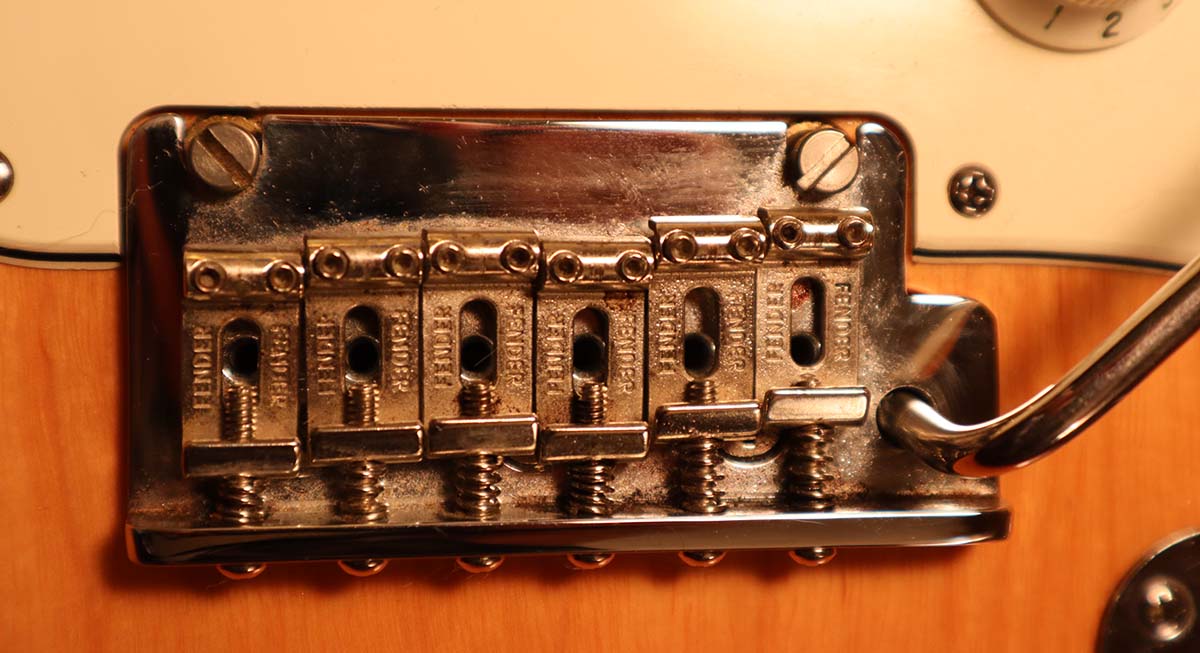
Some Stratocaster bridges use six individual saddles. This design gives you good control over string height and intonation, but it also makes careful adjustment important.

Set the tremolo bridge
The Stratocaster tremolo can be set to float or rest flat against the body. A floating bridge allows upward and downward pitch movement. A decked bridge gives a more stable feel and often makes tuning changes easier.
There is no single correct choice. Your style matters.
For a floating bridge:
- Tune the guitar.
- Check the rear edge of the bridge plate.
- Adjust the claw screws inside the spring cavity.
- Tighten both screws evenly to add spring tension.
- Loosen both screws evenly to reduce spring tension.
- Retune after every small change.
- Continue until the bridge sits at your desired angle.
Many players use three tremolo springs, while others use four or five. More springs increase resistance. The best number depends on string gauge, tuning, and how much tremolo movement you want.
For a decked bridge, tighten the claw until the bridge plate rests against the body. Check that the strings still return to pitch after bends and tremolo use.
A common mistake is adjusting the tremolo claw without retuning. Because string tension and spring tension balance each other, every change affects pitch.

Adjust the bridge saddles and intonation
Intonation makes the guitar play in tune across the fretboard. If the open string is tuned correctly but fretted notes sound sharp or flat, the saddle needs adjustment.
To set intonation:
- Install fresh strings.
- Tune the open string.
- Play the 12th fret harmonic.
- Tune the harmonic if needed.
- Play the fretted 12th fret note.
- Compare it with the open string and harmonic.
- Move the saddle in small steps.
- Retune and repeat.
If the fretted 12th fret note is sharp, move the saddle away from the neck. If it is flat, move the saddle toward the neck.
Use a good tuner and pluck each note with a normal attack. Picking too hard can make a note sound sharp and lead to a false adjustment.
The saddles usually form a gentle staircase, with the low strings farther from the neck than the high strings. Do not expect every saddle to sit in a straight line.

Set Stratocaster pickup height
Pickup height affects volume, tone, sustain, and note clarity. Pickups that sit too close to the strings can pull on them, especially on the bass side. This magnetic pull may cause strange overtones, reduced sustain, or unstable notes.
A useful starting method is:
- Fret the last fret.
- Measure the gap between the pickup pole pieces and the strings.
- Start around 6/64 inch on the bass side.
- Start around 5/64 inch on the treble side.
- Compare the volume of each pickup.
- Adjust in small steps.
Vintage-style, ceramic, and noiseless pickups may need different settings. Manufacturer recommendations are useful starting points, but your ears should make the final decision.
Raise a pickup for more output and presence. Lower it for a softer sound, more sustain, or less magnetic pull. The neck pickup often needs to sit lower because the strings vibrate more widely near the neck.
Check the nut and tuning stability
The nut guides the strings from the fretboard to the tuning machines. A poor nut can cause tuning problems, stiff bends, and sharp notes at the first few frets.
To check the nut:
- Tune the guitar.
- Play an open string.
- Play the same string at the third fret.
- Observe the gap above the first fret.
- Listen for a sudden pitch change when fretting near the nut.
- Check for binding when tuning.
If a string sits too high at the first fret, the nut slot may be too shallow. If it sits too low and buzzes when open, the slot may be too deep. Filing nut slots requires care because removing material cannot easily be undone.
Apply a small amount of suitable nut lubricant if the strings bind. Avoid using too much. Graphite from a soft pencil may help in some cases, but it will not fix a badly cut slot.
Test the complete setup
A setup is not finished when the screwdriver stops turning. It is finished when the guitar performs well in your hands.
Test the Stratocaster in the way you normally play:
- Play open chords.
- Play barre chords.
- Bend notes above the 12th fret.
- Pick softly and heavily.
- Use the tremolo if you normally use it.
- Compare the neck, middle, and bridge pickups.
- Check every fret for buzz and dead spots.
- Confirm that the guitar returns to pitch.
Listen for uneven volume between strings. Check whether bends choke out. Play familiar songs instead of only testing single notes. Your hands will reveal problems that a ruler cannot.
In my experience, the best setup is often a compromise. A player with a strong picking attack may need slightly higher action than a light-touch player. A blues player may prefer more relief and room for bends, while a technical player may want a flatter neck and lower action.
Common Stratocaster setup mistakes
Learning how to set up a Stratocaster guitar is easier when you know what to avoid. Most problems come from making several changes at once or using measurements without listening to the instrument.
Avoid these mistakes:
- Turning the truss rod more than a small amount at once
- Adjusting action before checking neck relief
- Setting intonation with old strings
- Changing string gauge without checking the tremolo
- Raising pickups too close to the strings
- Adjusting only one side of a bridge saddle
- Forgetting to retune after each adjustment
- Filing the nut without measuring first
- Chasing mild buzz that does not reach the amplifier
- Copying another player’s measurements without considering your technique
A small amount of acoustic buzz is not always a problem. Some buzz disappears through an amplifier. However, loud buzzing, dead notes, choking bends, or poor tuning stability needs further attention.
When to hire a guitar technician
You can safely perform many basic Stratocaster setup tasks at home. Truss rod adjustments, saddle height changes, intonation, and pickup height are manageable when done slowly with the right tools.
Contact a qualified guitar technician if you notice:
- A truss rod that will not turn
- A stripped adjustment nut
- A badly bowed or twisted neck
- Loose or lifted frets
- A cracked headstock
- A bridge that is pulling out of the body
- A nut that needs major filing
- Severe fret buzz in one area
- Electrical faults or weak solder joints
- A neck that will not stay attached correctly
A setup cannot repair every structural problem. It is better to pay for an inspection than to turn a small issue into permanent damage.
How often should you set up a Stratocaster?
Most Stratocasters benefit from a setup when the seasons change, after a string gauge change, or when the guitar no longer feels comfortable. A touring guitar may need attention more often than a home guitar.
Watch for these signs:
- New fret buzz
- High action
- Notes that sound out of tune higher on the neck
- A bridge that has shifted
- Strings that feel unusually stiff
- Tuning that changes after bends
- A neck that looks different from usual
Temperature and humidity changes can move the neck. Keep the guitar away from heaters, direct sunlight, and damp areas. Stable storage is one of the easiest ways to reduce setup problems.
Frequently Asked Questions About How to Set Up a Stratocaster Guitar
What should I adjust first on a Stratocaster?
Install fresh strings and tune the guitar first. Then check neck relief, because relief affects string action and should be set before bridge height and intonation.
How high should the strings be on a Stratocaster?
A common starting point is 4/64 inch for the low E string and 3/64 inch for the high E string at the 17th fret. Your ideal height may differ based on your playing force, fret condition, and preferred tone.
Which way do I turn the Stratocaster truss rod?
A clockwise turn usually reduces forward bow, while a counterclockwise turn usually adds relief. Make small changes only, and stop if the rod feels tight or difficult to turn.
Should a Stratocaster tremolo float or sit flat?
Either setup can work well. A floating tremolo offers upward and downward pitch movement, while a decked bridge provides greater stability and simpler tuning changes.
Why does my Stratocaster buzz after a setup?
Buzz can come from low action, insufficient neck relief, uneven frets, a poorly cut nut, or an overly aggressive picking style. Check relief and action first, then have the frets inspected if the buzz remains localized.
How do I fix Stratocaster intonation?
Tune the open string, compare the fretted 12th fret note with the 12th fret harmonic, and move the saddle in small steps. Move the saddle away from the neck when the fretted note is sharp, and toward the neck when it is flat.
Conclusion
A reliable Stratocaster setup follows a clear order: install fresh strings, check neck relief, set action, match the bridge radius, balance the tremolo, adjust intonation, and set pickup height. Work slowly, measure often, and make one change at a time.
The best setup is not the lowest possible action. It is the setup that matches your strings, tuning, playing style, and sound. Use this guide to make careful adjustments, and consult a guitar technician when a problem involves frets, the nut, or the neck itself. Share your setup results or explore more guitar maintenance guides to keep your Stratocaster playing its best.