

A guitar pull-off is a smooth technique that lets a fretting hand create a lower note without picking again.
If you are searching for how to pull off guitar, you are learning one of the core techniques behind clean riffs, fast solos, blues licks, and legato guitar playing. A good pull-off is not just a quick finger lift. It uses controlled finger motion, accurate timing, steady pressure, and a relaxed hand. This guide explains the technique step by step, shows common mistakes, and gives practice drills that work on both electric and acoustic guitar.
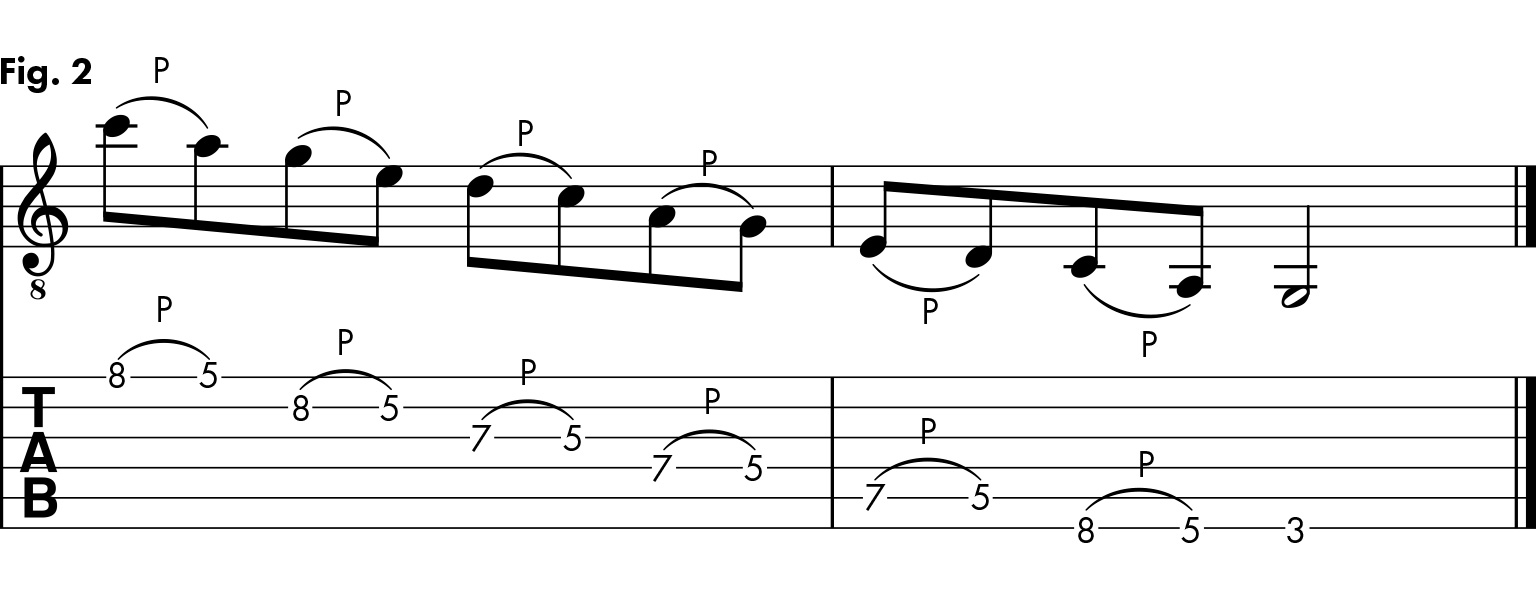
What Is a Pull-Off on Guitar?
A pull-off is a fretting-hand technique used to move from a higher note to a lower note on the same string. You pick the first note, then remove the higher fretting finger so the lower note rings without another pick stroke.
For example, place your first finger on the fifth fret and your third finger on the seventh fret of the same string. Pick the seventh-fret note, then pull your third finger away while keeping your first finger pressed down. The open sound from the first finger creates the fifth-fret note.
A pull-off is written in guitar tablature with the letter “p”:
e|------7p5------|
B|--------------|
G|--------------|
D|--------------|
A|--------------|
E|--------------|
This tab means you pick the note at the seventh fret and pull off to the note at the fifth fret.
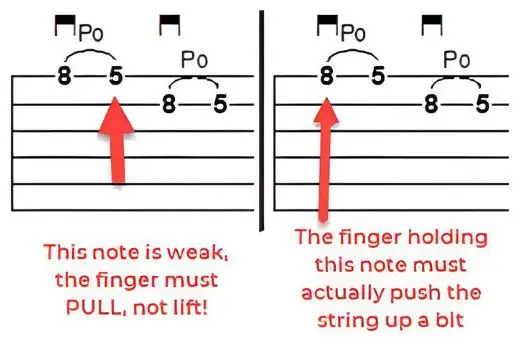
A pull-off differs from simply lifting your finger. If you lift straight up, the lower note may sound weak or may not sound at all. A proper pull-off gives the string a small sideways release, almost like lightly plucking it with the fretting finger.

How to Pull Off Guitar Correctly
Learning how to pull off guitar becomes much easier when you break the motion into small steps. Start slowly and focus on a clear sound rather than speed.
1. Choose two notes on one string
Begin with a simple two-fret pattern. Place your index finger on the fifth fret and your ring finger on the seventh fret of the high E string.
Your fingers should stay close to the fretboard. Avoid lifting the ring finger several inches into the air. Large movements waste time and make the technique less accurate.
2. Pick the higher note
Pick the seventh-fret note once. Let it ring for a moment so you can hear its pitch and volume.
Keep your index finger firmly on the fifth fret. That finger must already be in place before you remove the higher finger.
3. Pull the higher finger slightly down
Do not yank your finger straight off the string. Instead, move it slightly downward or toward the floor as you release the string.
This small movement gives the string enough energy to sound the lower note. Think of it as a tiny pluck, not a simple lift.
4. Keep the lower note pressed
Your index finger must press close to the fret wire. If it sits too far behind the fret, the note may buzz or sound dull.
The lower note should sound almost as full as the first note. It may be a little softer, but it should remain clear and controlled.
5. Mute unwanted strings
Your picking-hand palm can mute the lower strings. Your fretting-hand index finger can also lightly touch nearby strings.
This matters because pull-offs can create extra noise. Clean muting separates a polished guitar phrase from a messy one.

Pull-Off Technique for Beginners
If you are new to guitar, start with one-string exercises. The goal is to teach your fingers how much pressure and movement the technique needs.
Use a metronome at about 60 beats per minute. Play one pull-off per beat and listen closely to both notes.
e|--7p5--7p5--7p5--7p5--|
B|----------------------|
G|----------------------|
D|----------------------|
A|----------------------|
E|----------------------|
Pick only the first note of each pair. The second note should come from the pull-off.
Next, try the pattern on each string:
e|--7p5----------------|
B|--------7p5----------|
G|--------------7p5----|
D|------------------7p5|
A|---------------------|
E|---------------------|
Move slowly. Your fingers may feel stiff at first. That is normal, but sharp pain is not. Stop if you feel pain in your wrist, thumb, or fingers, and check your posture and hand tension.
A useful beginner rule is to practice clean pull-offs before fast pull-offs. Speed hides mistakes. Slow practice reveals them.

The Difference Between a Pull-Off and a Hammer-On
A pull-off moves from a higher fretted note to a lower note. A hammer-on moves from a lower note to a higher note without picking the second note.
Example of a hammer-on:
e|------5h7------|
B|--------------|
G|--------------|
D|--------------|
A|--------------|
E|--------------|
Example of a pull-off:
e|------7p5------|
B|--------------|
G|--------------|
D|--------------|
A|--------------|
E|--------------|
Both techniques are part of legato playing. Legato means creating smooth, connected notes with less reliance on repeated picking.
A hammer-on usually needs a firm finger drop. A pull-off needs a controlled release and a slight sideways motion. Many players find pull-offs harder at first because the lower note can disappear if the release is too passive.

Common Pull-Off Mistakes
Most problems with how to pull off guitar come from a few simple technique errors. Fixing them early will save you weeks of frustration.
Lifting the finger straight up
This is the most common mistake. A straight lift does not give the string enough motion, so the second note sounds weak.
Try releasing the finger with a small downward sweep. The movement should be subtle, not dramatic.
Pressing too hard
Excess pressure can make your hand tense. It also slows your fingers and may pull the note sharp.
Use only enough pressure to produce a clear note. Place your finger just behind the fret wire rather than pressing in the middle of the fret space.
Letting the lower note go flat
If the lower finger moves while the higher finger pulls off, the pitch may change. Keep the lower finger stable and close to the fret.
This is especially important during wide stretches or when playing with the little finger.
Playing too loudly with the first note
Some players pick the high note hard and produce a much softer lower note. The phrase then sounds uneven.
Practice matching the volume of both notes. You can also slightly reduce the picking force on the first note while improving the pull-off motion.
Ignoring string noise
Pull-offs can cause nearby strings to ring. This often happens during fast rock, metal, and blues passages.
Use the side of your picking hand to mute unused lower strings. Let your fretting hand touch higher strings lightly when needed.
Practicing only at high speed
Fast practice can reinforce poor movement. Use a metronome and increase the tempo only when every note is clear.
A good test is to play the same pattern slowly, at medium speed, and then fast. If the sound changes greatly, your technique needs more control.

Pull-Off Exercises That Build Control
These exercises help develop strength, timing, tone, and coordination. Practice each one for a few minutes rather than repeating one drill for too long.
Exercise 1: Two-fret pull-offs
e|--8p5--8p5--8p5--8p5--|
B|----------------------|
G|----------------------|
D|----------------------|
A|----------------------|
E|----------------------|
Use your index finger on the fifth fret and your pinky on the eighth fret. This exercise builds reach and control.
Exercise 2: Three-note pull-offs
e|--7p5p3--7p5p3--|
B|----------------|
G|----------------|
D|----------------|
A|----------------|
E|----------------|
Pick the seventh-fret note once. Then pull off to the fifth fret and again to the third fret.
This exercise is harder because the finger must release twice. Keep each finger ready before the phrase begins.
Exercise 3: Descending scale pull-offs
e|--8p7p5----------------|
B|----------8p6p5--------|
G|----------------7p5---|
D|----------------------|
A|----------------------|
E|----------------------|
This pattern introduces pull-offs into a musical scale shape. Play it slowly and keep the rhythm even.
Exercise 4: Pull-offs with a metronome
Set a metronome to 60 beats per minute. Play four notes per beat only when your technique is comfortable.
Then increase the speed by five beats per minute. If the notes become unclear, lower the tempo and rebuild your control.
How to Make Pull-Offs Sound Stronger
A strong pull-off comes from timing, finger placement, and a relaxed hand. Finger strength helps, but strength alone does not solve the problem.
Keep your thumb behind the guitar neck. Do not squeeze the neck like you are holding a heavy object. Your thumb should support the hand while allowing the fingers to move freely.
Use the tip of each finger and fret close to the metal fret wire. This reduces the pressure needed for a clean note.
Your fingernails should be short enough to let your fingertips contact the strings properly. Long nails can make accurate fretting difficult.
On electric guitar, moderate gain can make legato notes easier to hear, but too much gain also reveals unwanted noise. On acoustic guitar, you need more precise finger motion because the unplugged signal gives you less sustain.
A practical test is to play a pull-off without an amplifier. If both notes remain clear, the technique is likely under control. If only distortion makes the phrase sound smooth, work on the basic motion.
:max_bytes(150000):strip_icc()/pull-offs-56a462295f9b58b7d0d6b2ab.png)
How to Practice Pull-Offs Without Hand Strain
Good technique should feel controlled, not painful. Take short breaks every few minutes, especially during repeated drills.
Keep your wrist fairly straight and avoid bending it sharply toward the guitar. Let your elbow hang naturally instead of pressing it tightly against your body.
Before practicing, warm up with gentle chromatic exercises. Do not force your fingers to stretch farther than they can comfortably reach.
Use this simple practice plan:
- Play open strings for one minute to relax your picking hand.
- Practice 7p5 pull-offs for two minutes on one string.
- Move the pattern across all six strings.
- Practice a three-note pattern such as 7p5p3.
- Play a real lick that uses pull-offs.
- Record yourself and listen for uneven volume or noise.
In my own practice, the biggest improvement usually comes from reducing tension. Many players believe they need stronger fingers, but they often need smaller movements and better timing instead.

How Pull-Offs Are Used in Different Guitar Styles
Pull-offs appear in nearly every guitar style, but each genre uses them in a different way.
Blues guitar
Blues players use pull-offs in pentatonic licks, often moving from a bent or held note to a lower chord tone. The technique adds a vocal quality, like a singer dropping into a lower note.
Rock guitar
Rock guitar uses pull-offs for fast descending phrases and expressive riffs. Distortion can add sustain, but clean muting remains essential.
Metal guitar
Metal players often combine pull-offs with alternate picking, palm muting, and high gain. Precision matters because fast passages can become noisy very quickly.
Country guitar
Country players use pull-offs in hybrid-picked lines and open-string phrases. The technique helps connect fretted notes with ringing open strings.
Folk and acoustic guitar
Acoustic players use pull-offs in melodic fills and fingerstyle patterns. Clear finger placement is important because acoustic strings can require more effort to sound fully.
Classical guitar
Classical guitar technique uses similar left-hand releases, but the tone, posture, and right-hand approach differ. Players should follow classical instruction when working on formal classical repertoire.
Pull-Offs, Guitar Setup, and String Choice
Your guitar setup can affect how easy pull-offs feel. High action, old strings, or heavy string gauges may require more finger pressure.
Action is the distance between the strings and the frets. If the action is too high, pull-offs may feel harder and the notes may lose clarity.
A professional setup can check:
• Neck relief
• String height
• Fret condition
• Intonation
• Nut height
• Pickup height
Do not assume your technique is the only problem. A poorly adjusted guitar can make basic movements feel much harder.
Lighter strings may help beginners, but they are not automatically better for every player. The best string gauge depends on your tuning, guitar type, playing style, and comfort.
If your guitar buzzes badly or needs extreme pressure, have it checked by a qualified guitar technician. Technique cannot fully correct a hardware problem.
How Long Does It Take to Learn Pull-Offs?
Many beginners can produce a basic pull-off within a few practice sessions. A clean, even pull-off across different strings may take several weeks or longer.
Progress depends on practice quality, hand coordination, string tension, and previous musical experience. Ten focused minutes each day can be more useful than one long session each week.
Track three things as you practice:
• Is the second note clear?
• Is its volume close to the first note?
• Are nearby strings quiet?
When all three answers are yes, raise the metronome speed slowly. Do not measure progress by speed alone. A slow and musical pull-off is more useful than a fast and noisy one.
Frequently Asked Questions About How to Pull Off Guitar
What does “pull-off” mean on guitar?
A pull-off is a technique where you play a higher fretted note and release it to a lower fretted note without picking again. The releasing finger gives the string a small pluck as it leaves.
Why does my pull-off sound weak?
Your finger may be lifting straight up instead of moving slightly across the string. Make sure the lower finger stays pressed and that the higher finger releases with a small, controlled sweep.
Do I pick both notes in a pull-off?
No. In a standard pull-off, you pick the first, higher note only. The lower note comes from the fretting-hand release.
Can you do pull-offs on an acoustic guitar?
Yes. Pull-offs work on acoustic guitar, electric guitar, classical guitar, and bass. Acoustic guitars may require more accurate finger motion because the strings often have less amplified sustain.
Should pull-offs be fast?
Pull-offs can be fast, but speed should come after control. Practice slowly until both notes sound clear, then raise the tempo in small steps.
Are pull-offs harder than hammer-ons?
Many beginners find pull-offs slightly harder because the lower note must be created during the release. With steady practice, both techniques can become natural parts of legato playing.
Do I need strong fingers to perform pull-offs?
Finger strength helps, but control and timing matter more. A relaxed hand, proper fret placement, and a small sideways release usually improve pull-offs more than simply squeezing harder.
Conclusion
Learning how to pull off guitar is about creating a clear lower note with a controlled fretting-hand release. Start with two notes on one string, keep the lower finger planted, move the higher finger slightly across the string, and mute unwanted noise.
Practice slowly with a metronome and focus on equal volume, clean timing, and relaxed movement. Once the basic motion feels natural, add three-note patterns, scales, blues licks, and full guitar phrases.
Spend ten focused minutes today on the 7p5 exercise, record the result, and listen for improvement. Then explore more legato exercises and share your progress with other guitar players.