

Introduction
For readers in the United States, the piano is a familiar part of homes, schools, churches, concert halls, and popular music. Yet the modern piano did not begin in America. The piano was invented in Florence, Italy, around the year 1700 by Bartolomeo Cristofori.
Cristofori created a keyboard instrument that could play both soft and loud notes. That ability gave the instrument its early name, gravicembalo col piano e forte, which means “harpsichord with soft and loud.” The word “piano” comes from that phrase.
The piano later changed in Germany, England, France, and the United States. American makers, especially Steinway & Sons, helped shape the large concert grand piano used today.

Where Was the Piano Invented?
The piano was invented in Florence, Italy, by Bartolomeo Cristofori. He worked for Prince Ferdinando de’ Medici, a member of Florence’s powerful Medici family.
Cristofori was a skilled maker of keyboard instruments. Around 1700, he designed a new instrument that used hammers to strike strings. The player could control the volume by pressing the keys with more or less force.
This was a major change from older keyboard instruments. On a harpsichord, the strings were plucked. The player could not make one note much louder or softer by changing finger pressure. Cristofori’s design solved that problem.
The earliest known written record of Cristofori’s piano comes from an inventory made in 1700. It described an instrument with “soft and loud” control. Historians generally use this date as the birth of the piano, although Cristofori may have developed the design over several years.
Who Invented the Piano?
Bartolomeo Cristofori invented the piano. He was born in Padua, in what is now Italy, in 1655. He later moved to Florence to work for the Medici court.
Cristofori built at least three early pianos that still survive. Two are dated 1720 and 1722. One is held by the Metropolitan Museum of Art in New York. Another is in the Museo Nazionale degli Strumenti Musicali in Rome.
These surviving instruments show that Cristofori’s work was not just an idea on paper. He had already created a working keyboard action with many features found in later pianos.

What Instruments Came Before the Piano?
The piano developed from several older string and keyboard instruments. It did not appear from nowhere.
The main predecessors were:
- The dulcimer: A string instrument played by striking strings with small hammers.
- The clavichord: A quiet keyboard instrument in which metal blades touched the strings.
- The harpsichord: A keyboard instrument that plucked strings with small quills or similar parts.
- The organ: A keyboard instrument that produced sound through pipes rather than strings.
The piano combined ideas from these instruments. Like a dulcimer, it used hammers. Like a clavichord and harpsichord, it had a keyboard. But its key innovation was control.
When a player pressed a piano key, a felt-covered hammer moved toward a string and struck it. Pressing the key harder made the hammer move faster. That usually produced a louder sound. Pressing it gently produced a softer sound.
This relationship between touch and volume made the piano useful for expressive music. It could play melodies, chords, bass lines, and changing dynamics with one performer.
How Is a Piano Different From a Harpsichord?
A piano strikes its strings with hammers. A harpsichord plucks its strings.
That difference affects the sound and the player’s control. A harpsichord can have a bright, clear tone, but key pressure does not directly change the volume of each note. A piano can respond to touch, so the player can shape a phrase from quiet to loud.
Many modern pianos also have pedals. The sustain pedal lets notes ring after the player lifts the keys. Harpsichords may have stops or multiple keyboards, but they do not work in the same way as piano pedals.

How Did the Early Piano Develop?
The early piano developed slowly during the 1700s. Cristofori’s design was advanced, but it was not immediately common across Europe.
Italian writer Scipione Maffei described Cristofori’s instrument in a 1711 article. The article helped spread knowledge of the invention. German instrument makers then built their own versions.
One important maker was Gottfried Silbermann, who made pianos in Germany. Johann Sebastian Bach examined one of Silbermann’s instruments. Early reports suggest that Bach had concerns about its action but later approved improvements.
By the middle and late 1700s, piano makers were producing several forms of the instrument. These included:
- Square pianos, which had a rectangular case and horizontal strings.
- Grand pianos, which had a wing-shaped case and horizontal strings.
- Upright pianos, which placed the strings and soundboard in a vertical case.
The piano became more popular as composers wrote music that used its expressive range. Wolfgang Amadeus Mozart played and composed for the piano. Later, Ludwig van Beethoven helped push the instrument toward greater power and range.
Why Did the Piano Become So Popular?
The piano became popular because one person could play harmony, melody, rhythm, and bass at once.
It also worked well in private homes. A family could use a piano for lessons, practice, social music, and entertainment. In the 1800s, piano ownership became a sign of education and social status in many middle-class homes.
Music publishers also helped spread piano culture. They sold sheet music that amateurs could play at home. This created a large market for pianos, teachers, composers, and repair workers.

When Did the Piano Come to the United States?
The piano reached the American colonies during the 1700s. Wealthy families and public institutions imported European instruments. American makers later began building pianos locally.
The United States became a major piano-making center during the 1800s. Firms in cities such as Boston, New York, and Philadelphia produced instruments for a growing domestic market.
Several changes helped the American piano industry grow:
- Industrial production lowered costs. Factories could make parts in larger numbers.
- Urban populations increased. More homes, schools, theaters, and churches needed instruments.
- Music education expanded. Piano lessons became common for children.
- Rail transport improved distribution. Makers could ship pianos to more parts of the country.
- American designers changed the structure. Stronger frames allowed pianos to use higher string tension.
The piano was therefore not invented in the United States. However, American builders played a major role in making the modern piano larger, louder, and more durable.
What Did Steinway Change?
Steinway & Sons was founded in New York City in 1853 by Henry E. Steinway and his sons. The company introduced several important design improvements and helped establish the modern concert grand.
One major development was the use of an iron frame that could support high string tension. Steinway also advanced the overstrung design, in which some bass strings cross over other strings. This allowed a longer bass string length within a manageable case.
The company’s designs influenced concert pianos around the world. Other makers also contributed important innovations, so the modern piano is the result of work by many builders rather than one company.
For US readers, this history explains why “American piano” can mean something different from “where the piano was invented.” The invention began in Italy. The United States became one of the most influential centers of piano production and design.
How Did the Modern Piano Get Its Shape?
The modern piano has its familiar shape because its strings need length, tension, and support.
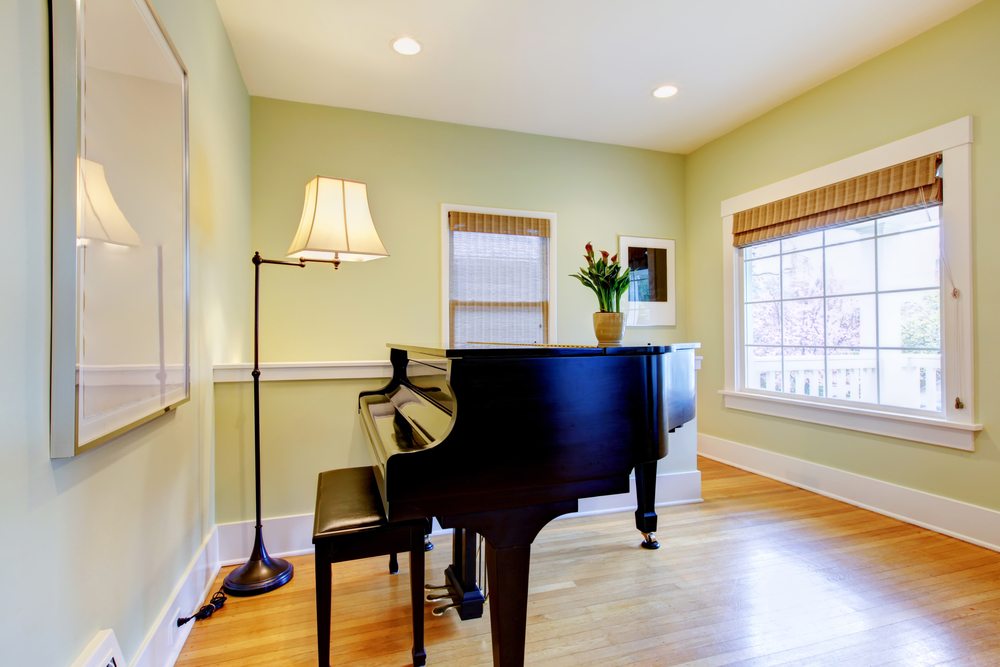
A grand piano places its strings horizontally. The bass strings are long and thick. The treble strings are shorter and thinner. The case widens toward the bass end, which creates the instrument’s curved, wing-like outline.
An upright piano turns the strings and soundboard into a vertical layout. This saves floor space. That design made the piano more practical for American homes, apartments, schools, and churches.
The main parts of an acoustic piano include:
- Keyboard: The set of keys used to control the notes.
- Action: The system of levers and parts between the keys and hammers.
- Hammers: Felt-covered parts that strike the strings.
- Strings: Metal wires that vibrate to create sound.
- Soundboard: A wooden panel that amplifies the string vibration.
- Frame: The structure that supports the tension of the strings.
- Pedals: Controls that change sustain, tone, or volume.
The instrument’s basic principle remains close to Cristofori’s idea: a key releases a hammer, and the hammer strikes a string.

Is the Piano Italian, German, English, or American?
The piano is Italian by invention, but its later development was international.
A simple way to understand its national history is:
| Part of the piano’s story | Main place associated with it |
|---|---|
| Invention | Florence, Italy |
| Early spread | Germany and other parts of Europe |
| Major 18th-century use | Austria, Germany, and England |
| Industrial growth | England, Germany, France, and the United States |
| Modern concert-piano influence | Several countries, including the United States and Germany |
Calling the piano “Italian” is correct when discussing its origin. Calling some pianos “American,” “German,” or “Japanese” usually refers to where they were designed, built, or associated with a manufacturer.
The country of manufacture can also change over time. A piano brand may have a long history in one country while some models are built in another country. Buyers should check the specific model and its production label instead of relying only on the brand name.
What Is the Difference Between an Acoustic Piano and a Digital Piano?
An acoustic piano creates sound through physical strings, hammers, and a soundboard. A digital piano creates sound through electronics, recordings, or digital models.
An acoustic piano has:
- Strings that vibrate.
- Hammers that strike the strings.
- A soundboard that projects the sound.
- Regular tuning needs.
- A strong connection between key movement and sound production.
A digital piano has:
- Electronic sensors.
- Speakers or headphone output.
- A power supply.
- No acoustic strings to tune.
- Features such as volume control, recording, and different instrument sounds.
A digital piano is not the same thing as the original invention made by Cristofori. It is a later electronic instrument that copies some of the piano’s key response and sound.
The best choice depends on the player’s needs. An acoustic piano may suit someone who wants traditional tone and does not mind tuning and maintenance. A digital piano may suit someone who needs headphones, lower weight, or easy volume control.
Common Misconceptions About the Piano’s Origin
Several common claims about the piano need a little correction.
“The piano was invented by Beethoven.”
Beethoven did not invent the piano. He was a major composer and pianist who helped expand the instrument’s musical possibilities.
“The piano came from the harpsichord.”
The harpsichord influenced piano development, but the piano was not simply a louder harpsichord. Its hammer action allowed control of volume through touch.
“The modern piano is the same as Cristofori’s piano.”
Cristofori’s instrument established the core idea. Modern pianos have a wider range, stronger frames, improved actions, better pedals, and more advanced manufacturing.
“Every piano with an Italian name was made in Italy.”
A brand name does not always show where a specific instrument was built. Check the soundboard label, serial information, and manufacturer records when origin matters.
“A digital piano is an acoustic piano.”
A digital piano can copy the feel or sound of an acoustic piano, but it creates sound electronically. The two instruments use different technologies.

How Can You Identify the Origin of a Piano?
To identify where a specific piano came from, start with the name and serial number.
Look in these places:
- Open the fallboard above the keys.
- Check the inside of the case.
- Look near the soundboard or iron frame.
- Find the serial number.
- Search the manufacturer’s official records.
- Ask a qualified piano technician to inspect the instrument.
A brand’s history can tell you where the company began. It may not tell you where your particular piano was made.
The serial number can help identify the production year. It may also help distinguish between models made in different factories. Be careful with online lists that give exact dates without identifying their source or model range.
If you plan to buy an older piano, have a technician inspect the soundboard, bridges, pinblock, action, strings, and frame. A piano’s age alone does not determine its value or condition.
Key Takeaways
- The piano was invented in Florence, Italy, around 1700.
- Bartolomeo Cristofori is credited with creating the first piano.
- The first piano used hammers to strike strings and allowed players to control volume through touch.
- The instrument developed from the dulcimer, clavichord, harpsichord, and other keyboard instruments.
- The United States did not invent the piano, but American makers helped shape the modern concert piano.
- Steinway & Sons, founded in New York City in 1853, became one of the most influential American piano companies.
- A specific piano’s country of origin should be checked through its label, serial number, model, and manufacturer records.
Frequently Asked Questions
Where did the piano originally come from?
The piano originally came from Florence, Italy. Bartolomeo Cristofori developed it for the Medici court around 1700.
Was the piano invented in Italy or Germany?
The piano was invented in Italy. German makers later improved and spread the design across Europe.
Who made the first piano?
Bartolomeo Cristofori made the first known piano. At least three of his early instruments still survive.
When did pianos become common in America?
Pianos became increasingly common in the United States during the 1800s. Local manufacturing, industrial production, music education, and home entertainment all helped increase ownership.
Is Steinway an American piano?
Steinway & Sons is an American-founded piano company. It was established in New York City in 1853. The origin of a particular Steinway depends on its model and production location.
What should I check if I own an old piano?
Check the brand, serial number, model, frame, soundboard, bridges, pinblock, strings, and action. A piano technician can tell you more about its condition and likely repair needs than its age alone.
Conclusion
The answer to “where is the piano from?” is Florence, Italy. Bartolomeo Cristofori created the instrument around 1700 by combining a keyboard with a hammer action that could produce soft and loud sounds.
The piano then became a shared achievement of European and American makers. Italy gave it its start, while builders in Germany, England, France, and the United States changed its size, power, range, and design. To identify the origin of a particular piano, use its manufacturer label, model, serial number, and production records.