

A 12-string guitar has six paired courses: octave strings on the lower four pairs and unison strings on the top two.
Learning what are the strings on a 12 string guitar makes the instrument much easier to tune, restring, and play. Each pair works together like one wide voice, but the octave pairs add the bright, rich sound that makes a 12-string guitar so special.
What Are the Strings on a 12 String Guitar?
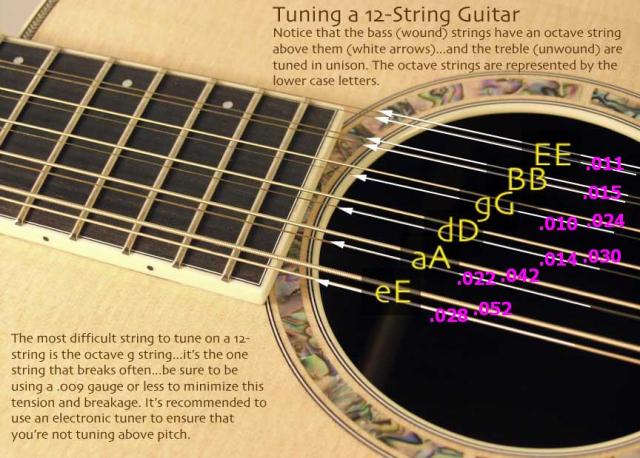
A standard 12-string guitar has 12 individual strings arranged in six pairs, called courses. Each course is tuned and played as a pair, so the guitar still uses the familiar six-note pattern:
- Low E
- A
- D
- G
- B
- High E
The main difference is that each note has a second string beside it. On the lower four courses, the second string is usually tuned one octave higher. On the B and high E courses, both strings use the same pitch.
This arrangement explains what are the strings on a 12 string guitar better than simply listing 12 notes. The guitar does not use 12 completely different notes. Instead, it doubles the normal six-string layout to create more volume, shimmer, and harmonic depth.

12-String Guitar String Order and Notes
Here is the standard tuning for a 12-string acoustic guitar, from the lowest course to the highest course:
| Course | Main string | Paired string | Relationship |
|---|---|---|---|
| Low E | E2 | E2 | Same pitch |
| A | A2 | A2 | Same pitch |
| D | D3 | D3 | Same pitch |
| G | G3 | G4 | One octave higher |
| B | B3 | B3 | Same pitch |
| High E | E4 | E4 | Same pitch |
The octave pair appears most often on the G course in standard 12-string tuning. This is because the G string is low enough to benefit from an extra octave but high enough to remain comfortable to play.
The low E, A, and D pairs are often both tuned to the same pitch. Their octave strings would need to be very thin or very high, which could make them less stable and less useful for normal playing.
Reading the string layout
When you hold the guitar in playing position, each course contains two strings placed close together. The thicker string usually carries the main note, while the thinner string creates the octave on the E, A, D, and G courses.
The exact physical order can vary by guitar brand and setup. For that reason, it is safer to identify strings by pitch and thickness rather than assuming the thinner string is always on a certain side.
A common way to describe the courses is:
• Low E pair: E and E
• A pair: A and A
• D pair: D and D
• G pair: G and high G
• B pair: B and B
• High E pair: E and E
This course-based view is the clearest answer to what are the strings on a 12 string guitar.

Why Does a 12-String Guitar Have Paired Strings?
Paired strings make a 12-string guitar sound wider and brighter than a six-string guitar. When you strum one course, both strings vibrate at nearly the same time. The small difference between their sound waves creates a natural shimmer.
The octave strings are especially important. For example, the G course contains a low G and a higher G. Your ear hears both notes as one musical idea, but the octave adds extra color and movement.
The B and high E courses use unison pairs. This means both strings produce the same note. They add fullness without creating a new octave.
You can think of the sound as two singers performing the same song, with some singers placed one octave apart. The result is bigger than either voice alone.
The role of unison strings
Unison strings help the upper courses sound clear and focused. If every pair used an octave, the high end could become too sharp and crowded.
The paired high B and high E strings also make familiar chord shapes sound more powerful. Open chords, especially G, C, D, and E, can sound almost orchestral on a well-set-up 12-string guitar.
What Is the Standard Tuning for a 12-String Guitar?
The standard tuning is usually written as:
E2 E2, A2 A2, D3 D3, G3 G4, B3 B3, E4 E4
From the lowest course to the highest, this gives the same basic tuning pattern as a six-string guitar:
E, A, D, G, B, E
The added strings do not normally change the main chord shapes. A standard G chord still uses the same fretting pattern. However, the extra strings make every strum and picked note sound fuller.
Some players use a tuner that displays each string one at a time. This can be helpful, but a clip-on tuner may struggle if both strings in a course ring together. Muting the nearby string or tuning each string separately can improve accuracy.
Standard tuning chart
| Course | Pitch names | Common string type |
|---|---|---|
| 6th course | E2 and E2 | Two thick wound strings |
| 5th course | A2 and A2 | Two wound strings |
| 4th course | D3 and D3 | Two wound strings |
| 3rd course | G3 and G4 | Wound G and thin octave G |
| 2nd course | B3 and B3 | Two plain strings |
| 1st course | E4 and E4 | Two plain strings |
Pitch labels can differ by octave-numbering system. The practical point is that the lowest pair is E, the next is A, and the highest pair is E.

Which Strings Are Octaves on a 12-String Guitar?
The octave pairs are normally the D and G courses, depending on the string design and tuning system. In many standard acoustic 12-string sets, the G course has a low G and a high G, while the D course may use a low D and a higher D.
However, string manufacturers do not all use the same octave plan. Some sets use octave strings on the lower four courses, while others use different gauges or layouts to reduce tension and improve playability.
Before replacing a string, check the package or the guitar maker’s recommended string chart. This small step can prevent a costly tuning mistake.
Common standard arrangement
The most common arrangement is:
• Low E: two E strings at the same pitch
• A: two A strings at the same pitch
• D: a low D and an octave D
• G: a low G and an octave G
• B: two B strings at the same pitch
• High E: two E strings at the same pitch
This is one reason people ask what are the strings on a 12 string guitar. The answer depends partly on whether they mean the six courses or all 12 individual strings.

How Are 12-String Guitar Strings Numbered?
String numbering can seem confusing because a 12-string guitar has both individual strings and paired courses.
When counting from the thinnest, highest string, the first course is usually the high E pair. The second course is the B pair. The lowest course is the low E pair.
A common individual-string order from highest to lowest is:
- High E string
- High E pair
- B string
- B pair
- G octave
- G main string
- D octave
- D main string
- A string
- A pair
- Low E string
- Low E pair
Manufacturers may label the two strings in a course differently. Some use numbers such as 1 and 2 for the high E pair, while others describe them as the “octave” and “main” strings.
For restringing, the most useful labels are usually:
• High E pair
• B pair
• G pair
• D pair
• A pair
• Low E pair
This naming system is less confusing than relying only on numbers.

What String Gauges Does a 12-String Guitar Use?
A 12-string guitar usually uses lighter strings than a six-string guitar. This helps control the total tension placed on the neck, bridge, and top.
Common 12-string acoustic sets may range from extra light to medium gauges. Exact sizes vary, but a set might include high E strings around .010 or .011 inches and low E strings around .046 to .052 inches.
The total tension still adds up quickly because the guitar carries 12 strings. A 12-string set is not simply a six-string set doubled. It is designed as a matched group with suitable gauges for the instrument.
Common gauge choices
• Extra light: easier to fret, softer tone, lower tension
• Light: a popular balance of comfort and volume
• Medium: stronger projection, but more hand and neck tension
• Custom sets: useful for alternate tunings or special repairs
Always check the manufacturer’s recommendation before changing gauges. A heavier set may cause high action, neck movement, bridge lift, or tuning problems.
In my own setup work, one of the most common mistakes is treating a 12-string guitar like a six-string guitar. Installing the wrong set can make the instrument feel stiff within minutes. The right set often improves comfort more than any expensive upgrade.

How Do You Tune a 12-String Guitar?
Tune each pair to its correct pitch, then compare the two strings by ear. The strings should sound like one note, except for octave pairs, which should sound like the same note at two different heights.
A reliable tuning method is:
- Loosen or mute all nearby strings.
- Tune the thicker string in the course.
- Tune the paired string separately.
- Play both strings together.
- Listen for unwanted pulsing or wavering.
- Repeat the check after stretching the strings gently.
A pulsing sound usually means the two strings are slightly out of tune. On unison pairs, the pitches should match closely. On octave pairs, the notes should remain musically related without sounding identical.
Use a chromatic tuner for the first pass. Then use your ears for the final check. A tuner tells you the note name, but your ears tell you whether the course sounds smooth.
A useful tuning tip
Tune slightly below the target pitch first, then raise the string slowly to the note. This helps the string settle against the tuning post and bridge.
After tuning all 12 strings, strum a few open chords. The instrument may shift slightly because each string adds tension. Recheck the tuning once or twice before playing a full song.

How Do You Restring a 12-String Guitar?
Restringing a 12-string guitar takes patience. The bridge and headstock can become crowded, and the extra strings make mistakes easier to miss.
Replace strings one course at a time if the guitar is in good condition and you want to keep the neck tension stable. Some repair technicians remove all the strings during a full clean, but beginners may find that method harder.
Follow these steps:
- Lay the guitar on a stable, padded surface.
- Identify the correct course before removing the old string.
- Remove one string and clean the exposed area.
- Install the new string through the bridge.
- Leave enough slack for two or three neat tuner-post wraps.
- Wind the string toward the center of the headstock.
- Bring it close to pitch without overtightening.
- Tune the paired string.
- Stretch both strings gently.
- Retune and check the bridge and nut.
Do not force a string into the wrong nut slot. The octave string and main string may have different slot widths. A string that sits too high or too low can create buzzing, poor intonation, or tuning instability.
My practical lesson is simple: label the old string before removing it if you are unsure. A quick photo of the headstock can also save time. It is much easier to copy a clear layout than to solve a puzzle with 12 loose strings.

How Does a 12-String Guitar Differ From a Six-String Guitar?
The biggest difference is the paired-string design. A six-string guitar has one string per course, while a 12-string guitar has two strings per course.
This changes the instrument in several ways:
• Chords sound broader and more colorful.
• Single-note lines have extra harmonic depth.
• The neck feels wider and more crowded.
• Fretting requires more pressure and accuracy.
• Tuning takes longer.
• String replacement costs more.
• The guitar may need more frequent setup work.
A 12-string guitar is not automatically better than a six-string guitar. It is better for certain sounds, such as folk, rock, country, worship, and layered acoustic parts.
For delicate fingerstyle work, some players prefer a six-string because each note is easier to control. For large open chords, a 12-string can fill the room with very little effort.
What Are the Benefits and Limitations of 12-String Guitar Strings?
The main benefit is sonic depth. The paired strings create natural doubling, while the octave courses add sparkle and movement.
Other benefits include:
• Stronger sound during solo acoustic playing
• Fuller open chords
• Richer arpeggios
• A wide stereo-like effect when recorded
• Excellent support for folk and acoustic rock
• More presence without heavy effects
The limitations are just as real. A 12-string guitar can be harder to tune, harder to restring, and more demanding on the hands.
Players with hand pain should use light strings, take breaks, and avoid squeezing the neck too hard. A professional setup can also reduce high action, which is often the main cause of discomfort.
The sound depends on more than the strings. The guitar’s bracing, body shape, scale length, nut width, bridge design, and construction all affect the result. This is why two guitars with the same string set can feel and sound very different.
Common 12-String Guitar Tuning Variations
Standard tuning is only one option. Players often tune a 12-string guitar down to reduce tension and create a warmer tone.
Common alternatives include:
• Whole-step-down tuning: D G C F A D
• Half-step-down tuning: E-flat, A-flat, D-flat, G-flat, B-flat, E-flat
• Open G tuning: useful for slide and blues
• Open D tuning: useful for ringing chord textures
• Nashville tuning: uses high octave strings on a six-string guitar
Lower tuning can make a 12-string guitar feel more relaxed. It may also reduce the risk of excessive tension on older instruments.
Nashville tuning deserves special attention. It is not the same as a normal 12-string guitar. A six-string guitar uses the thinner octave strings from a 12-string set, creating a bright, layered sound when combined with another guitar.
Before using an unusual tuning, confirm that the string gauges suit it. Very loose strings can sound unstable, while very tight strings can stress the instrument.
How Do You Choose the Right 12-String Guitar Strings?
Choose strings based on the guitar, your playing style, and the sound you want. The best string set is not always the heaviest or most expensive one.
Consider these factors:
• Guitar manufacturer recommendations
• Scale length
• Body size
• Current string gauge
• Playing comfort
• Desired brightness or warmth
• Standard or alternate tuning
• Age and condition of the instrument
Phosphor bronze strings often provide a balanced acoustic tone. 80/20 bronze strings can sound brighter and more metallic when new. Coated strings may last longer, though some players prefer the natural feel of uncoated strings.
If your guitar feels too stiff, try a lighter set. If the sound lacks body and the instrument handles the tension well, a slightly heavier set may help. Change one variable at a time so you know what improved or harmed the result.
Mistakes to Avoid With 12-String Guitar Strings
Many problems come from small errors rather than serious instrument damage. Knowing what are the strings on a 12 string guitar helps you avoid most of them.
Avoid these common mistakes:
• Installing a six-string set on a 12-string guitar
• Mixing random gauges without checking tension
• Tuning an octave string to the wrong octave
• Tightening a string far above its target pitch
• Cutting all strings before photographing the layout
• Ignoring buzzing at the nut or bridge
• Using heavy strings on an older guitar without advice
• Skipping a setup after changing gauge
A string that breaks during tuning is often a sign of a sharp nut slot, a rough bridge edge, or excessive tension. Do not simply install another string and repeat the same process.
If the bridge is lifting, the top is bulging sharply, or the neck has severe movement, stop playing and consult a qualified guitar repair technician. These issues need more than a fresh set of strings.
Frequently Asked Questions About What Are the Strings on a 12 String Guitar
What are the strings on a 12 string guitar in standard tuning?
The six courses are E, A, D, G, B, and E. The lower courses generally use paired notes, the middle courses may use octaves, and the B and high E courses usually use unison strings.
Are all 12 strings on a 12-string guitar different notes?
No. A 12-string guitar doubles six basic guitar notes. Some pairs use the same pitch, while octave pairs use the same note name at different pitches.
Which strings are octave strings on a 12-string guitar?
The D and G courses commonly include octave strings, while the B and high E courses usually use unison strings. The exact arrangement can vary by manufacturer and string set.
Can you use regular six-string guitar strings on a 12-string guitar?
No, not as a complete set. A 12-string guitar needs a matched 12-string set with the correct gauges, tension, and octave-string design.
Is a 12-string guitar harder to play?
It can be harder because the neck is wider and each course has two strings. Light strings, proper setup, relaxed fretting, and regular breaks make it much easier to play.
Why does my 12-string guitar sound out of tune?
The two strings in one course may be slightly mismatched in pitch. Tune each string separately, check the octave relationship, and inspect the nut, bridge, and tuning machines if the issue continues.
Conclusion
A standard 12-string guitar has six paired courses: low E, A, D, G, B, and high E. The lower and middle courses may use octave strings, while the B and high E courses usually use matching unison strings. This design creates the wide, shimmering sound that defines the instrument.
Understanding what are the strings on a 12 string guitar makes tuning, restringing, setup, and songwriting far less confusing. Start with a light, matched string set, tune each course carefully, and ask a repair professional for help if the guitar shows signs of excessive tension.
Pick up your guitar, check each pair, and listen closely to how the strings work together. Then explore alternate tunings, new chord shapes, and more 12-string techniques to find your own sound.